Why Your Data Readiness Standard Wasn’t Built for AI

Split conveyor belt image showing a human reviewer on the left actively examining a product data card categorized as Dining Chairs under warm amber lighting, while an AI processing unit on the right approves the same product with a green checkmark but incorrectly categorized as Office Chairs under cool blue lighting, illustrating the gap between human judgment and automated AI processing in data workflows

Think about the last time a data problem was identified before it became expensive. Who identified it?

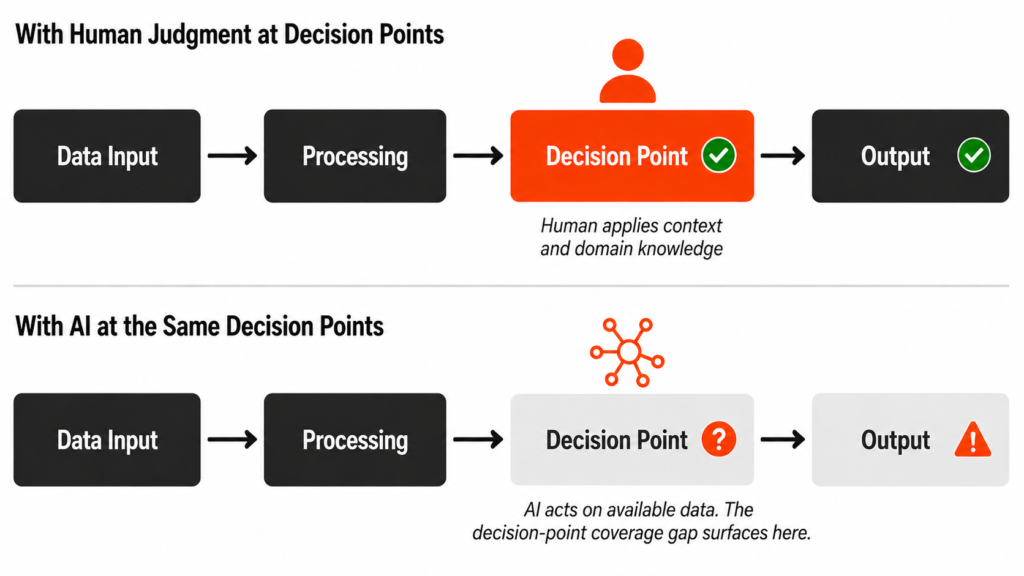
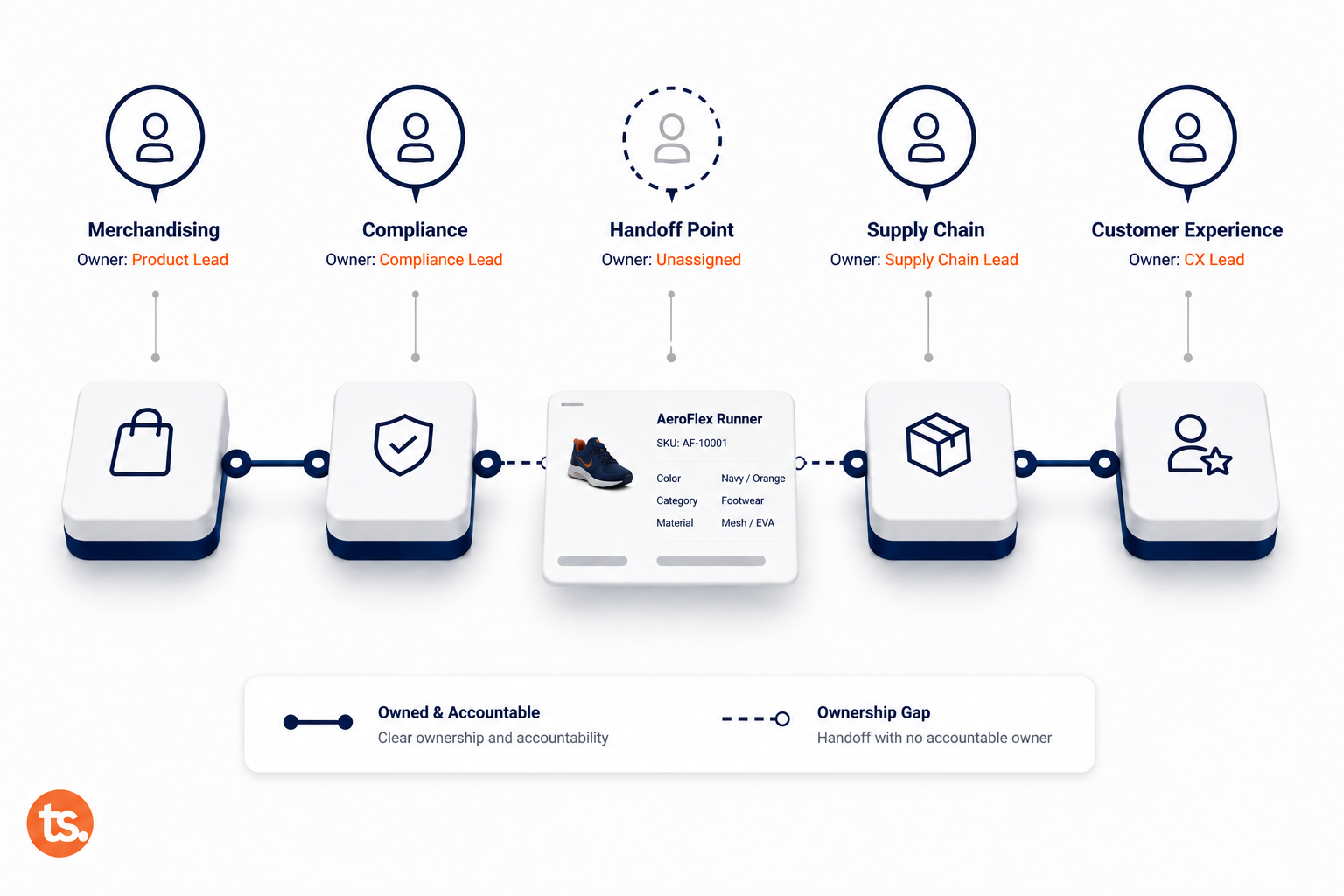
In most organizations there is someone, or a small group of people, who are deeply embedded in the actual workflow, identifying the exact gaps that automated systems miss despite rarely appearing in official governance frameworks or data dictionaries. They have been in the data long enough to know when something is off, and they act on that knowledge before it becomes a downstream problem.

When AI enters the workflow, that changes. Their role is occasionally restructured, but more often they are moved out of the process entirely on the assumption that speed is an improvement on judgment, or they remain but are asked to review so many outputs so quickly that the review becomes a formality rather than a genuine quality check.

The workflow looks the same from the outside, but the layer that used to surface what the rules missed is no longer functioning the way it was.

That is the gap most AI readiness assessments never account for, and it explains why an AI initiative can pass every data readiness check and still produce outcomes the business did not expect.

This blog covers one specific question most AI readiness assessments never ask: is the person who used to surface what the rules missed still in the process, and if they are, are they actually reviewing or just approving?

Key takeaways

  • Most AI readiness assessments evaluate whether data is accurate, complete, and consistent, leaving aside whether the human judgment that used to surface what the rules missed is still functioning in the process.
  • When AI replaces or accelerates a workflow, the human checkpoint that provided contextual correction often disappears with it, without anyone making a deliberate decision to remove it.
  • An AI outcome can be wrong even when the data is technically accurate, because the outcome depends on the contextual layer the data was missing.
  • The readiness standard your organization uses today was almost certainly built for a world where a human was still in the loop at the point where judgment mattered most.
  • Genuine AI readiness requires a different kind of assessment, one that starts from what the AI system will do with the data rather than from what the internal system requires the data to be.

What AI Readiness Assessments Are Actually Checking

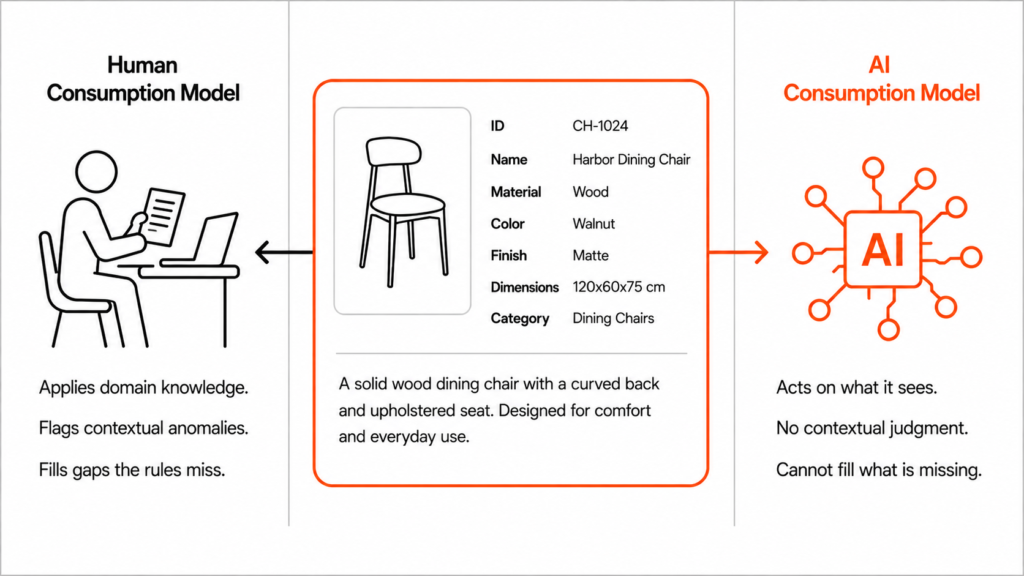
Flat editorial infographic showing a central product data card for a Harbor Dining Chair with two diverging paths — left path leading to a human reviewer icon labelled Human Consumption Model with descriptors applying domain knowledge, flagging contextual anomalies, and filling gaps the rules miss, and right path leading to an AI network icon labelled AI Consumption Model with descriptors acting on what it sees, no contextual judgment, and cannot fill what is missing

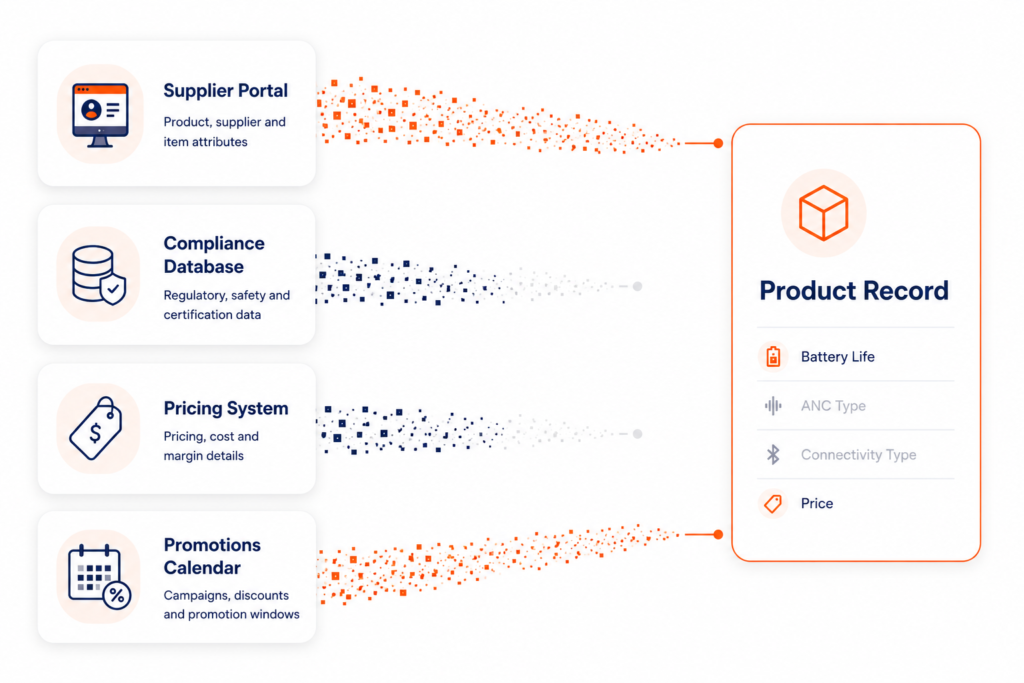
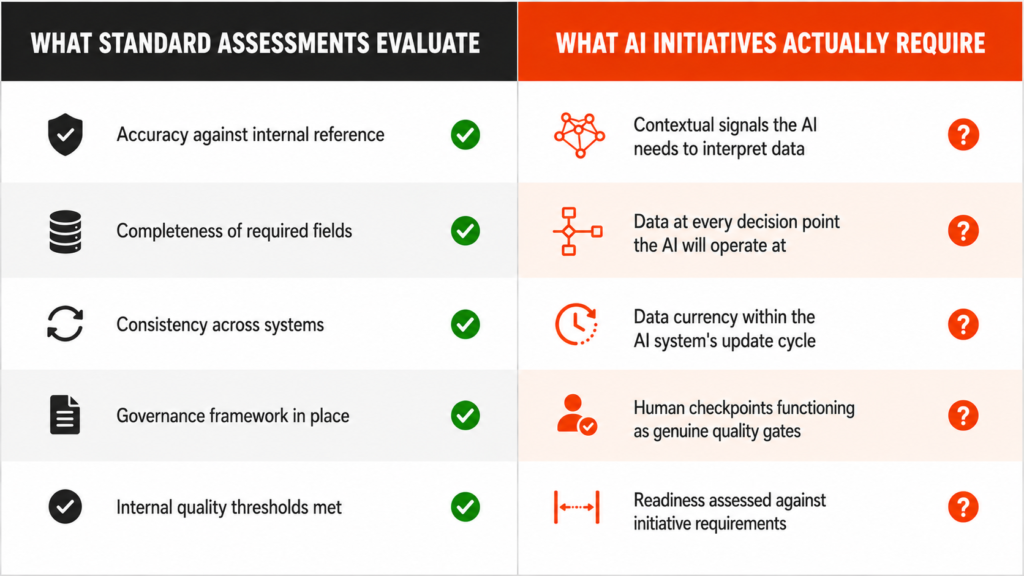
When most organizations assess whether their data is ready for AI, they evaluate it against accuracy, completeness, and consistency, covering whether the data matches a reference, the required fields are populated, and the values hold across systems. These dimensions were designed for a specific consumption model, one where data moves through a system, gets reviewed by a person, and the person’s judgment fills the gaps between what the rules enforce and what the business actually needs. In that model, a completeness check is meaningful because the reviewer will notice something missing and ask for it, while an accuracy check works because the person can flag a value that looks contextually wrong even if it is technically correct.

AI operates differently. The data moves through the system and the AI acts on what it sees, without the judgment or domain knowledge the human analyst used to supply, which means a completeness check only confirms that required fields are populated rather than confirming that the data contains the contextual signals the AI needs to produce a reliable output. The same limitation applies to accuracy — matching a reference does not tell you whether that reference reflects what the AI needs to make the right call in the specific situation it is processing.

Wait. Em dash still present in “The same limitation applies to accuracy — matching a reference.” Fix: “The same limitation applies to accuracy, since matching a reference does not tell you whether that reference reflects what the AI needs to make the right call in the specific situation it is processing.”

This is where most readiness frameworks stop short, and it is precisely what Accenture Research’s 2026 study on AI-ready data confirmed when surveying 2,000 organizations deploying advanced AI. Data readiness emerged as the most frequently cited barrier to AI value, with most organizations applying frameworks that predate the specific demands of agentic and advanced AI systems. The assessment was designed for one consumption model, and AI operates in a different one. What that difference costs an organization when it goes unexamined is more specific than most readiness frameworks were built to detect.

“Data readiness is the most frequently cited barrier to AI value. Most organizations are applying readiness frameworks that predate the specific demands of advanced AI systems.”

– Accenture Research, AI-Ready Data for Advanced AI, 2026

The Human Checkpoint Most Assessments Never Evaluate

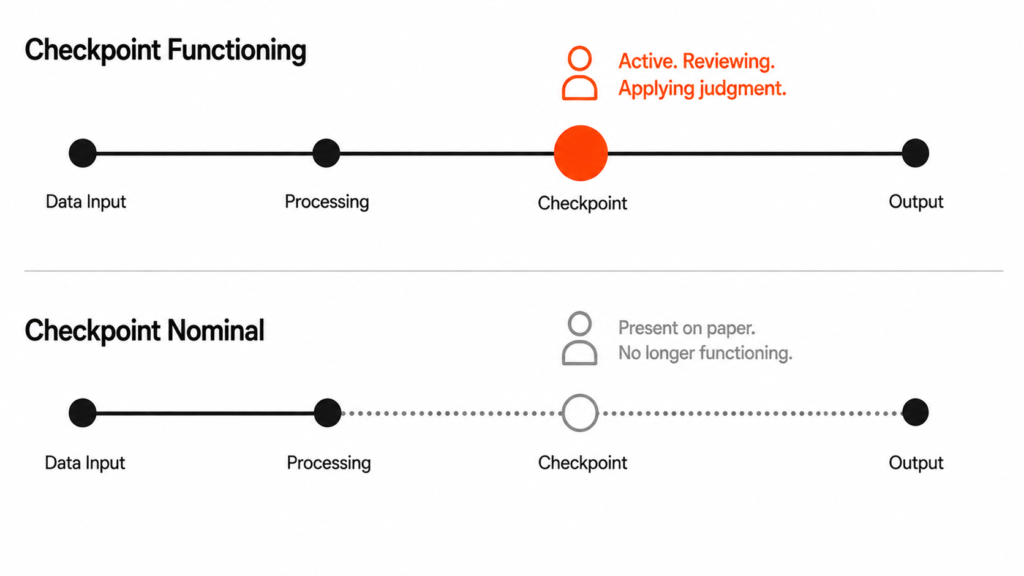
Two horizontal workflow timelines stacked vertically showing the same four stage process of Data Input, Processing, Checkpoint, and Output — top timeline showing the checkpoint marker as a large active orange circle with human figure icon labelled Active Reviewing Applying Judgment and solid connecting line, bottom timeline showing the same checkpoint as a greyed out empty circle with crossed human figure icon labelled Present on Paper No Longer Functioning and dotted bypass line skipping the checkpoint

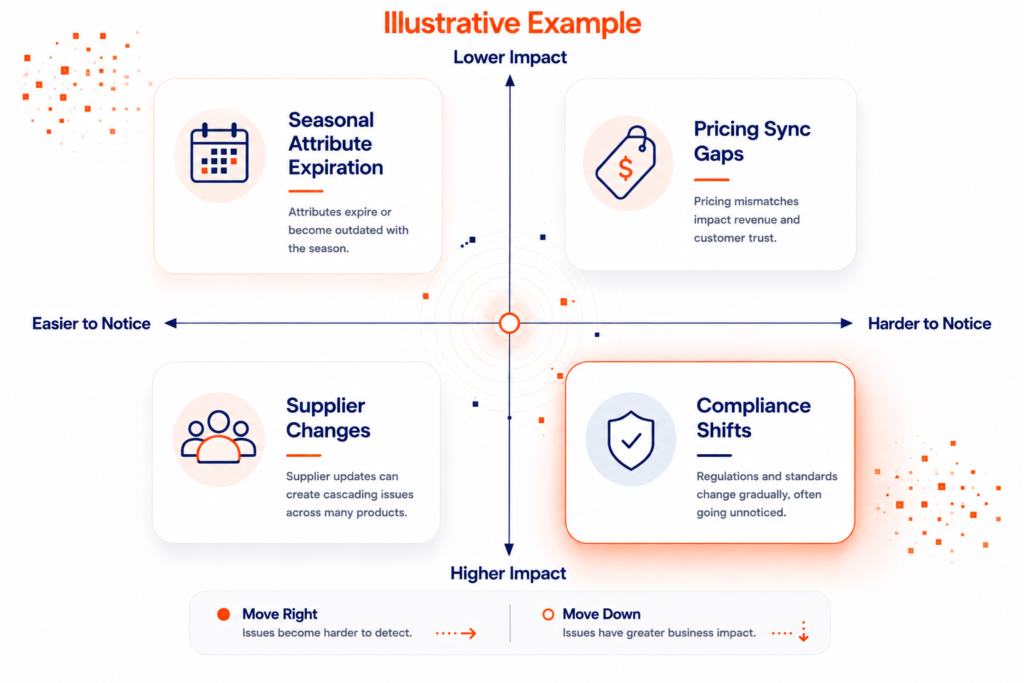
Every data workflow has moments where a human used to look at what the system produced and apply something the system could not supply independently: domain knowledge, business context, and pattern recognition built from years of seeing what the data means in practice.

Although this checkpoint rarely appeared in governance frameworks or data dictionaries as a formal quality control step, it functioned as one because the person running it had enough context to identify what the rules missed, consistently, before problems reached downstream.

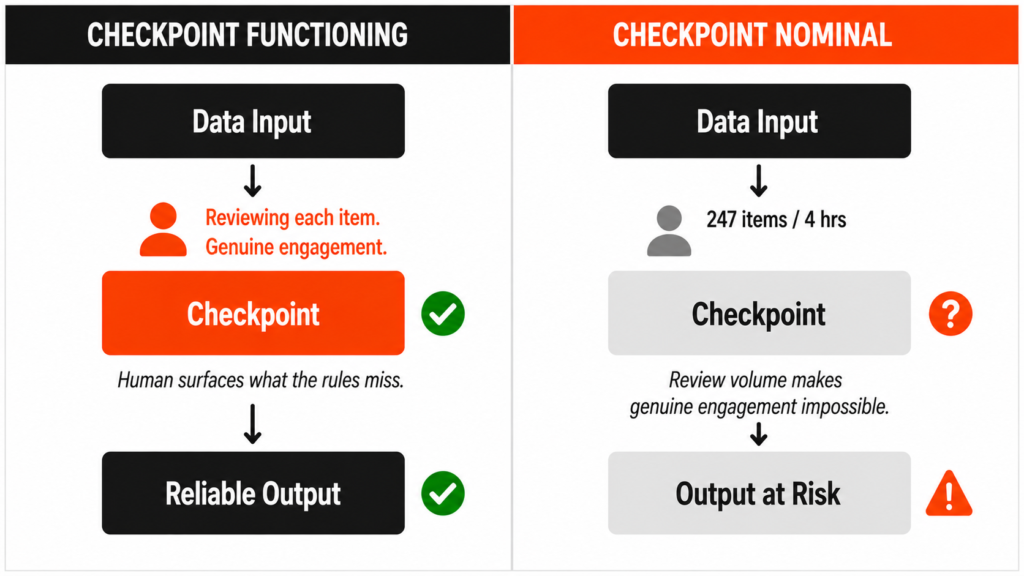
When AI enters the workflow, that person’s role changes in ways that are rarely planned deliberately. Their position is occasionally restructured, but more often they are moved out of the process entirely on the assumption that AI speed is an improvement on human judgment, or they remain while being asked to review so many outputs so quickly that the review becomes a signature rather than a genuine evaluation.

This is the dynamic MIT Sloan Management Review captured in its research on agentic AI, drawing on what leaders have learned from early deployments. The research found that human-in-the-loop oversight frequently becomes performative, with people asked to approve so many things so fast that they do not genuinely engage with what they are approving, leaving a checkpoint that still exists on paper but has stopped functioning as one.

“Human-in-the-loop oversight frequently becomes performative. People are asked to approve so many things so fast that they do not really engage with what they are approving. The checkpoint still exists on paper but has stopped functioning as one.”
— MIT Sloan Management Review, Agentic AI: What Leaders Wish They Knew Sooner

What that describes is a process design failure of exactly the kind a standard data readiness assessment was never built to surface, and by the time it becomes visible, the cost of addressing it has already grown significantly.

What Happens When the Checkpoint Disappears

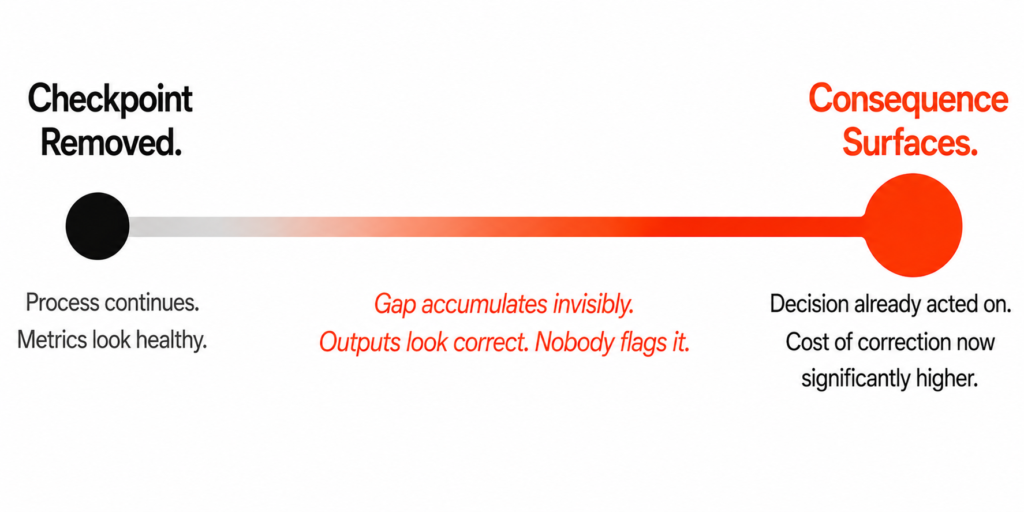
Single horizontal timeline with three marked points — a charcoal circle on the far left labelled Checkpoint Removed with descriptor Process continues Metrics look healthy, a long gradient section from grey to ThoughtSpark orange in the middle labelled Gap accumulates invisibly Outputs look correct Nobody flags it, and a large orange circle on the far right labelled Consequence Surfaces with descriptor Decision already acted on Cost of correction now significantly higher

The consequences of removing the human checkpoint are not always immediate, which is part of what makes this failure mode so difficult to detect and so expensive to correct.

The AI produces outputs, the outputs look correct, the metrics improve, and the initiative is declared a success before the team moves on to the next use case.

The gap surfaces later, when a pattern the human would have identified has been running long enough to produce a decision, a recommendation, or an output that the business has already acted on. By that point the cost of correction is significantly higher than the cost of maintaining the checkpoint would have been, and the connection between the missing checkpoint and the downstream consequence is rarely made because too much time has passed between the two events.

This is what Forrester’s research on the state of agentic AI in 2026 identified as a structural pattern rather than an isolated incident. The research found that agents bolted onto workflows built for human pace produce only task savings, and that genuine value requires rebuilding roles and approval structures around autonomy rather than attaching automation to a process still designed around manual review. The organizations that have captured AI value are those that redesigned the workflow around what the AI actually needs to perform reliably, including identifying where human judgment needs to remain, in what form, and at what frequency.

“Agents bolted onto workflows built for human pace produce only task savings. Real value requires rebuilding roles and approval structures around autonomy rather than attaching automation to a process still designed around manual review.”
— Forrester, The State of Agentic AI in 2026

The readiness failure in these cases is structural rather than technical, and it remains invisible to standard readiness assessments because those assessments were built to check the data rather than the process the data moves through, and that distinction points directly to how the standard itself was designed.

Why the Readiness Standard Wasn’t Built for This

The readiness standard most organizations apply to AI initiatives was built for a specific world, one where data moves through a system, a person reviews what comes out, and that person’s judgment is the last quality gate before the output reaches a decision.

In that world, accuracy, completeness, and consistency are the right dimensions to assess because they ensure the data is in the right shape for the person reviewing it, and the person does the rest. AI changed what the rest means. Without a person automatically in the loop, the AI acts on what it sees, without questioning contextually suspicious values, applying domain knowledge, or flagging data that reflects a state of the business that has already changed.

The readiness standard was built for a world where the human checkpoint was a given, and in an AI-first workflow the checkpoint becomes a deliberate design decision rather than an assumed constant. Most organizations are applying a framework designed before AI changed what readiness required, which is a failure of timing rather than intention, and the organizations that close this gap will do so by extending their existing framework to cover the dimensions the original design never needed to address.

What AI Readiness Actually Requires Now

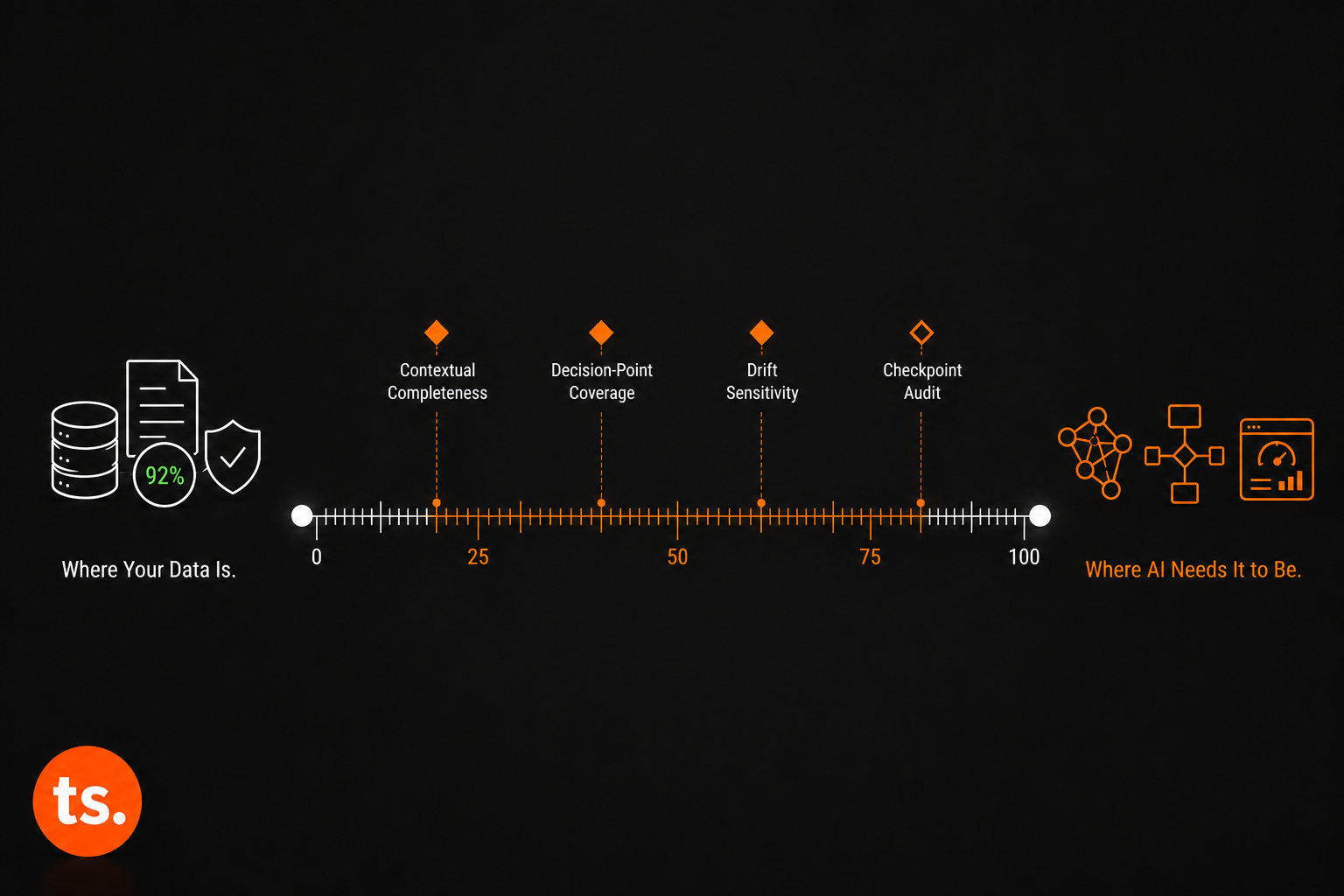
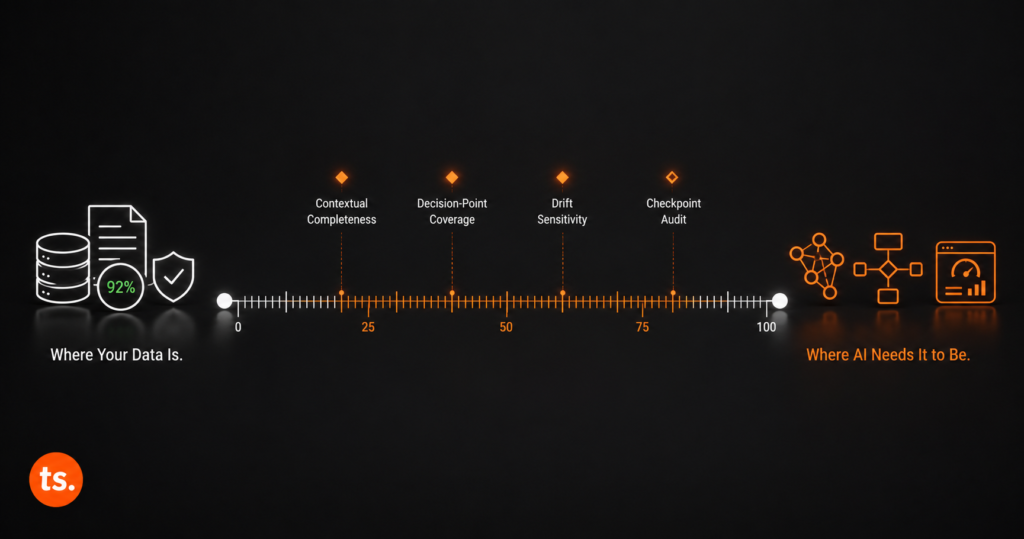
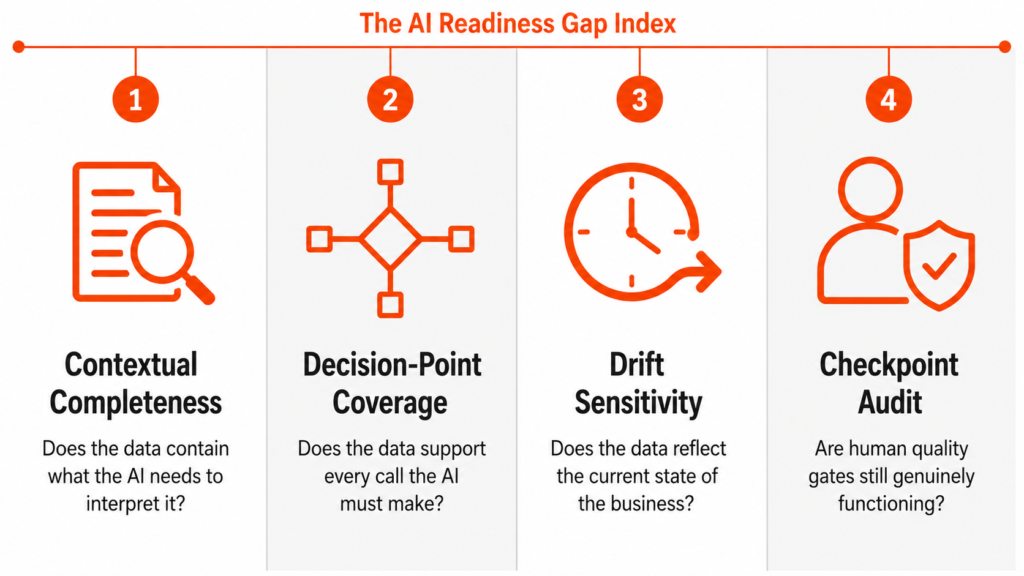
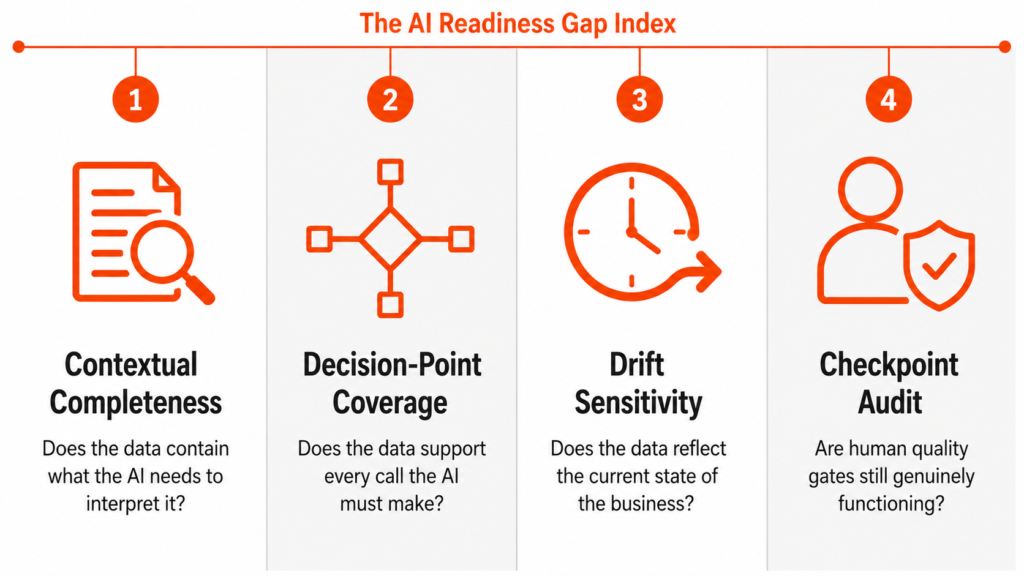
Genuine AI readiness extends the existing standard rather than replacing it, covering the dimensions the original framework never needed to address because a human was always there to fill them in. Four of those dimensions are worth examining specifically, because none of them appear in a standard completeness, accuracy, and consistency assessment, and all of them determine whether an AI initiative delivers what the business expects.

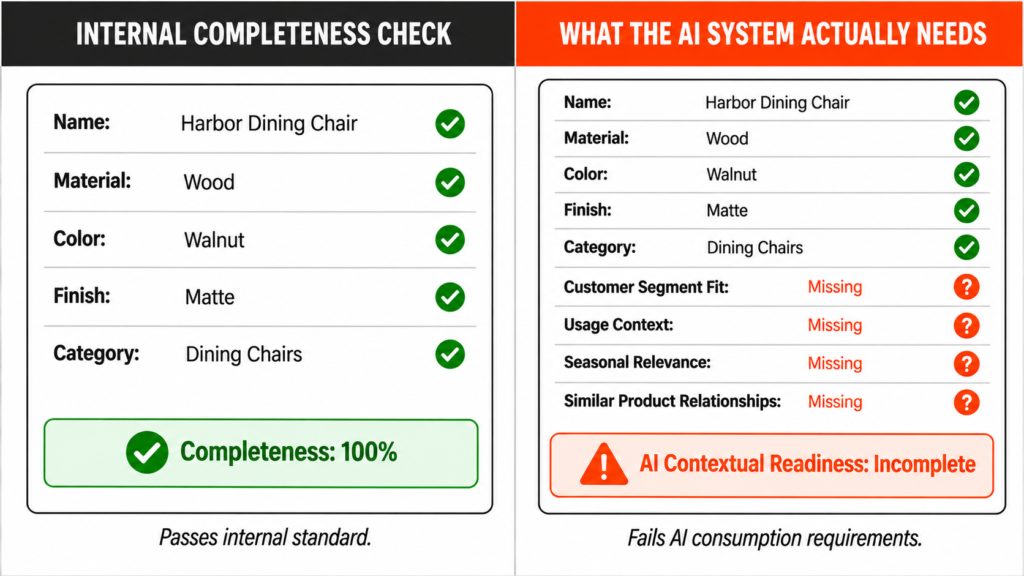
  • Contextual completeness. The AI needs more than populated fields, specifically the contextual signals that tell it how to interpret what it is seeing. A product record can be 100% complete against internal thresholds and still lack the attributes an AI personalization engine needs to make the right recommendation for a specific customer segment, because the internal threshold was defined for a human reviewer who would supply that context from memory.
  • Decision-point coverage. Mapping the points in the workflow where a human used to apply judgment, and evaluating whether the data at each of those points contains enough information for the AI to make the same call reliably, is a different exercise from checking whether the data is accurate and complete. Most readiness assessments do not attempt it.
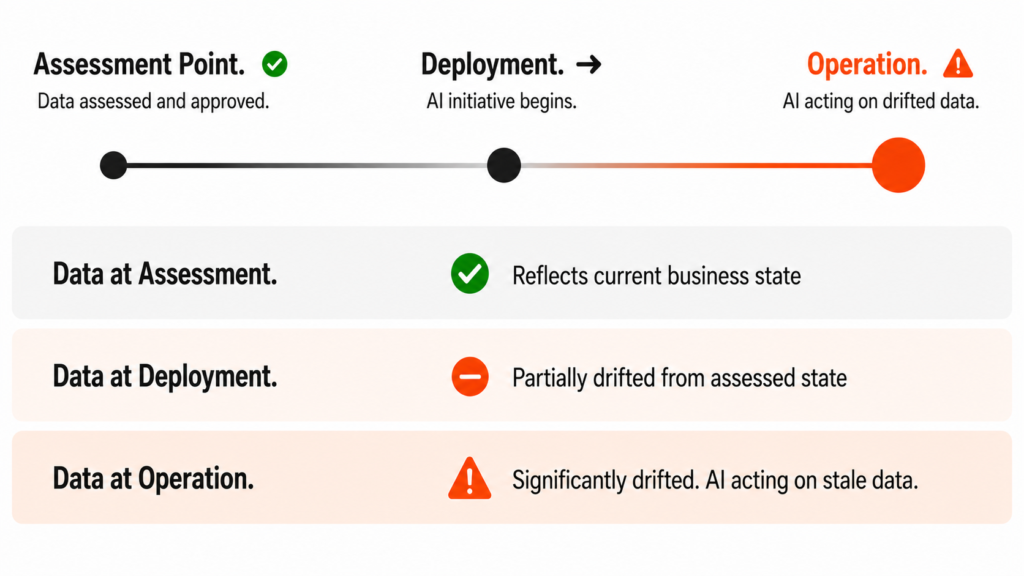
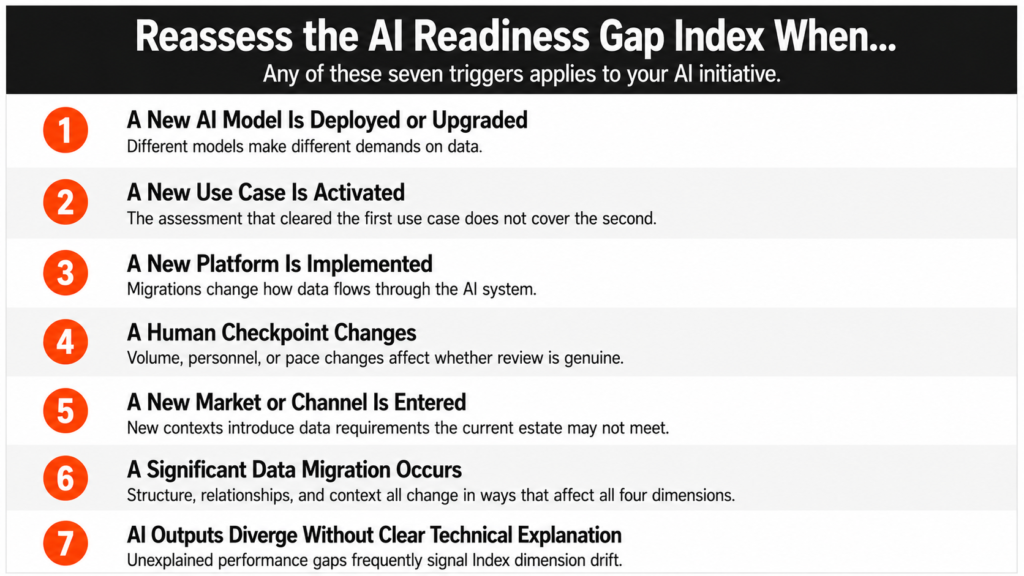
  • Drift sensitivity. Data that was accurate at the point of assessment may reflect a state of the business that has already changed by the time the AI acts on it, and the question worth asking is how quickly the data drifts relative to the AI’s update cycle. If the drift is faster than the cycle, the AI is consistently acting on a version of reality that no longer exists.
  • Checkpoint audit. Where in the workflow did a person used to surface what the rules missed, is that person still in the process, and if they are, are they genuinely reviewing or nominally approving? The checkpoint audit is the dimension most organizations have never formally conducted because it never needed to be an assessment step when the human was always there.

Understanding these four dimensions is the starting point, and knowing which of them your current standard already covers is what separates an organization that is genuinely ready from one that believes it is.

How to Know Whether Your Standard Has Kept Pace

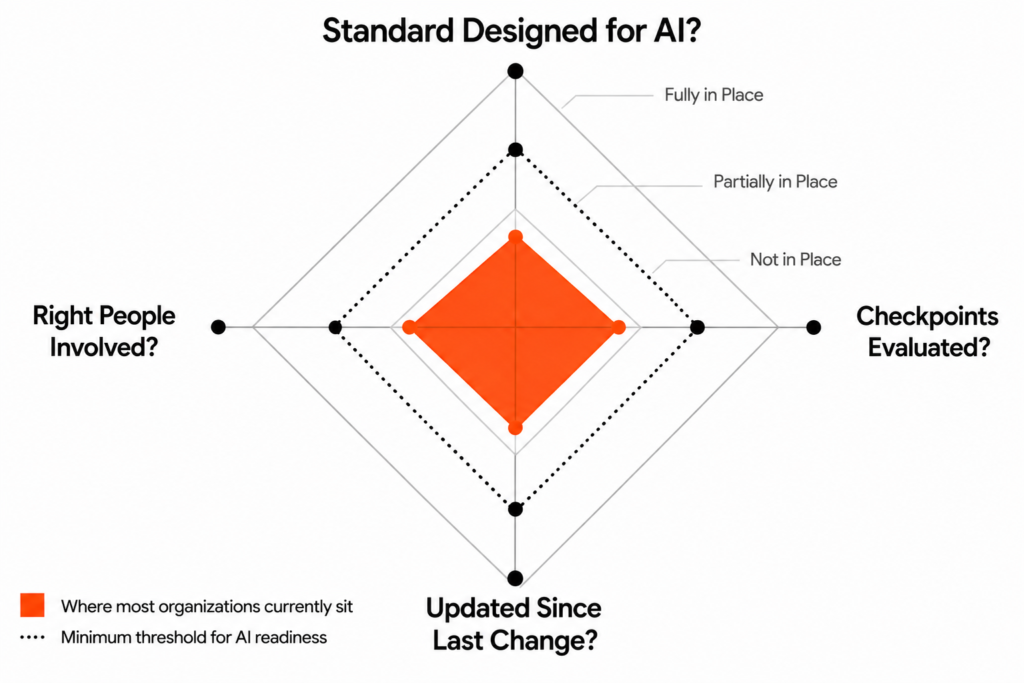
Radar chart with four axes labelled Standard Designed for AI, Checkpoints Evaluated, Updated Since Last Change, and Right People Involved, showing three concentric grid rings labelled Not in Place, Partially in Place, and Fully in Place, with a solid ThoughtSpark orange diamond polygon plotted at the Not in Place level on all four axes sitting below the dotted charcoal minimum threshold line, and a legend showing the orange shape represents where most organizations currently sit and the dotted line represents the minimum threshold for AI readiness

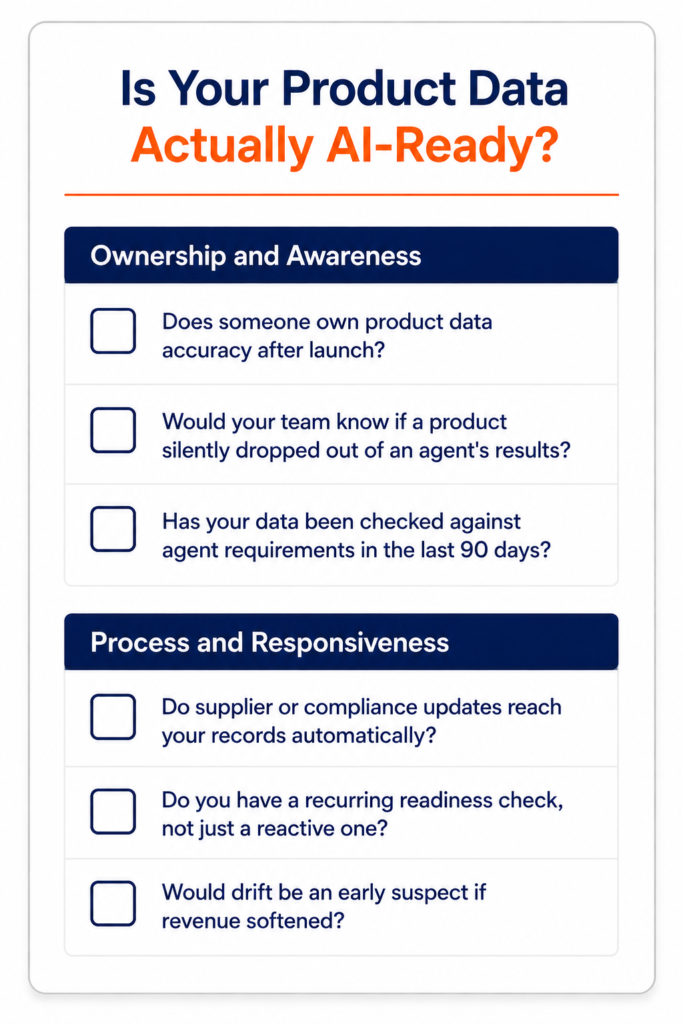
Before extending an existing readiness framework to cover an AI initiative, four questions are worth answering honestly. They are not designed to produce a score. They are designed to surface where the standard has stopped keeping pace with what the AI initiative actually requires.

  1. Was your readiness standard designed before your organization began using AI to consume the data it governs? A standard that predates the AI initiative it is now being applied to was almost certainly designed for a human consumption model, which makes it incomplete for what AI actually requires.
  2. Does your readiness assessment evaluate whether the human checkpoints in the workflow are genuinely functioning? A checkpoint that exists on paper but processes approvals too quickly for genuine engagement is functioning as a formality rather than a quality gate, and a readiness assessment that cannot distinguish between the two is missing the most critical quality layer in an AI workflow.
  3. Has your readiness standard been updated since the last significant change to how the data is consumed? Every time a new AI model is deployed, a new platform is implemented, or a new use case is activated, the consumption model changes, and the readiness standard needs to change with it. Most organizations update their data while leaving the framework they use to assess it unchanged, which means the standard is almost always lagging behind the current deployment.
  4. Do the people who designed your readiness standard understand what the AI system consuming the data actually does with it? If the consumption model has changed, if AI is now doing what a person used to do, the people responsible for the readiness standard need to understand the new model well enough to assess whether the data genuinely supports it, rather than assessing it against a model that no longer reflects how the data is used.

If the honest answer to any of these is no, your readiness standard has not kept pace with what your AI initiative will demand from the data, and the gap between what the standard checks and what AI actually needs is where the initiative’s most expensive surprises are waiting.

Before your next AI initiative extends your existing readiness framework to cover something it was never designed to assess, the question worth answering is whether the standard itself is ready for what AI actually requires, beyond whether the data meets the standard you already have.

That is the assessment ThoughtSpark helps enterprise data and AI teams conduct, identifying the specific distance between the readiness framework you have and the one your AI initiative actually needs, and building the path between the two.

Why Most Organizations Overestimate Their Data Readiness

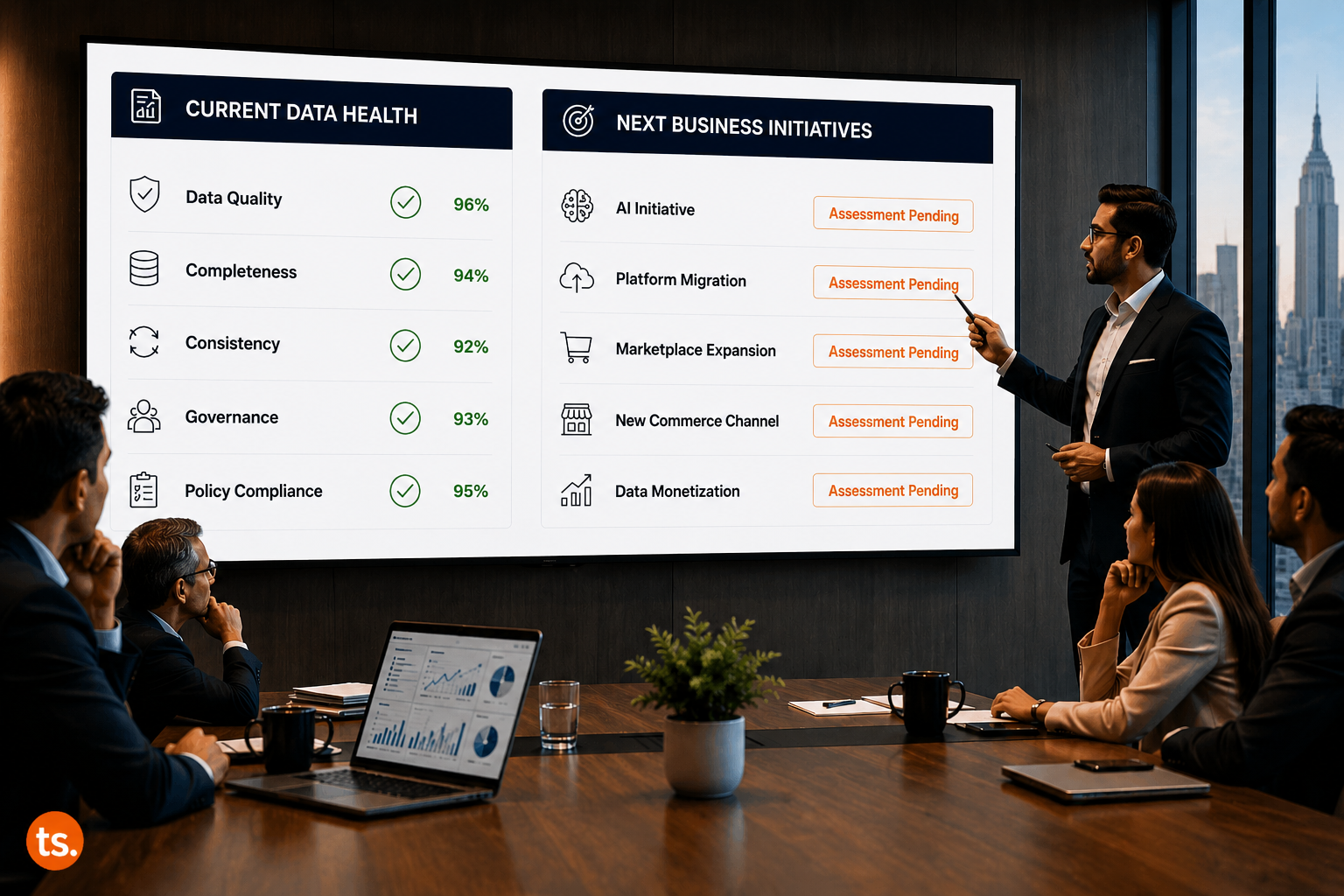
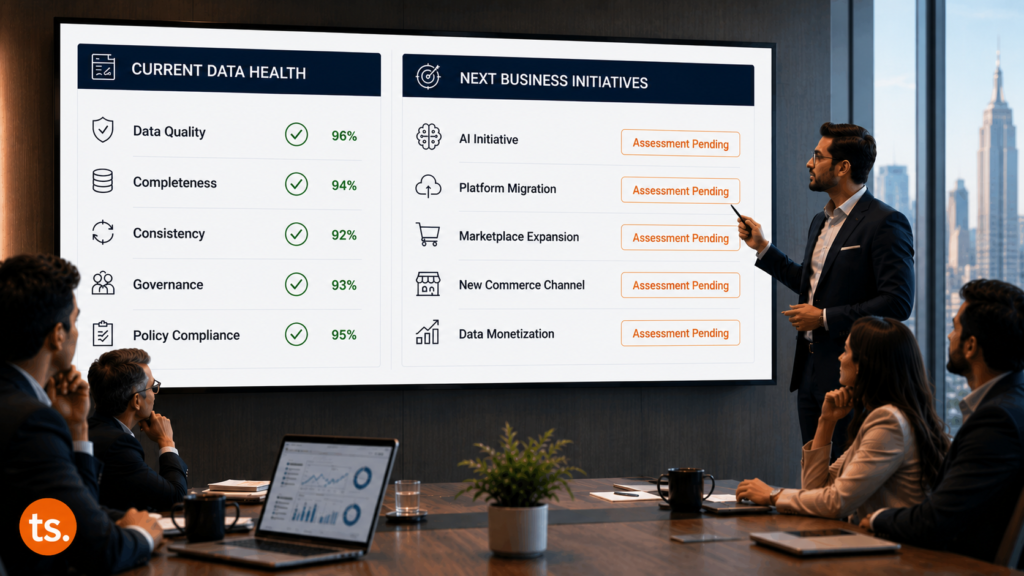
Business leader presenting to an executive team in a boardroom, pointing to a screen showing current data health scores of 96% quality, 94% completeness, 92% consistency, 93% governance, and 95% policy compliance on the left, alongside five next business initiatives including AI initiative, platform migration, marketplace expansion, new commerce channel, and data monetization all marked as assessment pending in orange on the right

Your organization has probably invested significantly in data readiness. 

A governance program. A platform migration. A data quality initiative. Possibly all three. The dashboards are improving. The CDO has a seat at the leadership table. The data strategy is documented and aligned to the technology roadmap. 

And yet, when a new AI initiative, a major platform decision, or a channel expansion needs your data to perform, something is not quite ready. 

That experience, of believing you are prepared and then discovering you are not, is not a failure of execution. It is a symptom of how most organizations define and measure data readiness, and that definition is almost always measuring the wrong thing. 

Key takeaways 

  • Most organizations assess data readiness against internal standards — whether their data meets the requirements of the systems that store it — not against what the business needs the data to actually do next. 
  • The IBM Institute for Business Value found that 81% of CDOs say their data strategy is integrated with their technology roadmap, yet only 26% are confident their data can support AI-enabled revenue streams. That 55-point gap is what overestimation looks like at scale. 
  • Overestimation happens in three specific ways: confusing governance with readiness, confusing clean data with usable data, and confusing historical readiness with forward readiness. 
  • Genuine data readiness is not a milestone you reach. It is a continuous assessment of whether your data can support the specific outcomes your organization is building toward next. 
  • The question worth asking before your next platform decision, AI initiative, or channel expansion is not whether your data passed the last quality review. It is whether your data is ready for what comes next.

Why Data Readiness Is Harder to Assess Than Most Organizations Realize 

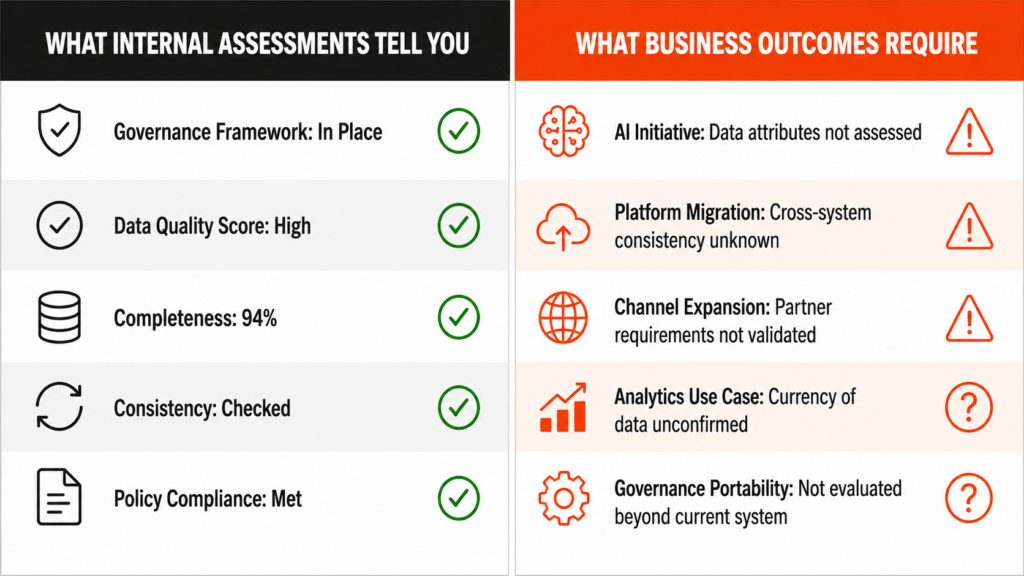
Two-column infographic comparing what internal data readiness assessments typically report including governance framework in place, high data quality score, 94% completeness, consistency checked, and policy compliance met with green checkmarks on the left, against what business outcomes actually require including unassessed data attributes for AI initiative, unknown cross-system consistency for platform migration, unvalidated partner requirements for channel expansion, unconfirmed data currency for analytics, and unevaluated governance portability — all marked with orange warning indicators on the right

Most Organizations assess data readiness using the tools they already have — quality dashboards, governance audit results, platform implementation reports, completeness scores. These tools measure internal conditions accurately, and the problem is that internal conditions are not what determines whether data performs when the business needs it to. 

A governance audit tells you whether your framework is in place. It does not tell you whether the data that framework governs is fit for the specific initiative you are about to commit to. A quality dashboard tells you whether your data meets the thresholds you defined when you built the measurement system, and it does not tell you whether those thresholds reflect what your next AI model, your next platform, or your next channel partner actually requires. 

The assessment looks healthy because it was designed to look healthy against the standards it was built to measure, and the gap between those standards and what the business actually needs the data to do is where the overestimation lives. 

The IBM Institute for Business Value’s 2025 CDO study, based on 1,700 senior data leaders across 27 geographies, found that 81% of CDOs report their data strategy is integrated with their technology roadmap, while only 26% are confident their data can support new AI-enabled revenue streams. That 55-point gap between strategic alignment and operational confidence is not a coincidence, and it is what happens when Organizations measure readiness against internal strategy alignment rather than against what specific business outcomes actually demand from the data. 

“81% of CDOs report their data strategy is integrated with their technology roadmap. Only 26% are confident their data can support new AI-enabled revenue streams. That 55-point gap is what overestimation looks like at scale.”

— IBM Institute for Business Value, 2025 CDO Study 

The Three Ways Organizations Overestimate Their Data Readiness

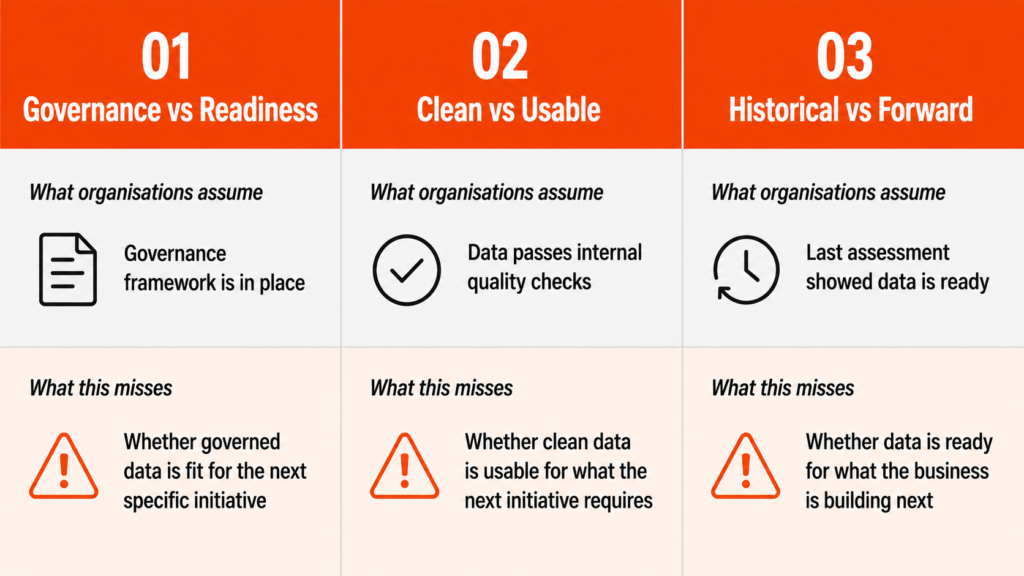
Three-panel infographic showing the three ways organisations overestimate their data readiness: panel one contrasting governance framework in place with whether governed data is fit for the next specific initiative, panel two contrasting data passing internal quality checks with whether clean data is usable for what the next initiative requires, and panel three contrasting last assessment showing data is ready with whether data is ready for what the business is building next

Overestimation is not a single failure. It happens in three specific and distinct ways, and most Organizations are experiencing at least one of them without recognizing it as overestimation rather than simply as an unexpected gap. 

Overestimation 1: Confusing Governance With Readiness

Having a governance framework is not the same as having data that is ready to perform. Governance defines the standard, and readiness means the data meets that standard in the specific context where it needs to be used. 

Most governance assessments evaluate whether the framework exists — whether ownership is assigned, whether policies are documented, whether quality controls are in place — and they do not evaluate whether the data the framework governs is actually fit for the next initiative the business is about to build on top of it. 

A governance Program that was designed to improve data consistency for internal reporting may produce data that is entirely consistent for that purpose and still inadequate for an AI initiative that requires different attribute completeness, different taxonomy consistency, or different cross-system coherence than the governance framework was ever designed to enforce. 

The governance is real. The readiness it implies for the next use case may not be. 

Overestimation 2: Confusing Clean Data With Usable Data 

Data that passes internal quality checks is clean against the internal standard, and it is not necessarily usable for the purpose the next initiative requires. 

A product catalogue that is 94% complete against internal thresholds may be significantly less complete against the specific requirements of an AI personalisation engine, a new retail channel, or a marketplace expansion, because the internal threshold was defined to reflect what the internal system needs while the external requirement reflects what the channel, the partner, or the AI model actually consumes. 

In each case the completeness score reflects what was defined as quality when the measurement system was built, and the operational consequence reflects what the next initiative actually needs from the data — which is why the score can look healthy while the readiness gap remains significant. 

Overestimation 3: Confusing Historical Readiness With Forward Readiness

A data quality assessment tells you how ready your data is today against the standards you defined in the past, and it does not tell you how ready your data is for what you are planning to build next. 

The next AI initiative, the next platform migration, the next channel expansion, and the next market entry will each make specific demands on your data that your current assessment was never designed to evaluate. The question the assessment answered was whether your data is ready for what you are already doing, and the question that determines whether your next initiative succeeds is whether your data is ready for what you have not yet built. 

A backward-looking metric tells you where you were. Genuine forward readiness requires asking specifically what the next initiative needs from your data and evaluating honestly whether the data can deliver it before the initiative has already committed to a timeline that assumes it can. 

The Cost of Getting the Assessment Wrong

The consequences of overestimating data readiness are not always immediately visible, which is part of what makes the overestimation so persistent. The initiative launches, the platform goes live, and the AI model gets deployed, and the gaps in the data do not announce themselves as data readiness failures. They present as performance problems, as unexpected manual workloads, as AI outputs that do not match projections, and as channel launches that take longer than planned. 

By the time the data readiness gap becomes undeniable, the initiative has already committed its timeline, its budget, and its leadership credibility to the assumption that the data was ready, and the cost of correcting the gap at that point is significantly higher than the cost of identifying it before the initiative began. 

McKinsey’s research on AI data readiness found that more than two-thirds of high-performing companies identify data as the primary obstacle for enabling AI, and only 7% of companies have fully scaled AI across their Organizations. The Organizations that have scaled successfully are the ones that assessed what their AI initiatives actually needed from the data before committing to the initiative, and closed the gaps they found before the initiative depended on data that was not yet ready to support it. 

“More than two-thirds of high-performing companies say data is the primary obstacle for enabling AI. Only 7% of companies have fully scaled AI across their Organizations.”

— McKinsey, AI Data Readiness: The Key to Scaling Impact, June 2026 

The cost of overestimation is not just delayed ROI. It is the accumulated cost of initiatives that underperform because the data foundation they assumed was ready was not prepared for what the initiative actually demanded. Most data projects do not fail at implementation. They fail before the first line of code because the data was never genuinely ready for what the project required of it. 

What Genuine Data Readiness Actually Requires

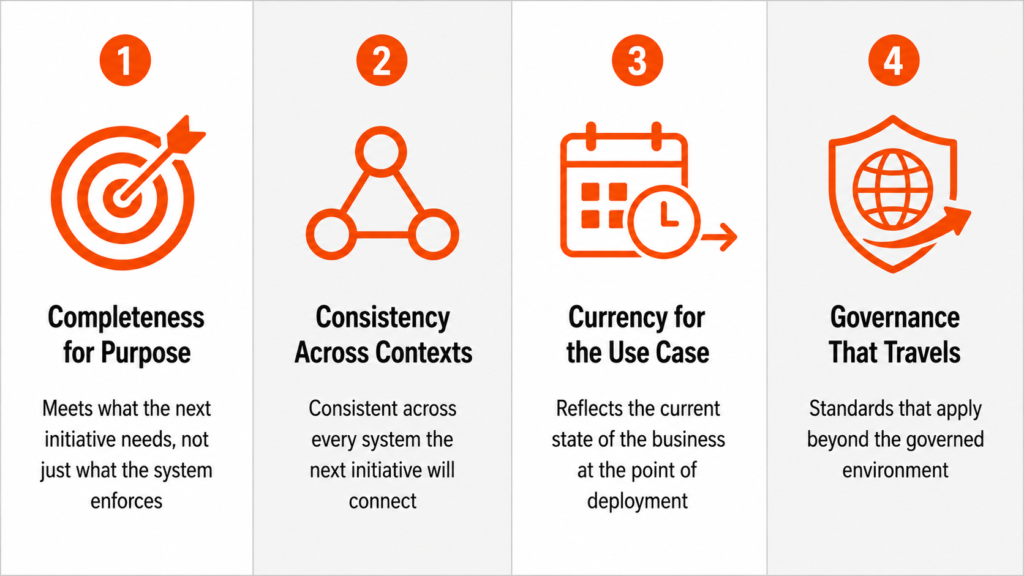
Four-pillar infographic showing the dimensions of genuine data readiness: pillar one completeness for purpose meaning meets what the next initiative needs not just what the system enforces, pillar two consistency across contexts meaning consistent across every system the next initiative will connect, pillar three currency for the use case meaning reflects the current state of the business at the point of deployment, and pillar four governance that travels meaning standards that apply beyond the governed environment

Genuine data readiness is not a status you achieve by completing a governance Program or passing a quality audit. It is a continuous assessment of whether your data can support the specific outcomes your organization is building toward, and it has four dimensions that most internal assessments do not capture. 

Completeness for purpose, not completeness for the system.

Internal completeness measures whether required fields are populated against the thresholds the system was configured to enforce, and completeness for purpose measures whether the data contains what the next initiative specifically needs — the attributes an AI model will consume, the fields a new channel requires, the data points a platform migration will need to carry cleanly across systems. The threshold that matters is the one your next initiative depends on, and that threshold is rarely the same as the one your system currently enforces. 

Consistency across contexts, not just within systems. 

Data that is internally consistent within one system may be inconsistent across the systems a new initiative needs to connect, and cross-system consistency — the same entity described the same way in the PIM, the ERP, the commerce platform, and the analytics layer — is what enables new initiatives to work with your data as it exists rather than requiring a cleaning and normalisation project before the initiative can begin. Most quality assessments evaluate consistency within a system, and genuine readiness requires evaluating it across every system the next initiative will touch. 

Currency for the use case, not just accuracy at the last assessment point. 

Data that was accurate and current when the last assessment was conducted may have drifted since then, and the next initiative will work with your data as it is at the moment of deployment rather than as it was at the moment of the last review. Currency for the use case means the data reflects the current state of the business in the specific dimensions the next initiative depends on, assessed at the point of deployment rather than at the point of governance review. 

Governance that travels with the data. 

Governance frameworks typically govern data within a defined system or domain, and genuine readiness means the governance standards travel with the data as it moves between systems, is consumed by new tools, and is used in new contexts. When data leaves a governed environment and enters an AI model, a new platform, or a partner integration, the governance constraints that made it trustworthy in the original context need to apply in the new one, and most governance assessments do not evaluate whether the framework performs beyond the boundary it was built to govern. 

How to Know Whether Your Data Is Actually Ready

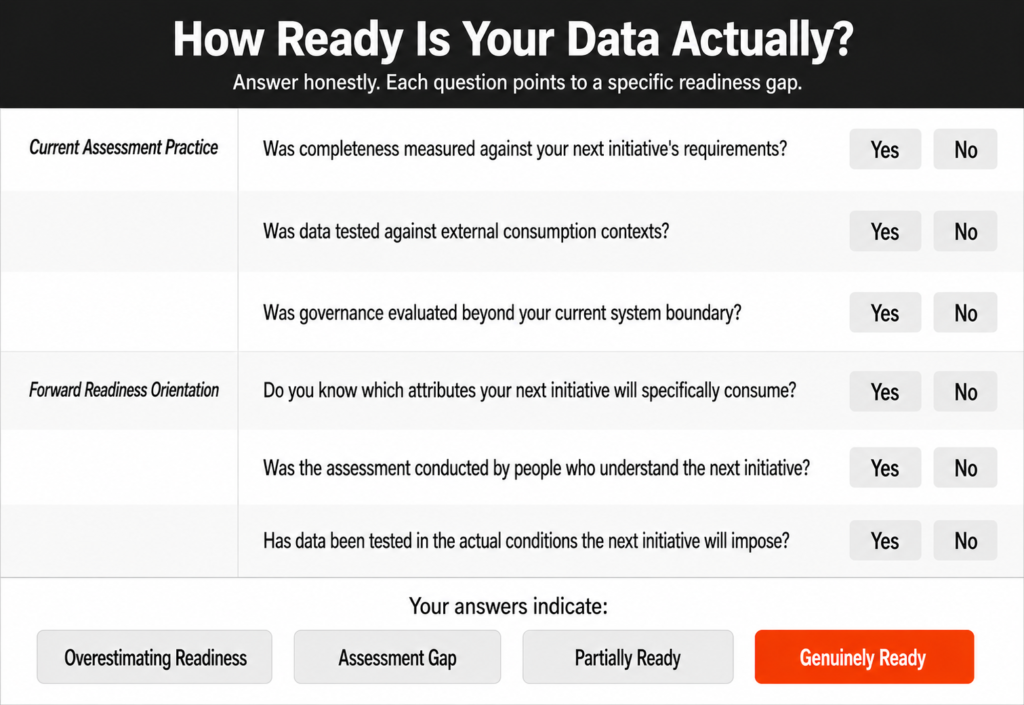
Diagnostic self-assessment infographic titled How Ready Is Your Data Actually with six yes or no questions divided into two sections: current assessment practice covering whether completeness was measured against next initiative requirements, whether data was tested against external consumption contexts, and whether governance was evaluated beyond the current system boundary, and forward readiness orientation covering whether attributes the next initiative will consume are known, whether the assessment involved people who understand the next initiative, and whether data has been tested in actual deployment conditions, with four outcome indicators at the bottom showing overestimating readiness, assessment gap, partially ready, and genuinely ready highlighted in orange

Before committing to the timeline and budget of your next major initiative, these six questions will tell you more about your actual data readiness than any internal quality dashboard will. 

On your current assessment practice: 

Was the completeness threshold your last data quality assessment measured against defined by the requirements of your next initiative, or by the requirements of your current system? 

Was your data tested against external consumption contexts — the AI model, the channel partner, the platform — or against internal storage and processing standards? 

Was your governance framework evaluated for how it performs when your data moves between systems and is consumed by tools and partners outside the governed environment? 

On your forward readiness orientation: 

Do you know specifically which data attributes your next AI initiative, platform migration, or channel expansion will consume, and have you assessed whether your data delivers them at the quality level required? 

Was your last data readiness assessment conducted by people who understand both the data estate and the specific business initiative it is supposed to support? 

Has your data been tested in the actual conditions the next initiative will impose, rather than in a controlled assessment environment built against internal standards? 

If your honest answers reveal that your assessments were defined against current system requirements rather than forward initiative requirements, and that your data has not been tested against the specific conditions the next initiative will impose, the gap between your reported readiness and your actual readiness is worth understanding before you commit to the next initiative’s timeline. 

What Closing the Gap Looks Like in Practice 

The Organizations that have moved from overestimating data readiness to genuinely achieving it did not do it by running better assessments of the same kind. They changed what the assessment was designed to answer. 

They assessed readiness forward, not backward. 

Starting from what the next initiative needs and working back to the data. That shift in direction changes every question the assessment asks, moving from “is our data clean?” to “is our data clean enough for what this initiative specifically requires?” 

They tested data against external consumption contexts. 

Running the data through the actual conditions the next initiative will impose before committing to the initiative timeline — the AI model consuming the actual data, the channel partner receiving the actual feed, the platform ingesting the actual records. The gaps that surface in this test are the gaps that would have appeared at deployment, surfaced early enough to close them before they cost anything beyond the time to fix them. 

They made readiness assessment a continuous practice. 

Moving from a pre-project checklist completed once before the initiative launches toward an ongoing evaluation of whether the data estate is keeping pace with what the business is building toward. As the business adds new products, enters new markets, adopts new platforms, and pursues new AI use cases, the readiness question changes, and the Organizations that stay genuinely ready are the ones that keep asking it rather than relying on the answer from the last time they asked. 

Before your next platform decision, AI initiative, or channel expansion, the question worth answering is not whether your data passed the last quality review. It is whether your data is genuinely ready for what comes next. 

That is the assessment ThoughtSpark helps enterprise data and commerce teams conduct and act on. The Data Readiness Hub is where that conversation starts, identifying the specific distance between where your data currently performs and where your next initiative needs it to perform, and building the path between the two.