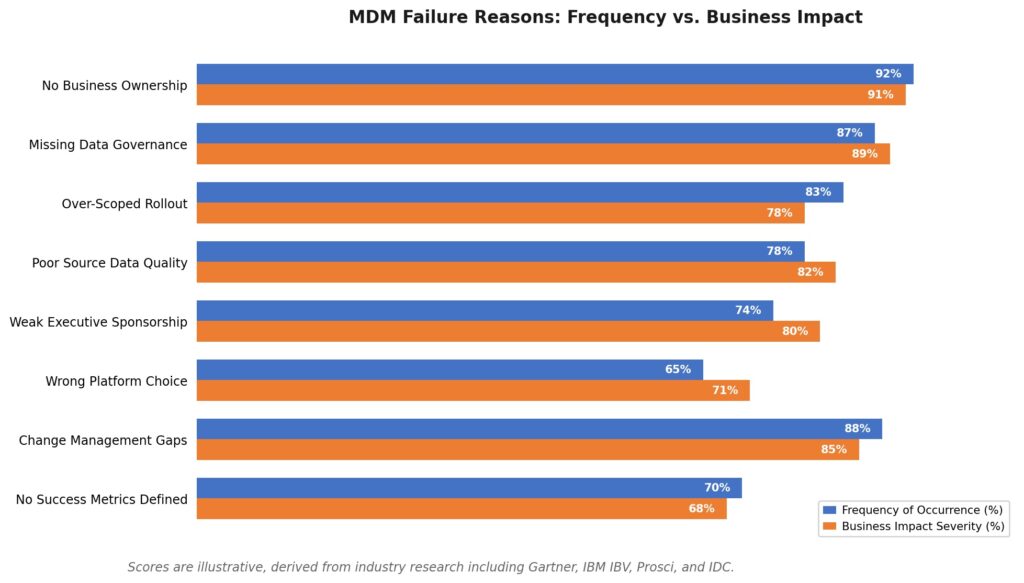
Did you know that 8 out of 10 data management programs are predicted to fail by 2027?
Not the ones run by companies that did not care. Not the ones that ran out of money halfway through. The ones with full budgets, experienced teams, and leadership that genuinely wanted it to work.
Take a moment with that number. Eight out of ten.
Now think about your own program. The meetings you sat through. The vendor you selected. The go-live everyone celebrated. And ask yourself honestly: looking back, did it deliver what was promised?
Because here is what nobody tells you before you start. MDM does not fail the way most technology programs fail. There is no crash. No error message. No moment where someone walks in and says it is over. The platform keeps running. Reports keep generating. Everything looks operational on the surface. But underneath, the business has quietly stopped trusting the data. Teams have gone back to their own spreadsheets. And the work that took eighteen months and significant budget is being ignored by the very people it was built for.
By the time anyone admits something went wrong, months of damage have already accumulated.
This article covers the eight MDM failure reasons it happens, where they start, why they are so easy to miss, and what the programs that actually deliver do differently.
What Is MDM and Why Does It Fail So Often?
Master Data Management (MDM) is the discipline of deciding which version of your data is the right one and making sure every system in your organization agrees on it.
Think about how many places your organization stores a customer name right now. Your CRM has one version. Your billing system has another. Your support platform has a third. Each one was updated at a different time by a different team. None of them fully match. And when someone needs to make a decision based on that customer, they have to guess which version to trust.
That is the problem MDM exists to solve. One version. Every system. No guessing.
But here is what surprises most people. The hardest part of MDM has nothing to do with technology. It never did.
In 2024, Gartner put a number on what data leaders have quietly known for years: by 2027, 80% of data and analytics governance initiatives will fail, and the primary reason is not technology. It is that governance never gets connected to tangible business outcomes (Gartner: 80% of D&A Governance Initiatives Will Fail by 2027). MDM is one of the most governance-dependent programs an organization can run. When governance fails, MDM fails with it.
The eight MDM failure reasons below are really eight versions of the same story. An organization that underestimated what MDM actually demands from a business.
A Pattern Most Teams Recognize
You have probably seen this play out. Maybe in your own organization. Maybe somewhere you worked before. A significant budget gets approved. The implementation runs for over a year. Go-live happens. And then, slowly and without any single dramatic moment, the business stops using it.
The platform is still running. The data is in there. But your colleagues are back on spreadsheets. Nobody trusts the golden record. And the question nobody wants to answer out loud: what actually went wrong?
Here is the honest answer. The technology worked fine. It almost always does. What failed was the set of decisions made before the technology was ever switched on. Ownership decisions. Governance decisions. Change decisions. The kind that feel procedural at the time but turn out to be the ones that mattered most.
The eight reasons below are where those decisions go wrong. They are not random. They follow a pattern. And once you see the pattern, you will recognize it everywhere.
8 MDM Failure Reasons That Consistently Sink Programs
MDM failure reasons are surprisingly predictable. You would think a global bank would have different struggles than a mid-size retailer, but the gaps are almost identical. The context changes, but the underlying friction never does.
1. MDM Treated as an IT Project
Why does MDM fail when business ownership is absent?
This is where most programs lose before they begin. And it is the most widespread of all MDM failure reasons.
Leadership approves MDM. It gets handed to IT because IT handles systems. IT builds it, configures it, and delivers it on time. Everyone celebrates go-live.
And then six months later, someone in your sales team is still working off their own spreadsheet. Someone in finance is updating customer records their own way. Someone in marketing is pulling data from a source nobody else recognizes. The MDM hub is running quietly in the background with data that nobody fully trusts.
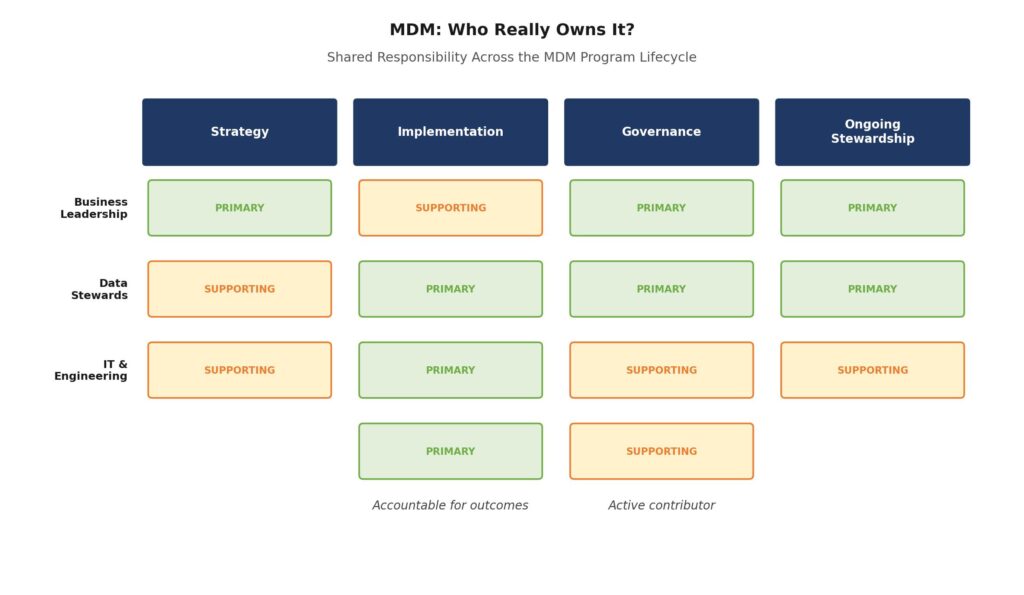
That is not an IT failure. IT delivered exactly what they were asked to deliver. The failure is that nobody in the business was ever made responsible for the data itself. MDM needs a business owner. Not a department. Not a committee. A named person whose job it is to care whether the data is right. Without that, the golden record has no one defending it.
Fix: Before implementation starts, put a name against every data domain. Not a department. Not a team. A person. Someone whose job it is to care whether that data is right.
2. Launching Without a Data Governance Framework
What happens when MDM goes live without governance in place?
Once you have named your data owners, the next question your team will almost certainly skip is: what are the actual rules?
Governance gets pushed in every program. There is always something more urgent. The platform needs configuring. The integrations need mapping. And governance feels like paperwork. So it gets scheduled for later. Later becomes after go-live. And six months after go-live, your data is a mess again. Duplicate records. Your CRM saying one thing, your billing system saying another. Nobody sure which version to trust or who to call about it.
It does not need to be a 50-page policy document. Governance is really just answering the questions that are going to come up anyway. Who in your organization gets to create a master record. Who approves a change to it. What happens when two of your systems disagree. Leave those questions open and every team around you will invent their own answer. And that inconsistency will not stay contained. It will spread.
Fix:
Treat governance as a workstream inside the MDM program. Define ownership, stewardship roles, quality rules, and escalation paths before configuration begins. Run governance design alongside platform setup, not as an afterthought.
A practical governance framework covers these five components:
Governance Component
What It Covers
Data Ownership
Named business owner accountable for quality outcomes per domain
Stewardship Roles
Day-to-day monitoring, exception handling, and record management
Policy Definition
Rules for creating, modifying, and retiring records
How data disputes get raised, reviewed, and resolved
3. Trying to Govern Everything at Once
Why do MDM programs fail when teams try to do too much at once?
Here is where ambition becomes the enemy.
Your leadership approved MDM. There is budget. There is momentum. And someone in the room says: while we are at it, let us fix customers, products, suppliers, and employee data all at once.
That decision feels like efficiency. What it actually does is guarantee that 18 months later, none of it is finished. Every domain you add slows every other domain down. Dependencies multiply. The team gets stretched across too many fronts. One day someone asks what has been delivered and the honest answer is: nothing production-ready yet.
One domain done completely and trusted by the business is worth more than five domains that are technically live but practically ignored. That first working domain is also your proof. The most persuasive argument for continued investment is a functioning MDM domain the business actually uses. That is how MDM programs build momentum rather than lose it.
Fix:
Pick one domain. The one keeping your CDO up at night or costing the most in rework. Deliver it end to end. Let it prove what good MDM looks like inside your organization. That is worth more than any program update deck when the next budget conversation comes around.
4. Assuming MDM Will Fix Source Data Quality
What data quality problems should you fix before MDM implementation?
This one catches almost everyone off guard, usually around month eight.
How clean is your data right now? Not the data you plan to have after MDM. The data sitting in your systems today, before a single integration is built.
Most teams do not check until it is too late. They migrate years of customer records, product entries, and supplier information into the new hub and then discover that the duplicates, the missing fields, the records nobody updated since 2019, all came with them. The platform does its best with what it receives. The output looks tidier. The underlying problems are still there, now with a golden record label attached.
Gartner puts the average annual cost of poor data quality at $12.9 million per organization (Gartner: The Financial Impact of Poor Data Quality, via IBM). That cost does not disappear when data moves into an MDM hub. It just becomes your MDM program’s problem. And this is one of the MDM failure reasons that is entirely preventable, but only if you look before you leap.
Fix:
Before a single integration is mapped, run a full data profiling exercise across every source system. Find out what you actually have, not what the system owners think they have. Budget for remediation. Assign an owner for it. Going into MDM with unresolved data quality issues is like renovating on a cracked foundation.
Data Domain
Common Quality Issues
Remediation Owner
Customer
Duplicates, missing fields, format inconsistencies across systems
Data Steward / CRM Owner
Product
Naming mismatches, incomplete specifications, orphaned records
Product Master Owner
Supplier
Duplicate vendors, inactive records, no standard identifier
Procurement Lead
Employee
Department mismatches, stale records, conflicting system entries
HR Data Owner
Data Quality Readiness: Common issues by domain before MDM implementation
5. Executive Sponsorship That Fades After Launch
How does loss of senior sponsorship derail an MDM program?
You can have ownership, governance, a focused scope, and clean data going in. And still watch the program slowly lose momentum if the right person stops paying attention.
Think back to the last time a key stakeholder left your organization mid-program. What happened to the things they owned?
In MDM, that moment is often the beginning of the end. The person who fought for the budget, who kept departments aligned, who resolved the arguments nobody else could, is gone. And suddenly your data ownership decisions are sitting in someone’s inbox with no one senior enough to move them forward. Meetings get skipped. Deliverables slip. Team members quietly redirect their energy to projects where accountability is clearer.
It looks like a resourcing problem from the outside. Underneath it is a governance problem. The program was built around a person, not a structure. And that is one of the MDM failure reasons that is hardest to see coming until it is already too late.
Fix:
Set up a data governance council where senior business leaders meet on a fixed cadence, not to receive updates but to make decisions. Connect MDM outcomes to the metrics those leaders are already measured on: data accuracy in financial close, customer record reliability in sales forecasting, supplier consistency in procurement. Build a reporting rhythm that surfaces risks and progress before they become surprises.
6. Choosing the Wrong MDM Platform
What makes platform selection a common MDM implementation failure?
Even with the right foundation in place, one decision can quietly undermine everything else.
The vendor demo was impressive. The platform handled everything they showed you. What they showed you, though, was their environment, their data, their best-case scenario.
Six months into your implementation, the gaps appear. Integrations described as straightforward are anything but. Customizations are piling up. The costs in the original business case look nothing like the actual invoice. And switching platforms now means starting over with the budget half spent.
Most platform decisions get made for the wrong reasons. An analyst ranking. A vendor relationship that already exists. A demo that looked impressive but had nothing in common with your actual data landscape. Picking the wrong platform is an MDM failure reason that stays with your program for years, as a slow and expensive friction that limits everything you try to do with it.
Fix:
Define your use cases, integration requirements, team capabilities, and realistic growth trajectory before engaging vendors. Run a proof of concept with your own data in your own environment. Evaluate total cost of ownership honestly. The platform that fits your context will outperform a prestigious one that does not.
Evaluation Criteria
Key Question to Ask
Use Case Fit
Does it handle your primary domain natively, without heavy customization?
Integration
How does it connect to your ERP, CRM, cloud platforms, and data pipelines?
Scalability
Can it grow with your data volume, domains, and user base over time?
Total Cost of Ownership
What are the full costs: licensing, implementation, support, and operations?
Implementation Load
What internal skills, external expertise, and timeline does it realistically require?
Vendor Support
What does post-go-live support, SLAs, and the product roadmap look like?
7. Underinvesting in Change Management
Why do employees resist MDM after go-live?
You have the ownership. The governance. The right scope. Clean data. Senior sponsorship. The right platform. And the program still fails to deliver value. This is where change management comes in, and this is the one most organizations consistently underestimate.
Your sales team did not ask for MDM. Your finance team did not design it. Your operations team found out about it three weeks before go-live. And now you are wondering why nobody is using it.
People do not resist change because they are difficult. They resist it because nobody brought them along. A two-hour training session the week before launch is not change management. It is a checkbox.
Prosci found that programs with excellent change management are seven times more likely to meet their objectives (Prosci: The Correlation Between Change Management and Project Success). Skipping it is one of the most expensive MDM failure reasons on this list, because you only find out the cost after the platform is already live.
Fix:
Build a change management workstream into the program plan from the beginning, not as a phase that follows go-live. Assign a change lead. Map impacted roles and design interventions specific to each. Set adoption metrics alongside technical delivery metrics and track both with equal rigor.
8. No Success Metrics Defined Before Implementation
How does the absence of KPIs contribute to MDM program failure?
And this is the one that makes all the others invisible.
Imagine your CFO asks you today: what has MDM delivered? Can you answer that with a number? Not a feeling. Not a project update. An actual before and after comparison.
Most teams cannot. Because nobody captured the baseline before the work started. The duplicates that existed before MDM. The average time it took to resolve a data conflict. The error rate in downstream reports. Without those numbers, you cannot prove improvement even when the improvement is real. And when you cannot prove improvement, the budget gets questioned. The program did not fail. Nobody measured whether it succeeded.
IDC research found that data mature organizations achieve 2.5x better business outcomes than those still finding their footing (IDC: How Data Maturity and Product Analytics Improve Business Outcomes). That kind of result does not happen by accident. It happens because someone decided to measure from the start. Not measuring is one of the MDM failure reasons that only hurts you later, when the questions get harder to answer.
Fix:
Define success metrics in the program charter before implementation starts. Capture a baseline. Build a reporting cadence into the program operating model. Stakeholders who see measurable progress stay invested. Those who cannot see progress find other priorities.
Metric
What It Measures
Target Direction
Duplicate Record Rate
Percentage of duplicate master records per domain
Decrease over time
Data Completeness
Critical attributes populated per record
Increase over time
Exception Resolution Time
Average time to close a data quality exception
Decrease over time
Golden Record Confidence
Platform confidence score assigned per record
Increase over time
Downstream Accuracy
Customer match rate, order accuracy, report reliability
Improve vs. baseline
Key Takeaways
Eight MDM failure reasons. Almost none of them technical. All of them connected.
Look at the list as a whole and you will notice something. Each failure creates the conditions for the next. No ownership means no governance. No governance means no consistent data. No consistent data means a platform that cannot perform as promised. A platform that disappoints kills executive confidence. And a program without confident leadership never builds the adoption it needs to justify its existence.
These are not eight separate problems. They are one problem at eight different stages of the same program.
Where Do You Go From Here?
None of the MDM failure reasons covered here are new. They have been showing up in post-implementation reviews for years. Across industries. Across budgets. Across platforms.
If you are reading this before your program starts, you are already ahead. The decisions that determine whether MDM succeeds happen early, long before go-live, and most teams make them without realizing how much weight they carry.
If you are reading this because something already went wrong, the pattern you just read is probably familiar. And the honest answer to why it happened is rarely the technology.
If any part of this felt familiar, you are not alone in it. Thoughtspark has worked through these same patterns with organizations at every stage, some before they started, some mid-program, some picking up the pieces. That conversation is always worth having.
Ready to Build MDM That Actually Works?
Whether you are evaluating MDM for the first time or stabilizing a program that has lost momentum, Thoughtspark offers a structured readiness assessment that gives your team an honest view of where you stand and what comes next.
Talk to our team. No generic playbooks. Just practitioners who have been here before.
Most MDM projects don’t fail because the technology is weak.
They fail because the organization underestimates what it really takes to implement Master Data Management successfully.
On paper, MDM sounds straightforward: create a single source of truth, clean up inconsistent data, and improve reporting. In reality, it touches systems, processes, ownership, governance, and culture. It forces teams to agree on definitions they have debated for years. It exposes data problems no one wanted to confront.
That’s why MDM implementation challenges are not small operational hurdles — they are structural business challenges.
In this article, we will break down the seven most common MDM implementation challenges and explain, in practical terms, how top-performing organizations overcome them. If you are planning an MDM initiative or trying to stabilize one, this guide will help you move forward with clarity and confidence.
Challenge 1: No Clear Business Goal
The Problem
Many companies start MDM without knowing exactly why. They say “we want better data” but can’t explain what that means in dollars and cents. Without a clear goal, the project loses steam and funding gets cut.
Real Example: A retail company started MDM to “improve customer data.” Six months in, executives asked “How much money is this saving us?” The team had no answer. The project was paused.
How Smart Companies Fix This
Set specific numbers: “Reduce duplicate customer records by 80% in 6 months”
Find an executive champion: Get a C-level leader who cares about the outcome
Show quick wins: Prove value in 90 days, not 2 years
Create a simple scorecard: Track 3-4 metrics everyone understands
Bottom Line: Top performers treat MDM Implementation Challenges like this by starting with the end in mind. They know exactly what success looks like before buying any software.
Challenge 2: Nobody Owns the Data
The Problem
When everyone owns the data, nobody owns it. Sales thinks Marketing should manage customer data. Marketing thinks IT should do it. IT says it’s a business problem. Result? Data stays messy because no one takes charge.
Real Example: A bank had 12 different versions of “customer address” across systems. When they asked “Who updates the official address?” they got 5 different answers. Their MDM project stalled for 8 months.
Give people real authority: Data stewards can say “no” to bad data
Create simple rules: Write down who can change what, and when
Meet regularly: Monthly 30-minute meetings to resolve conflicts
Bottom Line: Solving MDM Implementation Challenges around ownership means making one person accountable for each type of data. No committees. Single owners.
Challenge 3: Dirty Data Surprises
The Problem
Companies think their data is “pretty good” until they look closely. Then they find duplicates, missing fields, and 20 different ways to spell the same company name. Cleaning this takes way longer than planned.
Real Example: A manufacturer thought they had 50,000 customers. During MDM, they found 180,000 records with 40,000 duplicates. Cleaning took 14 months instead of 3.
How Smart Companies Fix This
Check data first: Spend 4 weeks profiling data before starting MDM
Start small: Fix your most important data first, don’t try to clean everything
Use smart matching: Software finds duplicates, humans confirm tricky ones
Set realistic timelines: Plan for 40% of effort to be data cleaning
Bottom Line: Top performers expect MDM Implementation Challenges with data quality. They don’t pretend their data is clean. They check first, then plan.
Challenge 4: Connecting to Too Many Systems
The Problem
Your MDM system needs to talk to ERP, CRM, e-commerce, and 15 other systems. Each connection is custom work. When one system changes, everything breaks. Maintenance becomes a nightmare.
Real Example: A healthcare company built 45 direct connections to their MDM hub. When they upgraded their ERP, 12 connections failed. Their IT team spent 6 months fixing integrations.
How Smart Companies Fix This
Use APIs: Let systems connect through standard interfaces, not custom code
Build a middle layer: Use an integration platform between MDM and other systems
Document everything: Write down how each connection works
Test connections early: Don’t wait until go-live to see if systems talk to each other
Bottom Line: Smart companies solve MDM Implementation Challenges with integration by designing for change. They know systems will be added and upgraded.
Challenge 5: People Don’t Want to Change
The Problem
Employees have their own spreadsheets and ways of working. They don’t trust a central system. They keep using old methods and ignore the new MDM tool. Adoption fails.
Real Example: A sales team kept their private customer list in Excel even after MDM launched. They said the new system was “too slow” and “didn’t have what I need.” Six months later, the data was still inconsistent.
How Smart Companies Fix This
Show personal benefits: “This saves you 2 hours a week on data entry”
Pick department champions: Find respected employees who support the change
Fix real pain points: If users say it’s slow, make it faster. Don’t just train more.
Make it easier: If the new way is harder than the old way, people won’t switch
Bottom Line: Overcoming MDM Implementation Challenges with adoption means making people want to change, not forcing them. Lead with benefits, not features.
Challenge 6: System Gets Too Slow
The Problem
MDM works fine with 10,000 records. But with 10 million records, searches take 30 seconds. Reports timeout. Users get frustrated. The system becomes unusable at scale.
Real Example: An insurance company’s MDM worked perfectly in testing. At full rollout with 8 million policies, simple lookups took 45 seconds. Users abandoned the system.
How Smart Companies Fix This
Test with real volume: Load your actual data size before launch, not sample data
Design for growth: Build architecture that handles 10x your current data
Use cloud scaling: Add computing power during busy times, reduce when quiet
Split heavy tasks: Do complex matching overnight, keep daytime searches fast
Bottom Line: Top performers anticipate MDM Implementation Challenges with performance. They test early with full data volumes and plan for growth.
Challenge 7: Losing Focus After Launch
The Problem
The project team celebrates go-live, then disbands. No one maintains the system. Data quality slowly degrades. Two years later, you’re back where you started.
Real Example: A consumer goods company launched MDM successfully. The project team moved to other work. After 18 months, data quality scores dropped from 95% to 67%. They had to re-implement.
How Smart Companies Fix This
Plan for “day 2” before launch: Keep a support team in place after go-live
Monitor automatically: Dashboards show data quality scores weekly
Schedule improvements: Quarterly updates to add features and fix issues
Assign a product owner: One person responsible for MDM long-term, not just implementation
Bottom Line: Successful companies know MDM Implementation Challenges don’t end at go-live. They plan for continuous care from the start.
Conclusion:
MDM implementation challenges are real, but they are not impossible to fix. The organizations that succeed don’t have fewer problems—they have better approaches to solving them. They invest in governance as seriously as technology. They treat change management as a core capability. They architect for scale and evolution, not just immediate requirements.
The cost of getting MDM wrong extends beyond budget overruns and missed deadlines. It means continuing to make decisions based on inconsistent data, missing cross-sell opportunities because you can’t connect customer relationships, and spending countless hours reconciling reports that should agree but don’t.
But get it right, and MDM becomes an invisible foundation that enables everything else—advanced analytics, AI/ML initiatives, customer experience transformation, and operational excellence.
Ready to Take Control of Your Master Data?
Implementing MDM is one of the most impactful — and complex — initiatives an organization can undertake. When done right, it improves operational efficiency, accelerates growth, and strengthens decision-making. When done poorly, it leads to delays, confusion, and wasted investment.
The difference is not just technology. It is clarity of scope, strong governance, practical execution, and experience navigating real-world MDM implementation challenges.
At ThoughtSpark, we help organizations move from strategy to execution with confidence. We work alongside your teams to define clear outcomes, design scalable governance models, and deliver focused, measurable MDM implementations — not theoretical frameworks.
Your CFO asks a simple question: “How many active customers do we have?”
Sales reports: 25,000
Finance says: 18,000
Marketing claims: 31,000
Three teams. Three different answers. Zero confidence. Everyone is sure their number is right. Meetings become arguments. Reports get questioned. Important decisions get delayed.
Eventually someone says, “We need MDM.”
Six months later, you’ve spent a lot of money on a new tool, added more processes, but you still don’t have one trusted version of the truth.
What went wrong?
You bought software. But you skipped the roadmap.
This article shows you how to build an MDM implementation roadmap that delivers real results—not just another failed IT project.
What Is an MDM Implementation Roadmap?
An MDM (Master Data Management) implementation roadmap is not a complicated technical document. It’s a simple business plan that answers four key questions:
1. What data problem is killing our business right now? 2. Which problem do we fix first? 3. Who’s responsible for fixing it? 4. How will we prove it worked?
Think home renovation: You don’t tear down all walls at once. You fix the leaking kitchen first—because it hurts most. Then you move room by room with a plan.
Without this approach, MDM becomes expensive chaos.
Why Many Companies Invest in MDM But See Little Value
Most companies invest in MDM for excellent reasons:
Streamlined operations
Faster decisions
Accurate reports
Happy customers
Yet studies show that roughly 75% of MDM projects fail to meet business goals. The main reasons are:
They start with tools instead of business problems
They try to fix all data at once
They don’t assign clear ownership
They forget to measure real business results
A strong roadmap prevents these mistakes.
The 10-Step MDM Implementation Roadmap (That Actually Works)
Step 1: Find Your Most Expensive Data Problem
Don’t start with “data quality.”
Start with: “Where is bad data costing us real money?”
Real Example:
An online retailer noticed:
Same customer has 5 different profiles
Loyalty points split across all 5
Customer can’t redeem points at checkout
Customer complains on social media
The problem isn’t “duplicate data.”
The problem is: We’re losing loyal customers and destroying our reputation.
That’s your starting point.
How to Find It:
Talk to customer service (what do customers complain about?)
Ask finance (what takes forever to reconcile?)
Check operations (what manual work happens daily?)
The loudest pain point becomes Phase 1.
Step 2: Map Your Current Mess (Keep It Simple)
You don’t need a perfect audit. You need clarity.
Ask three questions:
Where does this data live today?
CRM? ERP? Spreadsheets?
How many versions exist?
One customer in Salesforce, another in SAP, a third in Excel
Who uses this data every day?
Sales? Finance? Support? Executives?
Real Example:
A logistics company discovered:
Customer data lived in 7 different systems
Each system had different customer names and IDs
Ops team spent 4 hours daily fixing data manually
The roadmap doesn’t fix this overnight. But it names the problem clearly.
Step 3: Define Success in Business Terms (Not IT Jargon)
A roadmap without measurable outcomes is just a to-do list.
Bad Goals:
“Implement MDM”
“Improve data quality”
“Establish governance”
These mean nothing to the CEO.
Good Goals:
Reduce duplicate customers from 12% to 2%
Cut monthly reconciliation time from 5 days to 2 hours
Decrease customer complaints by 30%
Speed up product launches by 3 weeks
Simple Rule:
If your CFO reads your goal and says “So what?” Then Say
“We want accurate product descriptions so customers stop returning items due to wrong expectations. This will save us $200K annually in returns.”
Step 4: Pick ONE Domain to Start (Not Five)
This is where most MDM Implementation Roadmaps die.
Companies try to fix:
Customers
Products
Suppliers
Locations
Assets
All. At. Once.
Result? Nothing ships. Team burns out. Budget explodes.
Better Approach:
Choose ONE domain that:
Has high business impact
Leadership cares about
Can show results in 90 days
Real Example:
An e-commerce company started with product data only:
Wrong product descriptions
Incorrect sizes in listings
Pricing mismatches between website and checkout
Fixing this one domain:
Reduced returns by 22%
Improved conversion by 8%
Built trust in MDM
Then they expanded to customer data.
Pro Tip: Start where pain is loudest and wins are fastest.
When a duplicate customer appears, the Data Owner decides: “Which one is real?”
No committees. No endless meetings. Fast decisions.
Step 6: Design a Dead-Simple Data Flow
Your MDM Implementation Roadmap should explain how data moves—in language a 10-year-old could understand.
Simple Flow Example:
Customer data comes from CRM and ERP
MDM compares them and creates ONE trusted record
All teams use that one record
Changes go through approval
Everyone sees the same truth
That’s it.
Don’t overcomplicate this.
You can add complexity later. Right now, you need adoption.
Visual Tip:
Draw it on a whiteboard. If it takes more than 5 boxes and 4 arrows, simplify it.
Step 7: Choose Your MDM Tool AFTER the Roadmap (Not Before)
Most companies do this backwards.
They buy a tool first, then try to force their roadmap into it.
Better Way:
Build your MDM implementation roadmap. Then find a tool that supports it.
What Actually Matters:
Works with your existing systems (CRM, ERP, etc.)
Handles your data domains (customer, product, etc.)
Supports your governance workflow (approvals, rules)
Your team can actually use it (without 6 months of training)
Reality Check:
A simple tool used well beats a complex tool used poorly—every single time.
Step 8: Build in Phases (Not Big Bang)
A strong MDM implementation roadmap is phased. Not rushed.
Typical Phase Structure:
Phase 1: Pilot (Months 1-3)
ONE domain (e.g., customer data)
Limited scope (e.g., 1,000 records)
Small team (5-10 users)
Goal: Prove value fast
Phase 2: Expand (Months 4-6)
Add more attributes
Connect more systems
Strengthen governance
Goal: Build trust and adoption
Phase 3: Scale (Months 7-12)
Add new domains (products, suppliers)
Automate workflows
Enterprise-wide rollout
Goal: MDM as business-as-usual
Real Timeline Example:
Month 1-3: Customer pilot (sales and support only)
Month 4-6: Full customer rollout (all teams)
Month 7-9: Add product data
Month 10-12: Add supplier data
Why Phases Work:
Early wins build momentum. Small teams move fast. Lessons learned prevent big mistakes.
Step 9: Focus on Adoption, Not Just Accuracy
Here’s a painful truth:
Perfect data that nobody uses is worthless.
Your roadmap must include an adoption plan.
How to Drive Adoption:
Show, Don’t Tell
Demo how MDM saves time
Replace manual work with automation
Let users see the difference
Communicate Wins Early
“We eliminated 2,000 duplicate customers this month”
“Finance reconciliation dropped from 3 days to 4 hours”
“Customer complaints down 18%”
Make It Easier Than the Old Way
If MDM adds steps, people won’t use it
If MDM saves time, they’ll demand it
Real Example:
Finance team used to spend 3 days reconciling customer invoices.
After MDM: 3 hours.
They became MDM’s biggest advocates.
Adoption Tip: Train champions in each department. Let them spread the word.
Step 10: Measure Business Outcomes (Not Just Data Metrics)
Track what leadership actually cares about.
Data Metrics (Internal):
95% data accuracy
2% duplicate rate
99% completeness
These are fine. But executives don’t care.
Business Metrics (What Matters):
Reduced customer complaints by 30%
Faster reporting (from 5 days to 1 day)
Fewer manual errors (saving 200 hours/month)
Improved decision confidence (leadership trusts the numbers)
Revenue impact (faster product launches = more sales)
Example Dashboard:
Instead of:
“Customer data is 98% accurate”
Show:
“Customer service resolved 25% more tickets because agents now see complete customer history”
That’s a win the CEO understands.
What Makes an MDM Implementation Roadmap Actually Work?
After working with dozens of companies, here’s what separates success from failure:
Successful Roadmaps Are:
✅ Business-first (not IT-led) ✅ Simple (anyone can understand the plan) ✅ Phased (small wins build momentum) ✅ Owned (clear accountability) ✅ Outcome-focused (measure value, not activity)
Failed Roadmaps Are:
❌ Tool-first (bought software, then figured out the plan) ❌ Overly complex (100-page documents nobody reads) ❌ Big bang (trying to fix everything at once) ❌ Ownerless (committees make decisions) ❌ Activity-focused (we implemented MDM = success?)
Bottom Line:
MDM succeeds when people trust the data and actually use it every single day.
The Real ROI of a Strong MDM Roadmap
Let’s talk numbers.
Companies with a clear MDM implementation roadmap typically see:
40-60% reduction in manual data work
20-35% faster reporting and decision-making
15-25% decrease in customer complaints
$500K-$2M annual savings (depending on company size)
But the biggest ROI?
Trust.
When your CEO asks “How many customers do we have?”—everyone gives the same answer.
Meetings become shorter. Decisions become faster. Teams stop fighting about whose data is “right.”
That’s the power of a roadmap done right.
Ready to Build Your MDM Implementation Roadmap?
Most MDM projects fail—not because of bad technology, but because of no roadmap.
If you’re struggling with:
Duplicate customer or product data
Endless manual reconciliation
Reports nobody trusts
Systems that don’t talk to each other
MDM initiatives that stalled
You don’t need more tools. You need a clear plan.
How ThoughtSpark Can Help
At ThoughtSpark, we don’t just implement MDM—we build roadmaps that deliver real business value.
Our MDM-as-a-Service includes:
✅ Business-First Assessment We identify your most expensive data problem and quantify the ROI
✅ Custom Roadmap Design A phased plan tailored to your business goals, not generic templates
✅ Data Ownership Framework Clear roles and accountability—so decisions get made fast
✅ Tool-Agnostic Implementation We work with your existing systems and recommend the right MDM platform
✅ Change Management & Adoption We ensure your teams actually use MDM (not just IT)
✅ Measurable Outcomes Track business metrics that matter to leadership—not just data accuracy
Why Companies Choose ThoughtSpark:
Fast Time to Value: See results in 90 days, not 2 years
Business-Led Approach: We speak CFO language, not just IT jargon
Proven Methodology: Roadmaps built from real-world success (and failures)
End-to-End Support: From strategy to execution to optimization
Let’s Build Your MDM Implementation Roadmap
Book a free 30-minute MDM Strategy Session and we’ll:
Identify your highest-impact data problem
Map a phased roadmap to fix it
Show you the expected ROI in 90 days
No generic pitch. No pushy sales. Just honest advice.
You search for “Microsoft” in your CRM—3,200 orders found. Check your billing system—only 1,800. Look at shipping records—4,100 deliveries.
Same customer. Three different answers. Which one is real?
Now imagine this happening with every customer, product, and supplier in your business. That’s not a horror story—that’s your Tuesday.
The problem? Your data has multiple personalities. “Microsoft Corp,” “Microsoft Corporation,” “MSFT,” and “Microsoft Inc.” all live in different systems, and none of them talk to each other.
64% of companies now say fixing this mess is their top priority. Not because they’re perfectionists—because they literally can’t trust their own numbers anymore.
Master data is the cure. It’s one clean, authoritative list of who’s who and what’s what across your entire organization. One version of the truth. No more ghosts.
In this beginner’s breakdown, you’ll learn What is master data management, why it’s essential, how it works, where it’s used, what tools are involved, and how real organisations have benefited from adopting it.
What Is Master Data Management: The Fundamentals
Most organisations deal with huge amounts of information every day, but not all of it plays the same role. Some data changes constantly, some is used for calculations, and some forms the backbone of business operations. That foundational layer is what we call master data.
What Is Master Data?
Master data refers to the core business entities that remain relatively stable and are used repeatedly across departments and systems. These include:
Customers
Products and SKUs
Suppliers and vendors
Employees or workforce records
Locations, branches, warehouses
Assets and equipment
These are the pieces of information your organisation relies on to run daily operations. They don’t change as frequently as sales orders or payments.
To simplify things for beginners, it’s helpful to look at how master data differs from other types of data:
Master Data
Stable, shared business entities like customers, products, and suppliers.
Transactional Data
Day-to-day activities and events: orders, invoices, shipments, payments. These depend on master data to make sense.
Reference Data
Controlled lists used for classification: country codes, currency types, industry categories.
What Is Master Data Management?
If master data is the foundation, Master Data Management (MDM) is the discipline that keeps that foundation strong.
MDM basics aim to:
Remove duplicates
Standardise values
Correct inconsistent or incomplete records
Ensure every system works with the same version of customer, product, or supplier data.
Make data easier to search, use, and trust
Help teams avoid manual reconciliation and confusion.
Good MDM basics also introduce governance: who owns the data, who can update it, what rules apply, and how quality is measured
Why MDM Matters — Key Benefits & Business Value
Now that we know what is master data management, let’s look at its benefits. For anyone new to data management, Master Data Management (MDM) can feel like a technical concept reserved for IT teams. But when you break it down, the value it brings is very practical. Companies that address data quality first report 2.5× higher success rates in transformation or analytics initiatives than those that do not.
Below are the benefits that matter most, especially if you’re trying to understand why MDM deserves attention early in your data journey.
1. Better Data Quality and Fewer Errors
Most organisations don’t suffer from a lack of data; they suffer from too many versions of the same data. A customer might appear under three different spellings, a product may appear under slightly different codes, or a supplier’s details might be updated in one system but not another. These inconsistencies look small, but they create friction everywhere.
Aligning data from different systems into one trusted version
2. A Unified View Across Business Entities
One of the biggest advantages of MDM is its ability to bring everything together. Instead of each department maintaining its own version of customer or product data, MDM creates a single, unified view across the entire organisation.
For example:
A true customer view helps marketing personalise communication
A consistent product catalog avoids mismatches across online and offline channels
Supplier data aligned with product and inventory helps streamline procurement
Finance reports become more consistent when customer and product hierarchies match across systems
3. More Efficient Operations & Less Manual Work
A large portion of operational inefficiency comes from reconciling conflicting data, merging spreadsheets, fixing errors, rebuilding reports, or manually cleaning up entries.
MDM reduces this manual burden significantly by:
Cleaning and standardising data at the source
Maintaining rules that prevent bad data from entering systems
Allowing teams to trust the data instead of constantly correcting it
Making integrations between systems much easier
4. A Stronger Foundation for Analytics, BI, and AI
If your customer or product data is inconsistent, duplicated, or incomplete, your dashboards will be inaccurate and your AI models will perform poorly.
MDM creates the trusted data foundation that analytics and AI rely on by ensuring:
Each customer and product has a single, correct version
Relationships between entities are clear (e.g., which products belong to which category)
Data is complete and updated
Inconsistent or duplicated inputs don’t skew results
5. Better Compliance, Governance, and Risk Management
As businesses grow, regulations grow with them, including privacy rules, audit requirements, reporting obligations, and industry-specific standards.
MDM supports compliance by:
Maintaining accurate records of key entities
Ensuring data lineage is traceable (where data came from and how it changed)
Enforcing rules and master data definitions consistently
Reducing the risk of using outdated or incorrect information in regulated processes
How MDM Works — Core Components & Processes
Understanding how Master Data Management works becomes much easier once you break it into a few core steps.
1. Data Modelling & Taxonomy: Defining What Your Data Actually Is
Before anything else, you need clarity on the types of data your organisation relies on. Data modelling is simply the process of defining:
What entities do you have
What attributes describe them
How they relate to each other
A well-structured model gives your MDM system clarity on how data should be stored and used.
2. Data Consolidation & Integration: Bringing Everything Together
Most organisations store master data in dozens of places, including CRM tools, ERP systems, HR software, spreadsheets, legacy databases, and sometimes external sources. MDM consolidates these scattered pieces into a single, coordinated view.
This step includes:
Pulling data from different systems
Mapping fields (e.g., “Customer_Name” in one system = “FullName” in another)
Aligning formats and structures
Merging overlapping datasets
3. Data Cleaning, Standardisation & De-duplication
Once consolidated, master data often needs serious clean-up. MDM uses rules and automated checks to resolve the common issues:
Duplicate customer or product records
Incomplete or outdated fields
Misspellings and formatting errors
Conflicting information about the same entity
Variations in codes, naming conventions, units, and addresses
A practical example: If one system lists “Robert Singh,” another says “Rob Singh,” and a third stores “R. Singh,” MDM identifies them as the same person and unifies them.
4. Governance & Stewardship: The Rules That Keep Data Clean
Technology alone can’t keep data healthy. This is where importance of data governance comes in. MDM works best when clear policies and roles are in place.
Governance defines:
Who owns which data (e.g., marketing owns customer attributes, finance owns billing attributes)
Who can update records
What rules apply to each field
How quality is measured
How issues are handled
5. Golden Record Creation: Establishing the “Single Source of Truth”
After data is cleaned, standardised, and governed, MDM creates a golden record, the most accurate, complete, and trustworthy version of each entity.
This golden record contains:
The best available information
Verified attributes
Resolved duplicates
Consistent standards
6. Data Propagation: Making Sure All Systems Stay in Sync
The final step is distributing the mastered data back into the systems that need it. This ensures:
CRM systems get the latest customer details
ERP tools get unified product and supplier information
Analytics platforms use accurate, up-to-date data
Operations run on clear, consistent records
Real-World Case Studies
Case Study 1: Financial Services Credit Union- Building a Unified Customer View with MDM
Background A large credit union with multiple branches and product lines struggled with customer data split across legacy systems. Each unit kept its own records, resulting in no single, reliable view of members and affecting service, reporting, and operational efficiency.
Challenge
Data was often inconsistent or outdated, leaving staff without a full picture of member relationships. Routine updates, product recommendations, and tasks like address changes, risk checks, compliance reporting, and member-vote lists were slow and error-prone due to duplicates and conflicting records.
Approach The credit union deployed a customer master-data hub called MemberView, consolidating and deduplicating records from all systems into one source. Integrated with existing platforms and the data warehouse, it provided a portal where staff could access complete member profiles with single sign-on.
Outcomes Service quality improved as teams accessed accurate, unified profiles. Address changes and compliance processes became more reliable, marketing became more targeted, and operational work, such as preparing election lists, was streamlined through cleaner, consistent data.
Case Study 2: Hach – Improving Product Data Quality for Global Distribution
Background Hach, a global provider of water-quality testing instruments, manages a complex product catalogue across regions, languages, and strict regulatory environments.
Challenge Product information lived in multiple systems with inconsistencies in descriptions, specifications, documentation, and translations. Manual updates led to duplication and errors, slowing new product launches and making it harder for distributors and customers to access reliable information.
Approach Hach created a centralised master-data environment to standardise attributes, documentation, and regulatory details. Translation workflows were streamlined, and unified product data was pushed consistently across catalogues, digital channels, and internal systems.
Outcomes Product information became cleaner and more consistent globally. Distributors and customers accessed accurate, up-to-date details, reducing support issues. Internal teams gained confidence in product data, enabling faster updates, smoother launches, and improved compliance across markets. This example shows what is master data management in action—turning fragmented customer information into a single, trustworthy source.
Now that you understand what is master data management, let’s talk about where most beginners go wrong—and how to avoid those mistakes from day one.
1. Thinking MDM Is Just a “Database Cleanup”
A lot of people see MDM as a one-time tidy-up task, remove a few duplicates, fix some names, and the job is done. In reality, cleanup is only the starting point. Data will continue to change as customers update details, products evolve, and suppliers shift.
2. Expecting Immediate Results
MDM improves accuracy and consistency, but it isn’t a switch you flip. Early stages often involve profiling data, fixing underlying issues, and aligning teams on rules and master data definitions.
3. Taking a Siloed or Single-Domain Approach
Some organisations try to master only one domain, usually customers or products, and stop there. This limits long-term value because master data entities are connected. For example, customer data links to orders, which link to products, which link to suppliers.
4. Overlooking Governance as the Organisation Evolves
Businesses grow, acquire new tools, add new channels, and expand to new markets. If governance rules don’t evolve with them, master data becomes outdated or inconsistent. Governance must stay aligned with how the organisation actually operates.
5. Confusing Master Data with Other Data Types
Beginners often mix up master data, transactional data, and reference data. Understanding the difference is important, MDM focuses on the stable entities, not the daily transactions or classification lists.
Conclusion
Master data isn’t something you fix once and forget. It’s the layer everything else depends on, reporting, customer experience, analytics, compliance, all of it. As your systems and teams grow, the need for clean, consistent data only becomes more obvious.
Still wondering if that Microsoft discrepancy was 3,200 orders or 1,800?
Yeah. That’s the problem.
Understanding what is master data management is step one. Fixing yours is step two. ThoughtSpark helps companies find out exactly where their data is broken and fix it without blowing up their systems.
[Talk to us] — We’ll show you what’s actually happening in your data (spoiler: it’s messier than you think).
Your team spends hours hunting for the latest product specifications across spreadsheets, emails, and shared drives. A small inaccuracy—an outdated price, incorrect size, or missing attribute—can quickly lead to customer complaints, returns, and lost sales.
Poor product data costs businesses an estimated 15–25% of revenue through inefficiencies and missed opportunities. In today’s omnichannel environment, consistent and accurate product information isn’t optional—it’s foundational to trust, conversions, and growth.
This is where the benefits of PIM start to become clear. A Product Information Management system creates a single source of truth for all product data, ensuring accuracy and consistency across e-commerce platforms, marketplaces, print catalogs, and sales teams.
At ThoughtSpark, we specialize in data, AI, and digital transformation. We help organizations implement AI-enhanced PIM strategies that turn product information into a strategic asset, enabling faster innovation and measurable ROI.
Did You Know? PIM management is 6x faster than Excel, yet 70% of retailers still rely on spreadsheets—leaving revenue on the table.
What Is Product Information Management?
Product Information Management (PIM) is a centralized platform that collects, manages, enriches, and distributes product information across all channels. Think of it as the command center for your product catalog—handling descriptions, specs, images, pricing, translations, and more.
In 2026, with the global PIM market valued at $15.62 billion and projected to nearly double to $31.98 billion by 2029 (CAGR 15.4%), adoption is accelerating because businesses can no longer afford inconsistent data in an era of instant customer expectations
Top 10 Benefits of PIM
1. One Single Source of Truth
It stops everyone in your company from using different, conflicting information.
Example: Imagine your warehouse has the weight of a coffee maker as 5 kg, but the website lists it as 3 kg. With a PIM, everyone—sales, web team, customer service—pulls the correct 5 kg data from one central hub, eliminating confusion and errors.
2. Update Everything at Once, Instantly
Change information in one place, and it updates automatically everywhere you sell.
Example: You need to lower the price of a jacket for a flash sale. Instead of manually logging into Amazon, Shopify, and Walmart to change it, you update the price once in the PIM, and it pushes the new price to all those stores simultaneously.
3. Fewer Costly Mistakes
It drastically reduces human errors that lead to returns, bad reviews, and lost sales.
Example: A customer buys a blue shirt online but receives a red one because the warehouse had the wrong color code. A PIM ensures the “SKU 123” is always linked to “Blue” across all systems, so the right item is always shipped.
4. Sell on More Channels Easily
It formats your product info to meet the specific requirements of any new sales platform.
Example: You want to start selling on Home Depot’s marketplace. Their system needs unique codes and specific image sizes. Your PIM can automatically reorganize and export your product data into Home Depot’s exact required format, saving you weeks of manual work.
5. Launch New Products Faster
It streamlines and organizes the process of getting a product ready for sale.
Example: To launch a new smartphone, your marketing team needs descriptions, the tech team needs specs, and sales needs distributor info. A PIM provides a shared checklist and workspace where all teams can complete their parts efficiently, cutting the launch time from weeks to days.
6. Give Shoppers Richer, Better Information
It allows you to easily add all the details (videos, manuals, ingredient lists) that help customers feel confident buying.
Example: For a new blender, you can store and manage not just photos, but also a “how-to” video, the PDF instruction manual, a recipe booklet, and a detailed nutritional guide for smoothie mixes all in the PIM, making your product page much more helpful.
7. Make Your Team More Collaborative
It gets your marketing, sales, and support teams on the same page—literally.
Example: When customer support gets a question about a product’s compatibility, they can look in the PIM and see the exact, approved answer that the product manager wrote, instead of guessing or giving inconsistent information.
8. Improve Your Search Engine Ranking
Complete, well-organized product data is what search engines like Google love to show.
Example: A PIM helps you ensure every product page has a unique title, a complete description, and properly tagged “alt text” for images. This gives search engines more clear signals about your products, helping you rank higher in search results.
9. Expand Globally Without the Headache
It neatly organizes all the different languages, currencies, and local regulations for international markets.
Example: Selling a hair dryer in the US, UK, and Germany? The PIM can store the product description in English (US and UK versions) and German, list prices in dollars, pounds, and euros, and track the different electrical compliance labels required for each country.
10. Save Money and Increase Profit
PIM automates manual work, reduces errors, and helps sell more—all of which improve your bottom line.
Example: By eliminating manual data entry jobs, reducing product return rates from wrong info, and boosting sales with better product pages, the benefits of PIM pays for itself. The savings and new revenue directly increase your profit margins.
Ready to Experience the Benefits of PIM?
Don’t let scattered product data hold your business back in 2026.
If you’re serious about efficiency, revenue growth, and digital leadership, let’s talk.
We’ll analyze your current challenges and map out a clear path to leverage benefits of PIM for growth, efficiency, and unbeatable customer experiences.
Your Head of Sales presents a report showing a 15% increase in customer retention. Ten minutes later, your CFO walks in with a spreadsheet showing a 5% decline.
The room goes quiet.
This isn’t a reporting issue. It’s a leadership problem.
In 2026, the benefits of Master Data Management are impossible to ignore, data is the lifeblood of every organization—but for most enterprises, that data is fragmented, duplicated, and unreliable. Customer records live in dozens of systems. Product codes don’t match across platforms. Teams argue over whose numbers are correct.
According to Gartner, poor data quality costs organizations an average of $12.9 million per year.
At ThoughtSpark, we see this pattern repeatedly across B2B SaaS and data-driven enterprises. The companies that win are not the ones with the most data—they are the ones with the most trusted data.
That is where the benefits of Master Data Management (MDM) move from a “nice-to-have” initiative to a business-critical capability.
What Is Master Data Management (MDM)?
Master Data Management (MDM) is the discipline of creating and maintaining a single, trusted source of truth for an organization’s most critical business data—across all systems, teams, and processes.
MDM goes beyond basic data cleaning. It establishes:
Governance
Ownership
Standardization
Ongoing accuracy
In simple terms, MDM ensures that everyone in the organization works from the same, correct information.
Core Types of Master Data
Customer data: names, addresses, preferences, interaction history
Asset data: equipment, infrastructure, digital assets
Employee data: roles, hierarchies, skills
Simple example:
Without MDM: Customer John Smith has 3 different addresses in your systems. Marketing emails the wrong person. Shipping sends to an old address. Sales can’t reach him.
With MDM: One correct record. Everyone sees the same info. No mistakes.
Think of MDM as your company’s single source of truth. When everyone works from the same information, everything runs smoother.
What Happens Without Master Data Management?
Before exploring the benefits, it’s important to understand the alternative.
Without MDM, organizations experience:
Conflicting reports across departments
Poor customer experiences
Failed digital and AI initiatives
Compliance risks and regulatory exposure
Rising operational costs
Slow, uncertain decision-making
In short, growth becomes harder and risk increases.
10 Key Benefits of Master Data Management
1. Establish a Single Source of Truth Across the Company
Most companies store the same data in multiple systems, and each team views it differently. This creates confusion, inconsistent reports, and slow decision-making. Master Data Management brings all critical business data into one trusted source that everyone uses.
Real-world example: Your sales team says you have 50,000 customers. Marketing says 65,000. Finance says 48,000. Who’s right? Nobody knows because each department tracks customers differently. With MDM, everyone sees the same number: 52,347 unique customers. No confusion, no wasted time reconciling spreadsheets.
2. Accurate, Duplicate-Free Data Across All Systems
Data errors and duplicates slowly pile up in most systems and affect reporting and operations. Master Data Management automatically cleans, standardizes, and merges records so data stays accurate over time.
Real-world example: A customer places an order online. They type their address as “123 Main St” but your system has “123 Main Street” from a previous order. Now you have two records for the same person. MDM spots this instantly, merges the records, and updates everything. One customer, one accurate profile.
3. Customers Get Better Experiences
When customer data is scattered, service feels disconnected. Master Data Management brings all customer information together so every team sees the full picture.
Real-world example: Sarah buys running shoes from your website on Monday. On Tuesday, she visits your store. The sales associate has no idea about her online purchase and tries to sell her the same shoes again. Awkward. With MDM, the store associate sees Sarah’s online order immediately and says, “I see you ordered running shoes! Can I help you find matching workout gear?” Sarah feels recognized and valued.
4. Leaders Make Faster, Better Decisions
Leaders often lose time validating data before they can act. Master Data Management ensures reports and dashboards are accurate, so decisions happen faster.
Real-world example: Your CEO asks, “What’s our best-selling product category this quarter?” Without MDM, you spend 3 days collecting data from different systems, reconciling differences, and building a report. By then, the meeting is over. With MDM, you pull up a dashboard and answer in 30 seconds: “Athletic footwear, up 18% from last quarter.”
5. You Stay Compliant and Avoid Fines
Meeting data regulations is difficult when information is spread across systems. Master Data Management helps you find, control, and manage data consistently.
Real-world example: A customer in Europe requests deletion of their data under GDPR (their legal right). You think you’ve deleted everything, but their information is still in 3 other systems you forgot about. That’s a violation worth up to €20 million in fines. With MDM, you search once, find all instances of that customer’s data across every system, and delete everything properly. Compliance complete.
6. Operations Run Smoother and Cost Less
Disconnected data leads to duplicated work, errors, and unnecessary spending. Master Data Management helps eliminate this waste by standardizing data across systems.
Real-world example: Your company orders office supplies from the same vendor through 5 different purchasing systems. You’re paying 5 different prices for the same pens because nobody realizes you’re all buying from the same supplier. MDM reveals you’re actually buying from “ABC Office Supply,” “ABC Office Supplies Inc,” and “ABC Supply Company”—all the same vendor. You consolidate, negotiate better pricing, and save $200,000 annually.
7. Digital Projects Actually Succeed
New technology struggles when built on poor data. Master Data Management provides clean, consistent data that digital initiatives depend on.
Real-world example: You launch a fancy new mobile app so customers can track orders. But the app shows wrong delivery dates because it’s pulling from old, inaccurate data. Customers complain. The app fails. With MDM, the app pulls from your single source of truth. Delivery dates are accurate. Customers love it. The app succeeds.
8. Someone Is Actually Responsible for Data Quality
When no one owns the data, quality quickly declines. Master Data Management clearly defines who is responsible for each type of data and how it should be managed.
Real-world example: Product descriptions on your website are a disaster. Some are detailed, some are empty, some have typos. Nobody knows whose job it is to fix them, so nobody does. MDM establishes that the Product Marketing team owns product data. They have standards, review processes, and accountability. Product pages improve. Sales increase.
9. AI and Analytics Finally Work Right
AI and analytics depend on clean data. When data is inconsistent, results are unreliable. Master Data Management ensures advanced tools work with accurate information.
Real-world example: You build a machine learning model to predict which customers will buy next month. But your training data includes duplicate customers, so the model thinks John Smith and J. Smith are different people. The predictions are garbage. With MDM, the model trains on clean, accurate data. It correctly identifies high-probability buyers. Your marketing campaigns hit the right people and sales jump 30%.
10. Your Data Becomes a Revenue Source
When data is accurate and well-managed, it can create new revenue opportunities beyond daily operations.
Real-world example:
You run an e-commerce platform for online sellers. You see which products sell faster, what pricing works, and when demand spikes.
You turn these insights into a paid “Seller Intelligence” feature that helps merchants make better pricing and inventory decisions.
Conclusion:
Ready to unlock the full benefits of Master Data Management and accelerate business growth?
ThoughtSpark helps organizations eliminate data chaos and unlock the true value of Master Data Management to move faster, reduce costs, and scale AI with confidence.
One of the clearest signs of MDM challenges inside an organisation is simple: ask three teams for the same number and watch how many versions come back. A supplier exists under three different names. A customer record shows two conflicting addresses. A “final” report doesn’t match what another team pulled an hour earlier. No one planned for this mess, yet it quietly slows projects, derails AI pilots, and makes confident decision-making harder than it should be.
What’s changed in 2026 is the scale. Organisations aren’t just dealing with a handful of systems anymore; they’re managing data spread across cloud apps, regional platforms, automation tools, partner networks, and legacy software that refuses to retire. The result? Even well-managed companies find themselves wrestling with basic questions such as: Which record is correct? Who owns this data? How did we end up with five versions of the same product?
This is where Master Data Management should bring order, but MDM also brings its own challenges, and many teams learn the hard way. This guide offers a clear, practical look at those MDM challenges, why they persist, and how organisations are overcoming them today.
Why MDM Projects Fail: The Reality Check
Most organisations step into Master Data Management with good intentions, aiming to clean up core records, align systems, and finally operate from a single version of the truth. In practice, however, MDM challenges surface quickly and prove far more complex than expected. According to Gartner, up to 75% of MDM programs fail to meet their intended business objectives because teams underestimate the depth, interdependencies, and organisational impact of the data issues they are trying to solve.
Many of these MDM challenges emerge before an initiative even gains momentum. This is why understanding them upfront is non-negotiable. When leaders approach MDM with a realistic view of where it commonly breaks, whether through governance gaps, unclear ownership, technical constraints, or cultural resistance, programs are designed more effectively, expectations are set correctly, and costly missteps are far easier to avoid.
Common Technical & Data Challenges in MDM
Data Silos and Fragmented Sources
According to McKinsey research, 80% of organisations say their divisions still operate in data silos. When you start looking closely at your master data, one of the first things you’ll notice is how scattered it is, this is one of the major master data pitfalls. Customer records sit in one system, product details in another, supplier data in yet another, and older information remains buried in spreadsheets. As your teams adopt more SaaS tools, the fragmentation grows. If each system holds a different version of the same record, you’ll spend more time reconciling than improving.
Poor Data Quality: Duplicates, Inconsistencies, Missing Values
Quality issues usually surface next. You’ll find duplicates, missing fields, outdated attributes, or formats that don’t match across teams. And if you’re working on AI or automation, these gaps become even more visible; models simply can’t perform well when the underlying master data is unreliable. These problems accumulate quietly, but their impact shows up everywhere.
Integrating Legacy, Cloud, and Third-Party Systems
You’ll also face integration challenges. Most organisations run a mix of legacy platforms, cloud applications, and external data sources, each structured differently. Bringing them together requires careful mapping and transformation, and schema mismatches are common. Without a solid integration approach, establishing consistent master data across your organisation becomes much harder than expected.
Organisational & Governance Challenges
Lack of Clear Governance and Data Ownership
One of the quickest ways an MDM initiative loses ground is when no one is clearly responsible for the “golden record.” If ownership isn’t defined, your data begins to drift almost immediately. Different teams update information in different systems, rules aren’t applied consistently, and quality declines faster than you expect, leading to master data pitfalls. Without agreed-upon roles and standards, even the best technology can’t keep your data aligned.
Misalignment with Business Objectives and Weak Sponsorship
Another challenge is alignment. If your MDM effort is viewed as an IT cleanup exercise rather than a business initiative, it won’t receive the attention, resources, or sponsorship it needs. When the business isn’t invested, priorities shift, momentum fades, and MDM becomes another project that “never quite landed.”
Treating MDM as a One-Time Project
The last organisational hurdle is the belief that MDM is something you can implement once and forget. Master data changes constantly, new customers, new products, new suppliers, new regulations. Teams often underestimate this, only to realise months later that they’re back to reconciling the same inconsistencies MDM was meant to fix.
By 2026, you’re managing far more data than your earlier MDM plans ever anticipated. Hybrid and multi-cloud environments, microservices, partner platforms, and an ever-expanding SaaS tool stack all contribute to complexity that grows every quarter. Each system introduces its own structure and version of a customer, product, or supplier, and the effort required to keep those records aligned increases with every new tool your organisation adopts.
Real-Time and Streaming Data Expectations
You’re also dealing with rising demand for real-time insight. Whether it’s operational dashboards, supply-chain tracking, fraud alerts, or personalised customer experiences, many of your business processes now expect data that’s accurate the moment it arrives. If your master data is updated only once a day, your teams end up making decisions based on information that’s already out of date.
Pressure to Produce AI-Ready, Trusted Master Data
The final challenge is the push from AI and automation. Machine learning models rely heavily on consistent, complete master data, and they fail quickly when fed duplicate or conflicting records. As adoption grows, so does the scrutiny around data accuracy, lineage, and governance. With compliance regulations tightening, you’re expected to demonstrate that the data supporting your algorithms is reliable and well-managed.
How to Overcome MDM Challenges in 2026: Strategic & Practical Steps
Start with Alignment and Executive Buy-In
If you want your MDM features to succeed, start by making the business case crystal clear. Tie MDM directly to goals your leadership already cares about, customer experience, regulatory compliance, faster reporting, reduced operational friction, or AI readiness. When executives see that poor master data is blocking these outcomes, sponsorship becomes much easier.
Define Governance, Stewardship, and Accountability
Next, make ownership explicit. Decide who is responsible for each domain, who approves changes, and which rules apply across systems. Understanding the role of data governance helps prevent data drift and ensures consistent updates as your organisation grows. Stewardship roles don’t need to be heavy or bureaucratic; they simply ensure that someone is accountable for maintaining the “golden record” in each domain.
Map Your Data Landscape and Prioritise Domains
Before you fix anything, you need to understand where your data lives, how it moves, and which systems create or consume it. Once you have that picture, choose a starting domain, customer, product, supplier, asset, or location. Begin with the domain that creates the most friction or has the highest business value.
Cleanse, Standardise, and Consolidate Data
With a domain selected, focus on cleaning and consolidating the underlying records. This includes removing duplicates, filling in missing values, harmonising formats, correcting outdated details, and merging fragmented records into a single, trusted version. The quality of this foundation determines how well your MDM system performs in the future.
Adopt a Flexible, Scalable Architecture
By 2026, you need an upgraded MDM architecture that can handle hybrid-cloud, API-driven, and real-time environments. Choose platforms and designs that support incremental growth, work well across cloud ecosystems, and allow you to plug in new systems without re-engineering everything. Scalability should be designed in from the start, not added as an afterthought.
Embed MDM into Operations and Culture
MDM isn’t a project you complete; it’s a discipline you maintain. To avoid MDM implementation issues, build regular quality checks into your processes. Document standards and make them easy for teams to follow. Train business users so they understand the basics of data accuracy and why it matters.
Use Automation and AI to Reduce Manual Overhead
Finally, use automation wherever it makes sense. Modern tools can match and merge records, assess profile data quality, identify anomalies, and suggest enrichments with far less manual effort. These automations won’t replace governance, but they will help you maintain cleaner, more consistent master data at scale, especially as volumes and systems continue to grow.
Real-World Case Studies: Learning from Others
Case Study 1: Airbnb; Empowering Global Employees With Unified Master Data
Background A global hospitality and lodging company managing thousands of employees, hosts, listings, and partners faced increasing complexity in coordinating internal operations and data across regions. With such scale, inconsistent or fragmented master data, such as staff/host profiles, property metadata, and regional compliance data, threatens operational efficiency and internal collaboration.
Challenge Employee, host, and listing data were stored across multiple systems and regional databases. This led to duplicated records, outdated information, inconsistent contact and identity data, and difficulties coordinating across regions. The lack of a unified master data backbone made onboarding, internal resource allocation, compliance checks, and global operations coordination difficult.
Approach The company implemented a master data management framework that consolidated core reference data, staff, host, property, and compliance metadata into a central, governed registry. The registry was structured to serve as a single source of truth for internal teams worldwide, ensuring consistency in identity, roles, property data, and regulatory information. Processes and roles were aligned to govern updates, manage synchronisation, and maintain data quality across jurisdictions worldwide.
Outcome With unified master data, internal workflows improved: employee and host profiles became consistent across regions, coordination for global staffing and property management became smoother, and compliance and identity checks became reliable and auditable. Operational overhead from data mismatches was reduced, enabling the company to scale its personnel and property operations globally with greater control and confidence.
As your business scales, unresolved MDM challenges don’t disappear; they become more visible and more expensive. The organisations that stay ahead in 2026 are those that take these issues seriously and build a steady, repeatable approach to managing core data. When you get that foundation right, a lot of the friction you deal with today, slow reporting, mismatched records, stalled AI projects, starts to ease on its own.
If you’re looking at your current landscape and recognising some of these MDM challenges, you don’t have to solve them in isolation. At ThoughtSpark, we spend a lot of time helping teams understand where their data is today and what a realistic path forward looks like. If clarity is what you need next, we’re here to help you get there.
Introduction: Why Master Data Matters More Than Ever in 2026
If there’s one thing every leadership team has learned over the past two years, it’s this: you can pour millions into AI, automation, and cloud programs, but none of it delivers if your data isn’t trustworthy. A recent Gartner analysis put it bluntly: 52% of digital transformation efforts fall short because the underlying data is fragmented or unreliable. And in 2026, with data coming in from dozens of apps, regions, and platforms, that problem will only grow louder.
Master Data Management sits right at the centre of this challenge. It is the practice of establishing and protecting the core reference data that an enterprise relies on, customers, suppliers, locations, products, assets, and more, so every team works from the same, agreed-upon truth. It sounds simple, but when you’re juggling hybrid cloud systems and legacy platforms, achieving that consistency becomes a serious operational hurdle.
This guide is built to help you cut through the noise. We’ll unpack what modern Master Data Management really looks like in 2026, the tools leaders are betting on, the ROI they’re seeing, real case studies from global enterprises, and a clear roadmap you can adapt for your own organisation.
What Is Master Data Management (MDM) — Fundamentals & Evolution
If you’ve ever been in a meeting where two teams present completely different numbers for the same metric, you’ve already experienced why Master Data Management exists. It’s one of those functions that rarely gets talked about, yet it quietly supports nearly every part of your business, forecasting, reporting, customer experience, compliance, and AI performance.
Organizations losing an average of US $12.9 million annually to poor data quality underscore just how expensive messy master data can be. Meanwhile, with 85 % of enterprise AI projects failing due to data issues, it’s clear: no AI, analytics or digital-transformation boost will deliver unless the foundational data is clean, unified and governed.
Most organisations don’t realise how dependent they are on their master data until it starts working against them. A supplier record is duplicated across systems. A product is listed under multiple variations. Customer information is scattered between CRM, billing, service, and marketing tools. At that point, “master data” stops being an IT term, it becomes a barrier to alignment, speed, and confident decision-making.
Modern Master Data Management has less to do with the technology itself and more to do with aligning your organisation around a single, reliable view of the business. And in 2026, with data flowing from more systems than ever and AI initiatives relying on trustworthy inputs, that shared reality is becoming a true strategic advantage.
Let’s break down what MDM actually involves and how it has evolved into a critical business capability.
Core Concepts & Scope
What “master data” really means
Master data sounds abstract, but you interact with it every day. It’s the core set of business entities that don’t change often, but when they do, the effects ripple across your entire organisation. Industry definitions describe master data as the foundational reference data shared across your enterprise, such as:
Customers
Products and SKUs
Suppliers and partners
Employees and contractors
Locations, warehouses, markets
Assets and equipment
This data underpins almost everything you do. If it’s inconsistent, the effects show up quickly, reports drift, supply chain numbers don’t line up, AI models misfire, and customer interactions lose their edge.
Clean master data reduces friction. It prevents costly reconciliations. It cuts down errors before they snowball. It gives your analytics and AI teams something reliable to work with. That’s why treating this data strategically, not reactively, matters so much.
The core processes that make up MDM
Master Data Management isn’t a single platform or interface. It’s a combination of processes designed to keep your foundational data aligned, accurate, and useful across every system. The most critical components include:
1. Data validation
This ensures that data enters your systems cleanly and consistently. For example:
Customer names follow a standard format
Product codes adhere to naming conventions
Mandatory fields aren’t left blank
Validation keeps bad data from entering in the first place.
2. Matching and merging duplicates
Duplication is one of the most common and expensive data problems enterprises face. The same entity appears multiple times with minor variations. Modern Master Data Management performs intelligent matching, compares attributes, and merges duplicates into a single, trusted record, often automatically.
3. Data enrichment
Most data arrives incomplete. Master Data Management fills gaps, standardises fields, and augments content with verified information, improving completeness and usability.
4. Data modelling
This defines:
What core entities exist
How do they relate to each other
Which attributes matter
How data travels across systems
A strong, well-governed data model makes your entire digital ecosystem more predictable and scalable.
5. Data catalogues and enterprise glossaries
A data catalogue clarifies where reliable data lives. A glossary ensures everyone uses the same definitions. If “active customer” has three interpretations, your reporting will always be misaligned.
Together, these processes create a trusted foundation your organisation can rely on every day.
Traditional MDM vs Modern 2026 MDM: What’s Changed
If you’ve heard leaders dismiss Master Data Management as slow, rigid, or overly technical, that impression typically comes from older generations of the technology. Historically, MDM was:
Difficult and time-intensive to implement
Highly manual
Dependent on specialists
Limited in scope
Slow to adapt to business changes
Many organisations stepped away from early MDM initiatives because the effort felt disproportionate to the value. That picture has changed dramatically.
The legacy challenges enterprises struggled with
Earlier Master Data Management approaches came with several predictable issues:
High customisation requirements, making projects long and expensive
Slow onboarding, with teams waiting months for models and rules to be configured
Minimal automation, forcing humans to handle duplicates and data exceptions
Single-domain focus, often limited to customers or products
Low business adoption, because interfaces were built for technical users
It’s no surprise that many early MDM programs lost momentum.
The shift: AI, cloud, and automation reshape MDM in 2026
Today, Master Data Management operates in an entirely different environment. The evolution is structural, not cosmetic.
AI-driven MDM
Machine learning now handles what used to take weeks:
Identifying duplicates
Suggesting merges
Highlighting anomalies
Filling missing attributes
Spotting relationships in sprawling datasets
This dramatically reduces manual review and accelerates decision-making.
Cloud-native delivery
Master Data Management is no longer tied to expensive, rigid on-premise deployments. Cloud-native delivery allows you to:
Deploy quickly
Scale as new data sources come online
Integrate more easily with modern data stacks
Receive continuous updates
In a multi-cloud world, this flexibility is a must.
Automation-first workflows
Traditional workflows that required human intervention, validation, policy enforcement, and quality checks now run automatically. This reduces operational cost and frees your teams from routine cleanup work.
The rise of multi-domain MDM
Perhaps the biggest evolution is scope. Master Data Management isn’t restricted to customer or product data anymore. Modern MDM supports multi-domain management across:
Customers
Products
Suppliers
Assets
Locations
Workforce data
Financial entities
This creates a true single source of truth instead of a patchwork of partial views. When each department maintains its own version of reality, alignment is impossible. Multi-domain Master Data Management solves that.
Why this evolution matters to you
The shift from traditional to modern MDM isn’t simply an IT upgrade, it’s a foundation for growth. When your master data is accurate and aligned:
AI models finally perform at the level you expect
Your analysts focus on insights instead of cleanup
Compliance processes move faster
Customer experiences become more unified
Supply chains gain visibility
Leadership decisions become more confident and timely
Modern Master Data Management removes the hidden friction slowing down your digital initiatives. It turns scattered, inconsistent data into something your organisation can trust and act on.
And in 2026, that trust is what will separate businesses that scale with confidence from those that constantly fight their own data.
Why MDM Matters in 2026 — Key Benefits & Business Drivers
When you step back from the mechanics of Master Data Management, the models, the validations, the matching rules, one thing becomes clear: all of it exists to solve a very human problem. Your teams cannot work together, make confident decisions, or scale transformation if they’re all working from different versions of the truth. That gap between “what we think is happening” and “what is actually happening” is where money leaks, AI underperforms, and customer experience breaks.
And that’s exactly why MDM holds so much weight in 2026. Let’s look at the benefits that matter most to leadership teams right now.
A single version of the truth — the foundation for real alignment
You’ve probably seen how quickly meetings derail when data doesn’t match across teams. Someone pulls a report from the CRM, another pulls from a finance dashboard, and suddenly you’re debating definitions instead of making decisions.
MDM puts an end to that.
It gives your organisation one consistent, verified view of customers, products, suppliers, locations, assets, the core entities that shape your business. Once those are aligned, the noise disappears. Teams stop arguing about numbers and start working from the same baseline.
Reliable data quality that doesn’t collapse under scale
Every enterprise leader has felt the pain of inconsistent or incomplete data: duplicate customer records, half-filled supplier forms, product information that changes between systems. These issues seem small when viewed individually, but at scale, they erode trust and slow down your entire organisation.
Modern MDM strengthens your data quality in three ways:
It cleans up duplicates automatically
It standardises inconsistent formats
It enriches missing information using defined rules
Instead of relying on analysts to manually fix issues, your data becomes reliable from the moment it enters your ecosystem. That reliability matters far more now, because your AI models, dashboards, and automation tools are only as good as the inputs they receive. Clean master data gives them a fighting chance to perform as intended.
Operational efficiency that shows up where it hurts most
If you ask any data or analytics team where their time goes, you’ll hear the same story: endless reconciliation, merging mismatched data, correcting errors, re-running reports, chasing down definitions. It’s an invisible tax on productivity.
Master Data Management reduces this tax significantly. When core data is consistent and governed at the source, the ripple effects are immediate:
Fewer manual fixes
Faster reporting cycles
Less time wasted comparing spreadsheets
Smoother hand-offs between teams
More predictable processes across regions
In environments where speed is a competitive differentiator, shaving days or even hours off data workflows compounds into real value.
Better decision-making and true readiness for analytics and AI
Leaders want to move faster. They want to trust their dashboards. They want AI programs that don’t stall after the pilot phase. But none of that is possible without strong master data.
MDM ensures the inputs feeding your BI platforms and machine learning models are credible. When your core entities are consistent, governed, and linked correctly, your insights become sharper:
Customer segmentation becomes more accurate
Forecasting becomes more dependable
AI models stop breaking due to inconsistent inputs
Experimentation becomes easier and lower-risk
MDM doesn’t replace AI or analytics; it accelerates them. It removes the friction that slows down innovation.
A stronger compliance posture and clearer governance
Regulatory pressure isn’t easing up; if anything, it’s intensifying. Data privacy laws, audit requirements, reporting obligations, cross-border rules… every organisation is carrying more risk than before.
Master Data Management helps you stay ahead of this risk. By structuring, governing, and documenting your core data, it becomes easier to:
Prove accuracy
Demonstrate lineage
Restrict access appropriately
Respond quickly to audits
Maintain consistent definitions across regions
Governance stops being an afterthought and becomes a built-in part of how your data operates. In 2026, that can make the difference between proactive compliance and costly firefighting.
Lower cost of bad data and stronger ROI across initiatives
Every organisation pays for poor data quality; sometimes quietly, sometimes painfully. It shows up as:
Wrong orders
Invoice errors
Inefficient campaigns
Failed AI models
Slow manual reconciling
Redundant technology
MDM reduces these costs before they escalate. When your core data is accurate, governed, and consistent, the ROI shows up across multiple fronts: better utilisation of existing tools, fewer operational errors, faster time-to-insight, and smoother customer journeys.
A foundation that scales as your business grows
Enterprises aren’t just scaling in headcount or revenue, they’re scaling in data complexity. Cloud migrations, new platforms, mergers and acquisitions, expanding product lines, new markets… each adds another layer of data variation. Without MDM, this complexity fractures your systems.
Modern MDM is designed to support this growth. It adapts as:
New regions come online
New product families are added
New systems enter the architecture
New data types flow in from AI, IoT, and automation tools
Instead of breaking under complexity, your data foundation becomes stronger with every expansion.
Why this matters now
The truth is simple: organisations no longer have the luxury of waiting for data problems to fix themselves. The pace of transformation, customer expectations, and the demands of AI all require data that is consistent, trusted, and connected.
Master Data Management delivers exactly that. And in 2026, it will be one of the clearest differentiators between organisations that scale confidently and those that get weighed down by their own complexity.
Common Use Cases / Domains for MDM
Below are the core use cases where a strong MDM program pays off.
Customer data integration & 360° customer view
Almost every modern business, sales, marketing, and support revolves around customer data. Yet all too often, that data lives in fragments: CRM, billing, support logs, marketing systems, spreadsheets. Master Data Management lets you unify that into a single, trusted “customer profile.”
With clean master customer data, you get a true 360° view, including purchase history, interactions, support history, and billing status, all tied to a single golden record.
That unified view powers personalised marketing, accurate segmentation, better customer support, and consistent experience across channels.
It also reduces waste: duplicate contacts, outdated entries, multiple emails to the same customer, and inconsistent follow-ups.
Sadly, poor customer data quality is common: one study found duplicate or stale data in many CRM systems, leading to confusion and inefficiencies across teams.
Product Information Management (PIM) & catalogue consistency
If your company deals with a sizeable or complex product portfolio, manufacturing, retail, e-commerce, or distribution, MDM plays a foundational role in Product Information Management (PIM).
Consistent product master data means every product has standardised attributes: SKU, category, specifications, pricing, supply-chain tags, etc., uniformly defined across systems.
That standardisation simplifies inventory tracking, ensures accurate product listings across channels (online, wholesale, retail), supports better supply chain coordination, and reduces mismatches or confusion.
For enterprises launching products across multiple markets or channels, it drastically reduces errors and accelerates time-to-market.
Without Master Data Management solutions, product data tends to fragment, each channel or system develops its own structure.
Mergers & Acquisitions (System Consolidation)
Growth through acquisition or internal restructuring often brings complexity: multiple legacy systems, different data standards, duplicated or inconsistent master data across entities.
MDM provides a clean, governed way to merge, deduplicate, harmonise all data into one unified system. Industry guidance frequently cites MDM as a best practice for post-merger or integration scenarios, enabling smoother consolidation and unified operations.
In manufacturing, logistics, retail, or any industry dependent on supply chains and assets, master data spans suppliers, assets, inventory, location hierarchies, warehouses, and more.
Master Data Management helps by:
Ensuring every supplier or vendor is represented by a clean, unique record, avoiding duplicate vendor entries or mismatched supplier codes.
Providing accurate, consistent product/asset master data so that inventory, procurement, maintenance, and logistics operate in sync.
Supporting asset management processes, maintenance, depreciation, ownership, and movement, based on verified data.
Because supply chain complexity is rising (global suppliers, multiple warehouses, diversified product lines), poor master data can lead to shipment delays, incorrect orders, compliance issues, and inflated costs.
For businesses in regulated sectors, finance, healthcare, pharmaceuticals, services, data integrity isn’t optional; it’s vital for compliance, audits, risk management, and regulatory reporting.
Master Data Managementsolutions helps by:
Maintaining clean, governed master data for entities like customers, suppliers, patients, providers, assets, and locations, ensuring accuracy and traceability.
Supporting audit trails, data lineage, and governance policies, making it easier to demonstrate compliance with data regulations (privacy, transparency, reporting).
Reducing risk associated with data duplication, outdated records, and inconsistent definitions, which often lead to compliance failures or regulatory penalties.
When MDM is a Game Changer
If you manage a diverse product portfolio across multiple channels, MDM ensures consistency.
If your customer interactions span sales, support, marketing, and billing, MDM helps unify data across touchpoints.
If you’re growing through acquisitions or expanding globally, MDM simplifies integration.
If your business depends on supply chains, assets, or vendor networks, MDM provides clarity and control.
If you operate in a regulated industry, MDM underpins compliance, governance, and risk management.
MDM Strategy for Implemention in 2026
By now, we’ve covered what MDM is and why it matters. But knowing theory isn’t enough, you need a clear, actionable MDM strategy to embed MDM in your organisation. In 2026, as data grows rapidly and complexity rises, a structured implementation plan turns MDM from a concept into a business enabler. Here’s a step-by-step framework designed for modern enterprises.
Define Business Case & Goals
Before you touch any tool or data model, begin with why: what business problems you’re trying to solve with MDM. When you define clear objectives, you set the direction, secure stakeholder buy-in, and make it easier to justify resources.
Ask yourself: Are we doing this to clean up customer records? Support compliance? Consolidate legacy systems after a merger? Improve analytics and AI readiness? Reduce the cost of poor data quality?
Also, get granular about which data domains matter for now, customer, product, supplier, asset, location, employee, or some combination. Pick what gives the highest impact for your business. This scoping helps you avoid biting off more than you can chew and ensures early wins.
Why it matters now: With growing investments in AI/ML and data analytics, clean master data becomes non-negotiable for accurate insights and performance.
Establish Data Governance & Stewardship
Master Data Management isn’t a one-time project; it’s a discipline. Without governance, the data will decay again. That’s why establishing robust data governance and stewardship is critical.
Set up a governance council (with stakeholders from departments like operations, IT, compliance, and finance).
Define data standards and policies for data creation, updates, validation, access, and retention. If teams don’t follow the same definitions or rules, MDM loses value.
Assign data stewards / owners for different domains (customer, product, supplier, etc.). Clearly defined roles ensure accountability and continuity.
This governance framework ensures that once you invest in MDM, data quality doesn’t degrade over time, even as systems, teams, and use-cases evolve.
Choose the Right MDM Tool / Platform — Selection Criteria
Not all Master Data Managementsolutions are created equal. Picking the right platform makes a big difference between a successful program and one that becomes shelfware.
When evaluating tools, consider:
Multi-domain support: Can it handle customer, product, supplier, asset, location, and more? If you restrict to just one domain, you lose integration benefits.
Adaptability & scalability: As your organization grows, merges, and enters new markets, the MDM platform should adapt without a complete overhaul.
Automation & AI/ML support: Modern Master Data Managementsolutions leverage AI/ML for tasks like duplicate detection, data matching, enrichment, and anomaly detection. This reduces manual effort and increases accuracy over time.
Integration capabilities: The tool must integrate with your existing ERP, CRM, data warehouse, analytics, and other systems, so master data flows everywhere it’s needed.
Governance features: Built-in support for data policies, stewardship workflows, lineage, change tracking, helpful for compliance and long-term maintenance.
Selecting the right platform ensures that MDM isn’t just implemented, it becomes maintainable, scalable, and valuable.
Plan and Execute Implementation Roadmap
Jumping straight from decision to “go live” often leads to chaos or failure. Instead, break your Master Data Management solutions rollout into phases. A phased approach reduces risk, ensures early wins, and builds confidence across teams. Common roadmap phases:
Pilot Domain Selection — choose one domain (e.g., customer or product) that’s high-impact and manageable.
Data Profiling & Audit — map all data sources, catalogue existing master data, identify duplicates, inconsistencies,and missing values.
Data Cleansing and Standardization — clean up duplicates, standardise formats, fill missing attributes, apply data standards.
Implement Governance & Stewardship Workflows — define who owns what, who approves changes, how updates are managed and audited.
Roll-out to Additional Domains — once pilot domain is stable, scale to other domains (supplier, asset, location, etc.).
Integration with Systems — connect master data to ERP, CRM, BI/analytics, reporting, and compliance systems so all downstream processes benefit.
Training & Change Management — educate teams, set up data stewardship culture, ensure adoption, not just deployment.
This step-by-step approach aligns with documented best practices: a clear vision, governance, phased execution, and continuous improvement.
Change management matters; if your teams don’t buy in, even the best MDM plan will stall. Involve key stakeholders early, communicate value, and build data awareness across departments.
Monitor, Maintain & Evolve — Treat MDM as Discipline, Not Project
Building a Master Data Management foundation doesn’t guarantee long-term success unless you treat it as an ongoing discipline.
Continuous data quality monitoring — regularly check for duplicates, missing values, inconsistent entries, and data decay. As systems, data sources, and business processes evolve, old data degrades.
Governance policy updates — when your organization changes (mergers, acquisitions, new systems, new regulations), update policies to reflect the new reality.
Periodic ROI & impact reviews — measure improvements: reduced errors, lower duplication, faster reporting, fewer compliance incidents, better analytics outcomes, time saved, cost reductions. Use these metrics to justify ongoing investment.
Feedback loops and stewardship — data stewards should periodically review data health, handle anomalies, and work with business teams to maintain standards.
Tools & Technologies for MDM in 2026
Choosing the right technology stack is one of the most important decisions you’ll make in your MDM journey. The way organisations manage, share, and activate master data has evolved rapidly, and the tools available today reflect that shift. Instead of static systems designed for a single domain, modern MDM platforms are flexible, cloud-ready, and increasingly automated, built to support the complexity of 2026 data ecosystems.
Different Types of MDM Platforms
Enterprises now have several architectural options depending on their scale, existing systems, and strategic priorities.
On-premise platforms
These were once the default for MDM. They offer control and predictable performance, but come with significant challenges: complex setup, higher maintenance workloads, slower upgrades, and limited elasticity. They still make sense in highly regulated environments with strict data residency rules, but adoption has been steadily declining.
Cloud-native MDM
This is where most organisations are heading. Cloud-native platforms enable faster deployments, seamless updates, and the flexibility to expand into new domains without extensive re-engineering. They easily connect with data lakes, cloud warehouses, and SaaS applications; a necessity when your enterprise stack includes everything from ERP and CRM tools to marketing automation and AI systems.
Multi-domain MDM suites
Rather than focusing on a single domain, such as customer data or product information, multi-domain platforms manage all core entities in a single environment: customers, products, suppliers, assets, locations, workforce data, and more. This approach reduces fragmentation and ensures consistency across operational and analytical systems.
How AI and Machine Learning Transform MDM
One of the most significant changes in the last few years has been the integration of AI and machine learning into Master Data Managementsolution workflows. These capabilities go far beyond simple automation.
AI now supports:
Intelligent matching and deduplication — identifying duplicates even when names, formats, or attributes differ
Automated merging — suggesting or executing merges with high accuracy
Data enrichment — filling in missing fields based on patterns or trusted sources
Rule inference — learning validation rules by analysing existing data behaviour
Anomaly detection — flagging inconsistencies before they impact downstream systems
The result is faster processing, fewer manual interventions, and higher data quality. Automating the bulk of quality checks helps organisations escape that cycle of hidden costs.
MDM Integration Across the Data Ecosystem
Master Data Management solutions deliver value only if the mastered data flows everywhere it’s needed. Modern platforms ,therefore, prioritise seamless integration across:
ERP and supply chain systems
CRM platforms and marketing tools
Data warehouses and data lakes
BI and analytics platforms
AI/ML pipelines
Compliance and reporting systems
With these integrations in place, master data becomes an active asset rather than a static repository.
Scalability and Flexibility as Core Requirements
Data environments change quickly; new markets, acquisitions, additional applications, regulatory changes, and AI initiatives all add complexity. MDM tools in 2026 must keep up with this pace.
Modern platforms support:
Elastic scaling as volumes increase
Adding new domains without re-architecting
Modular expansion as teams adopt governance or analytics capabilities
Flexible modelling to accommodate business rule changes
MDM systems need to function reliably across those complex environments without slowing teams down.
Measuring ROI & Business Impact
One of the biggest questions leaders ask when considering MDM is simple: How do we know it’s working? Unlike a new application or analytics dashboard, MDM doesn’t show its value in flashy interfaces. Its impact appears in how smoothly your business runs, how confidently people make decisions, and how much rework disappears from your organisation. To measure ROI meaningfully, you need a mix of quantitative and qualitative indicators that reflect the true value of clean, consistent master data.
The Metrics That Matter
Start with the fundamentals, the health of your data. Strong MDM programs typically track:
Accuracy: How closely master data reflects reality.
Completeness: How often key fields are filled correctly.
Consistency: Whether data remains uniform across systems and processes.
Duplicate reduction: How much duplication is eliminated over time?
Decrease in duplicated technology or overlapping systems.
Improved team productivity
These operational improvements are often where ROI becomes most visible.
How a Single Version of Truth Supports Better Decisions
A unified data foundation changes the speed and certainty with which your teams operate. When everyone, from sales to finance to supply chain, works from the same version of reality, decision-making shifts from defensive to strategic.
Master Data Management strengthens:
Analytics reliability: Insights are grounded in validated, consistent data.
AI and ML performance: Models no longer break due to conflicting inputs or missing fields.
Forecast accuracy: Clean product, customer, and supplier data feed trustworthy projections.
Time-to-insight: Analysts spend less time cleaning data and more time interpreting it.
A recent survey found that companies lose up to 6% of annual revenue when AI systems perform poorly because of inconsistent or incomplete data. With a solid MDM foundation, those losses shrink, and advanced analytics become far more dependable.
Governance, Risk Reduction & Compliance
Modern regulatory expectations, from privacy requirements to reporting standards, demand structured, transparent data practices. MDM supports this through:
Clear ownership and stewardship
Standardised definitions and rules
Traceable data lineage
Consistent updates across the organisation
When data doesn’t drift or fragment, compliance risk drops sharply. Audit cycles shorten. Reporting becomes more accurate. Organisations avoid the financial and reputational costs associated with using inconsistent or unverifiable data in highly regulated environments.
Short-Term Costs vs Long-Term Value
Master Data Management does require investment, time, technology, and governance resources. But the long-term benefits far outweigh the initial lift. Once master data is aligned:
Operational waste shrinks
Decision cycles accelerate
AI becomes more reliable
Customer experiences improve
Integration efforts become smoother
Teams trust and use data more confidently
Think of MDM the way you would think of renovating a building’s foundation. The upfront work is significant, but it creates stability, resilience, and scalability for years to come. As enterprises grow more digital and more dependent on analytics, the value of a strong data foundation compounds.
Real-World Case Studies: How Modern MDM Drives Enterprise Impact
Case Study 1: Mölnlycke Health Care — Building a Reliable Data Foundation for Global Operations
Background Mölnlycke Health Care, a global medical solutions provider, operates across more than 100 countries and manages thousands of products, suppliers, and customer relationships. As the company expanded, its data landscape became increasingly fragmented. Critical master data, from product specifications to customer hierarchies, existed in multiple systems without a single source of truth. This created reporting inconsistencies, slowed decision-making, and introduced operational risks.
The Challenge Mölnlycke struggled with disconnected data sources, duplicate records, and limited visibility across its global business units. The lack of standardised master data made it difficult to maintain consistency in product listings, manage supply chain operations efficiently, and support analytics efforts. Leadership recognised that without a stable data foundation, scaling digital transformation initiatives would be nearly impossible.
The Approach The organisation implemented a modern MDM solution to centralise and govern core business entities. This included harmonising product data, standardising customer and supplier information, and establishing a global governance model. The platform provided automated data matching, quality checks, enrichment, and workflows to maintain ongoing accuracy.
According to the published case study, the focus was not only on technology but also on aligning business stakeholders around shared definitions and improving stewardship across regions. This change management effort helped ensure the system was adopted and trusted across departments.
The Results Mölnlycke reported significant improvements shortly after deployment:
Consolidated and harmonised master data from previously siloed systems
Higher data accuracy across product, customer, and supplier entities
Simplified reporting and enhanced analytics capabilities
More reliable data feeding into global operations and planning systems
The organisation established a scalable, governed MDM foundation that supports continuous improvement, enabling it to expand product lines, enter new markets, and strengthen operational efficiency without being held back by data inconsistencies.
Case Study 2: Office Depot — Enhancing Digital Experience Through Mastered Product & Customer Data
Background Office Depot, a major retailer and e-commerce operator, manages an extensive catalogue of office supplies and serves millions of customers across physical stores and digital channels. As online sales grew, the company faced mounting pressure to deliver accurate, structured, and easily searchable product information, critical for customer experience and conversion.
The Challenge Office Depot’s product and customer data lived in separate systems with inconsistent standards. Product records contained variations in naming conventions, missing attributes, and duplicate entries. Customer profiles were fragmented across marketing, commerce, and service systems. These inconsistencies created friction in search results, lowered product discoverability, and led to abandoned website sessions.
The Approach To resolve these issues, Office Depot implemented an enhanced master data management programme that brought structure and consistency to its core business entities. The initiative focused on:
Standardising product information across all channels
Removing duplicates and enriching incomplete product attributes
Aligning customer data to support personalised experiences
Establishing data governance workflows for ongoing quality control
The Master Data Management system served as the single source of truth powering both storefront experiences and internal operational systems.
The Results The improvements were measurable and directly tied to business outcomes:
Significantly enhanced search accuracy, allowing customers to find products faster
Reduced data errors across digital and operational systems
Lowered cart abandonment driven by inaccurate or incomplete product details
Improved overall customer experience and digital conversion rates
By establishing a governed and centralised master data layer, Office Depot strengthened its e-commerce performance and created a scalable foundation for future digital initiatives.
Challenges & Common Pitfalls in MDM Implementation (And How to Avoid Them)
Even the most forward-looking organisations can stumble when implementing MDM. Not because the concept is flawed, but because the execution touches so many systems, teams, and long-standing ways of working. Understanding the typical pitfalls upfront helps you avoid delays, budget overruns, and adoption failures, and ensures your MDM foundation actually delivers the value you expect.
1. The Perception of Complexity, Cost, and Heavy Resources
For many leaders, MDM still carries the reputation of being slow, expensive, and highly technical, a “big IT project” that requires armies of specialists. That perception comes from earlier generations of MDM, which were difficult to customise and even harder to maintain.
How to avoid this: Modern MDM platforms are far more accessible. Cloud-native deployment reduces infrastructure costs. Prebuilt data models, AI-assisted matching, and guided workflows reduce the required expertise. Instead of treating MDM as a monolithic build, break it into manageable phases with clear business outcomes. Start with a pilot domain, demonstrate early wins, and expand once the value is proven.
2. Weak Governance and Unclear Data Ownership
One of the fastest ways for an MDM initiative to lose momentum is unclear ownership. If no one is accountable for creating, updating, or validating master data, the system will gradually degrade, undoing months of effort.
How to avoid this: Put governance in place early. Define data owners, stewards, and approval workflows before the first dataset is loaded. Align teams on definitions, standards, and responsibilities. Governance is not the “extra work” around MDM, it’s what makes the entire program sustainable.
3. Over-focusing on a Single Domain
Some organisations start MDM with a single domain, such as customer or product data, and never move beyond it. While a single-domain approach can deliver value, it often creates the illusion of progress while deeper fragmentation persists across the business.
How to avoid this: Use a phased rollout, not a siloed one. Begin with a high-impact domain, but design your architecture to expand into others. True MDM maturity comes from connecting customer, product, supplier, asset, and location data into a unified picture. Multi-domain planning prevents you from having to rebuild the foundation later.
4. Resistance to Change and Lack of Stakeholder Buy-In
Data touches every part of the business, which means MDM introduces new processes, rules, and responsibilities. Resistance is natural, especially when teams feel data ownership is being “taken away” or workflows are being disrupted.
How to avoid this: Bring stakeholders in early. Communicate the value of MDM in their terms: faster reporting for finance, fewer errors for operations, better insights for marketing, improved customer experiences for digital teams. When users understand that MDM makes their lives easier, adoption follows.
5. Underestimating Ongoing Maintenance and Stewardship
Master Data Management is not a one-time clean-up. Data decays, processes change, systems evolve, and acquisitions introduce new complexity. Many programs fail because companies treat MDM as a project rather than a long-term discipline.
How to avoid this: Build stewardship into day-to-day operations. Establish audits, quality dashboards, governance reviews, and automated monitoring. Modern platforms make this easier with alerts, workflows, and AI-powered anomaly detection, but people and process still matter.
6. Not Leveraging Modern AI-Driven Capabilities
Some organisations still approach MDM with a purely manual mindset, manual matching, manual validation, and manual enrichment. That approach is slow, error-prone, and nearly impossible to scale.
How to avoid this: Use modern automation and AI wherever possible. Intelligent matching, automated merging, data profiling, rule inference, and anomaly detection dramatically reduce manual effort. Scalable automation ensures MDM grows with your organisation rather than becoming a bottleneck.
Future Trends & What to Expect in MDM Beyond 2026
The future of MDM is not about bigger databases or more rigid rules; it’s about intelligent automation, dynamic data flows, and tighter alignment with business MDM strategy. Here’s what forward-looking enterprises should prepare for.
AI and Machine Learning Will Become the Default Engine Behind MDM
AI-enabled MDM is no longer an early innovation; it’s becoming foundational. Over the next few years, we’ll see AI handling an even broader set of responsibilities:
Automated matching and merging with near-human precision
Enrichment of missing or incomplete attributes
Continuous profiling and anomaly detection
Learning-based rule generation and classification
Proactive recommendations for governance and data quality
This is especially important as data volumes and system interactions multiply.
Real-Time, Dynamic MDM for Event-Driven Enterprises
Traditional MDM works in batch cycles, data is pulled, cleansed, validated, and fed downstream. But modern enterprises increasingly rely on real-time analytics, instant personalisation, and automated decisioning. The future of MDM will support:
Streaming data ingestion
Continuous updates to golden records
Instant recognition of new customers, suppliers, products, or events
Real-time validation and enrichment
As cloud-native architectures and microservices become the norm, MDM will shift from a static system of record to a dynamic “data activation layer” that responds instantly as new information enters the enterprise ecosystem.
Multi-Domain and Cross-Domain MDM Will Be the Standard
Single-domain MDM (like customer-only or product-only) once made sense. But business processes rarely operate in isolation. Customer onboarding depends on product availability, supplier relationships impact delivery timelines, and workforce data shapes operational planning.
Future-ready Master Data Management systems will:
Link customers, products, suppliers, assets, locations, financial entities, and workforce records
Support complex hierarchical and network relationships
Enable cross-domain analytics that reflect how businesses actually operate
This holistic visibility will be essential for scaling AI, automation, and enterprise-wide transformation initiatives.
Stronger Alignment With Governance, Compliance, and Privacy Frameworks
Regulatory requirements around data privacy, reporting, and transparency are intensifying globally. MDM will increasingly function as the central enforcement layer for:
Data access rules
Data lineage and auditability
Retention and expiration policies
Consent tracking
Classification and sensitivity tagging
As regulations evolve, governance cannot be bolted on as an afterthought. It must be deeply embedded, and MDM will be the mechanism that ensures compliance at scale.
MDM as a Core Enabler of AI, BI, and Personalised Customer Experiences
AI initiatives often fail not because models are flawed, but because the underlying data is inconsistent or incomplete. MDM provides the trust layer required for:
Personalised customer journeys
Predictive analytics
Automated supply-chain optimisation
Fraud detection and risk modelling
Operational forecasting
The organisations that succeed with AI will be those that treat MDM not as a data project, but as an AI enabler.
Cloud-Native, Modular, and Flexible Platforms Will Dominate
Legacy MDM systems were rigid and slow to adapt. The next generation will be:
Cloud-native from the ground up
Modular, allowing teams to adopt capabilities incrementally
Extensible through APIs and microservices
Designed for fast deployment and continuous iteration
Conclusion
Master Data Management has quietly moved from a “good to have someday” to a foundation that companies simply can’t ignore. With data flowing in from dozens of systems, AI models relying on clean inputs, and compliance rules tightening worldwide, MDM is now what keeps organisations steady as they scale. If you’re considering this journey, begin small, build governance early, and choose tools that will grow with your business. And if you want an experienced partner to help shape a practical, future-ready approach, ThoughtSpark can support you in turning MDM from a technical initiative into a long-term strategic advantage, quietly, effectively, and at your pace.
You’ve heard the buzz: PIM, MDM, data governance, platform rollouts. For years, companies have chased the perfect tech stack and launched multi-year initiatives to “manage” their data.
But here’s the question no one stopped to ask:
Is your data even ready to be managed?
We assumed clean, consistent, enriched data would just show up at the system’s front door. That assumption? It’s costing businesses time, money, and credibility. Because messy input equals messy output, no matter how advanced the platform.
You probably know the pain:
Reports questioned.
Launches delayed.
Teams are firefighting the same issues over and over.
It’s not because people aren’t working hard. They are. But when the foundation isn’t stable, nothing stacked on top of it holds for long.
The answer isn’t just another system. It’s smarter preparation.
That starts with data readiness.
Let’s Get Clear: What Is Data Readiness?
Think of it like prepping a canvas before a painting.
Data readiness refers to the preparation that enables systems like PIM or MDM to perform their functions effectively. It’s the foundation work that ensures your data is clean, complete, and aligned with how your business actually runs.
It’s not just a one-time cleanse. It’s a capability.
One that:
Automates profiling, standardisation, and enrichment.
Flag issues before they become problems.
Prepares your data to flow seamlessly across systems and channels.
The goal isn’t perfection. It’s trust. Usability. Consistency. Data your teams can count on and act on.
Because if your platform is constantly reacting to messy inputs, then your people are constantly reacting too.
And that cycle? It never stops.
What Does Data Readiness Involve?
It’s not a black box. It’s a set of smart, deliberate actions.
Here’s what goes into making data business-ready:
1. Cleansing
Start with the basics: remove duplicates, correct errors, and weed out outdated values.
If your team is fixing the same issue every quarter, that’s not governance, it’s a broken process.
2. Standardisation
Different formats, naming conventions, and abbreviations all wreak havoc downstream. Data readiness ensures a consistent language, whether it’s product names, units, SKUs, or attributes.
Readiness means filling in the blanks, automatically where possible, so every product record is complete and channel-ready.
4. Mapping & Alignment
Your data doesn’t live in one place. ERP, eComm, suppliers, distributors, they all speak slightly different dialects.
Data readiness bridges those gaps, aligning structures and meanings across systems.
5. Validation Rules
What does “good” look like?
Define it. Encode it. Build rules that flag non-compliant data before it slows you down. That way, you catch the issues before they become delays.
Why Does This Matter So Much?
Because systems don’t magically fix data. They manage what they’re given.
Here’s what happens when you skip readiness:
You spend months just prepping data to be loaded.
Reports still don’t align.
Channels get incomplete content.
Teams don’t trust what’s in the system, so they go back to Excel.
And when that happens? The value of your expensive tech stack plummets.
Let’s put it plainly:
Good data makes your tech better. Bad data makes it irrelevant.
Governance vs. Readiness: Know the Difference
Most companies have spent the last decade building governance models. And that’s not a bad thing.
But here’s the distinction:
Governance is how you manage data after it enters the system
Readiness is how you prepare it before it gets there. Both matter. But one has to come first.
So, Where Do You Begin?
No, you don’t need to rip and replace your stack, just yet.
No, you don’t need to start from scratch, just yet.
You start with an honest audit:
Where is your data coming from?
Where is it breaking down?
Where are the trust gaps?
What does the business need the data to actually do?
Once you’ve mapped that out, you can build a targeted, practical roadmap. One that modernises your data without blowing up everything you’ve already built.
Remember: the system isn’t the point. The data is.
How Data Readiness Supports MDM and PIM
If you’ve invested in a PIM or MDM platform, or you’re considering one, you might think that’s the fix.
But even the best platforms can’t solve data quality on their own. What they can do is amplify what they’re given.
Data readiness is what makes those platforms shine.
It ensures:
Faster time-to-value.
Fewer post-launch cleanups.
Better automation outcomes.
More trust from business users.
It’s not a nice-to-have. It’s what makes the whole investment work.
What Good Looks Like
When your data is ready, everything changes.
Product launches move faster.
Channel syndication becomes scalable.
AI tools get the clean inputs they need.
Reports are reliable.
And business users actually use the systems.
No more Excel workarounds. No more duplicate firefighting. No more launch delays.
Just clean, connected, usable data that drives outcomes.
That’s the goal.
And it’s achievable.
The Bottom Line
Data readiness isn’t another project.
It’s a mindset shift.
It’s recognising that systems don’t create quality data. People and processes do. And when you embed readiness into your operations, you’re not just managing data, you’re unlocking its potential.
The faster you stop assuming clean data will just show up, the faster you can start building a strategy that actually delivers.
So before the next replatform. Before the next budget cycle. Before the next wave of tools:
Google handles 8.5 billion searches every day and processes massive amounts of user data — yet it has paid $0 in GDPR fines since 2018. How is this possible?
The answer is data governance. Google built a rock-solid system that keeps data safe, compliant, and ready for AI — all without slowing down innovation.
The benefits of data governance go beyond compliance — they save millions, speed up AI, and build unbreakable trust. In fact, the benefits of data governance are now a competitive weapon: zero fines, 3x faster innovation, and customers who stay loyal.
In this blog, you’ll discover Google’s secret framework, the 7 key benefits of data governance, real wins from P&G and Walmart, and a 30-day plan you can launch tomorrow.
Let’s get started.
The Problem: Compliance Risks Are Expensive and Growing
Most companies face serious data challenges:
Fines: The average GDPR penalty in 2025 is $10.2 million.
Breaches: A single data breach costs $4.45 million on average.
AI Failures: 71% of AI models fail due to poor data quality.
Without proper data governance, your company is exposed to:
Legal penalties
Lost customer trust
Wasted AI investments
But Google? Zero fines. Zero breaches. 98% AI accuracy. They solved the problem — and you can too.
The Solution: Google’s 7-Step Data Governance Framework
Google doesn’t leave data safety to chance. They use a simple, automated 7-step system that works 24/7 — like a security guard that never sleeps.
You don’t need to be Google to use it. Any company can copy these steps using free or low-cost tools.
Let’s walk through each step — in plain English, with real examples, and exactly how it works.
Step 1: Classify All Data
What it means: Find and label sensitive information automatically.
Example: Names, emails, credit card numbers, health records.
How Google does it:
They use Google Cloud DLP (Data Loss Prevention). It scans every file, email, or database and tags private data in seconds.
Why it matters:
If you don’t know what is sensitive, you can’t protect it. This is the first lock on the door.
You can do it too:
Start with the free tier of Google Cloud DLP — it scans up to 1 GB/month for free.
Step 2: Enforce Policies Automatically
What it means: Set rules like “Only HR can see salary data” — and the system enforces them without humans.
How Google does it:
They use IAM (Identity and Access Management). It’s like a digital bouncer:
“You’re in marketing? You can’t open finance files.”
“You’re in Europe? You can’t send data to the US.”
Why it matters:
No more “oops, I clicked the wrong file.” Human error = 95% of breaches. This removes the human.
You can do it too:
Use Google IAM or even Microsoft Azure AD — both have free setup guides.
Step 3: Audit Everything in Real-Time
What it means: Record every single action on data — who opened it, when, and why.
How Google does it:
They log everything in BigQuery — a giant, unchangeable notebook.
“John in Sales opened Customer_X.csv at 2:14 PM.”
Can’t delete. Can’t edit. Forever stored.
Why it matters:
When regulators ask, “Prove you’re compliant,” you just show the log. No panic. No paperwork.
You can do it too:
Use Google BigQuery (free up to 1 TB/month) or open-source tools like ELK Stack.
Step 4: Encrypt Data Everywhere
What it means: Scramble data so only authorized people can read it — even if it’s stolen.
How Google does it:
They use AES-256 encryption (military-grade):
Data at rest (stored in databases) → locked
Data in transit (moving between servers) → locked
Why it matters:
Even if a hacker breaks in, they get gibberish. No leak = no fine.
You can do it too:
Enable encryption in Google Cloud Storage (free by default) or use VeraCrypt (free tool).
Step 5: Track Data Lineage
What it means: Know the full journey of every piece of data — from source to final use.
How Google does it:
They use Google Data Catalog. It answers:
“Where did this customer score come from?”
“Was it altered? By whom? When?”
Why it matters:
AI fails when data is dirty or unknown. Lineage = trust in your insights.
You can do it too:
Try Google Data Catalog (free search) or open-source Amundsen (by Lyft).
Step 6: Gate AI Models
What it means: Only let clean, approved data into your AI training. Block the rest.
How Google does it:
Vertex AI checks every dataset before training:
“Is it tagged?”
“Is it encrypted?”
“Is it audited?”
If no → rejected.
Why it matters:
Bad data = bad AI. Google’s Gemini model is 98% accurate because it only eats governed data.
You can do it too:
Use Vertex AI pipelines or build rules in Python + Pandas.
Real Stories: How 3 Companies Won with Data Governance
These aren’t hypotheticals—they’re verified examples from publicly documented case studies of companies that tackled real data chaos with governance. Each implemented a structured framework (like automated classification, audits, and lineage tracking) and saw measurable results in under 90 days.
Drawing from reports by Gartner, Forrester, and industry analyses, here’s what happened.
1. Procter & Gamble (P&G) – Consumer Goods Giant
The headache: P&G managed over 32 unique SAP instances and billions of records across fragmented systems. Analysts spent weeks downloading and manually reconciling data from multiple sources, leading to errors in supply chain forecasts and product launches. No central control meant business units used their own ad-hoc processes, risking inaccuracies in master data like supplier details.
What they did: P&G deployed a centralized data quality platform for governance, including automated tagging for sensitive data, lineage tracking to spot duplicates, and quality rules enforced across all SAP systems. They created a data quality assurance plan to phase out third-party tools and unify master data management.
The headache: Patient records were scattered across disparate systems post-acquisitions, creating privacy risks under HIPAA. Doctors wasted hours searching for reliable data, leading to delays in diagnoses and inefficient clinical workflows. Interoperability issues meant no unified view of patient history, lab results, or billing.
What they did: Mayo Clinic implemented standardized data entry protocols, quality standards for patient info, and a governance framework with encryption, real-time access audits, and a central catalog for interoperability. This ensured compliant handling of sensitive health data while enabling secure sharing.
The win:
Compliance: Zero breaches in two years, passing all HIPAA audits with full traceability.
Care quality: 30% faster access to records, streamlining workflows and improving collaboration among 70,000+ staff.
Bonus: Saved 3,000 hours annually on manual data corrections—freeing clinicians for patient care, not paperwork.
The headache: Data from thousands of stores, suppliers, and online channels was mismatched, causing 20% inaccuracies in AI-driven predictions. Stockouts cost millions in lost sales, and supply chain delays stemmed from inconsistent inventory and supplier data across siloed systems.
What they did: Walmart built a “Data Café” governance model with master data management (MDM) for a single source of truth on products and suppliers. They added automated validation, quality cleansing, and security measures to gate data for AI use, standardizing flows across their ecosystem.
The win:
Efficiency: 40% faster supply chain insights, reducing out-of-stocks by 15%.
Revenue boost: $1 billion in incremental online sales from personalized recommendations and reliable inventory data.
Bonus: Customer satisfaction rose 12%, with fewer “item not available” issues—driven by accurate, governed data.
These companies started with core governance basics: unified rules, automation, and accountability. No massive rip-and-replace—just targeted fixes that scaled. As Gartner notes, mature governance like this can cut data-related costs by 25% while boosting trust and speed.
Proof positive: It works across scales and sectors.
Actionable Steps: Your 30-Day Data Governance Launch Plan
You’ve seen the wins. Now get them — in 30 days, with no big budget or team.
This is a step-by-step, copy-paste plan used by companies like P&G, Mayo Clinic, and Walmart to go from chaos to control.
You don’t need to be a tech genius. Just follow the timeline.
Week 1: Map & Secure the Basics
Goal: Know what data you have — and lock down the risky stuff.
Day
Task
Tool (Free or Low-Cost)
1–2
List all data sources (databases, spreadsheets, cloud drives)