
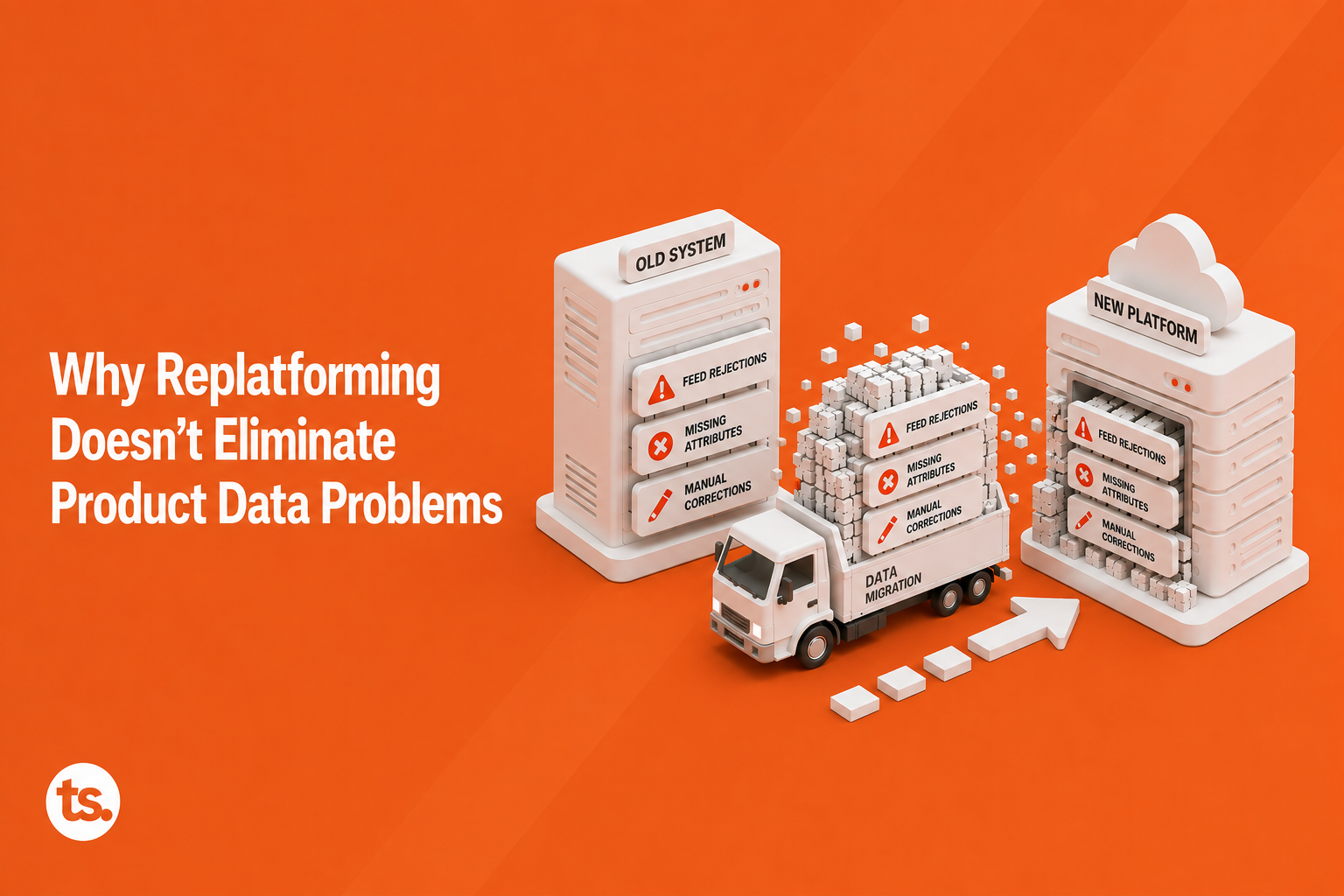
This is a situation most commerce teams recognize. A migration finishes, the platform goes live, and leadership assumes the difficult part is over.
Weeks or months later, someone is still exporting product feeds into spreadsheets before retailer submission deadlines, correcting attribute values manually, and uploading them again the same way they did before the migration.
The implementation project had already been signed off. The rollout finished on schedule, integrations were stable, and the data was sitting in the new platform.
But the operational correction work never really disappeared. It just carried forward into the new environment.
The question worth sitting with is why replatforming keeps producing the same operational friction, across different organisations, different platforms, and different migration projects.
How Product Data Problems Continue After a Successful Migration
It shows up across consumer goods, manufacturing, and retail. In organisations that have made significant platform investments and measured success at go-live, the migration finishes, the project closes, and teams usually find the same operational bottlenecks waiting for them once the day-to-day work resumes.
In most retrospectives, nobody names the reason clearly. Doing so would mean acknowledging that the platform was never really what needed fixing.
The migration addressed the operational problem leadership could see. Most of what sat underneath it stayed where it was.
Why Organisations Misdiagnose Product Data Problems as Platform Problems
When leadership approves a replatforming project, the question they believe they are answering is: why is our commerce operation not performing the way it should?
After months of internal review, vendor evaluation, and business case work, the answer that tends to emerge is that the platform is the limiting factor. Replace it, and things improve.
That logic holds together in most planning conversations. It also tends to be the wrong diagnosis.
The problems usually start showing up in familiar ways:
- Manual correction workflows that run before every major deadline
- Feed rejections that arrive without obvious explanation
- Product records that show different values depending on which system you look at
- Enrichment gaps that only surface three days before a campaign goes live
Most of these already exist long before the migration begins. Teams experience the friction through the platform first, so over time the platform becomes the thing organisations focus on fixing. But the underlying issues live in how product data has been maintained across teams and systems, often for years.
They tend to surface through things like:
- Attribute standards that were never aligned across departments
- Taxonomy that slowly stopped matching as different teams updated it independently
- Product records with no clearly defined ownership once they moved between platforms
- Governance decisions that never became part of how anyone actually worked day to day
After the migration finishes, teams often find they are still dealing with many of the same problems they had before. They are just happening inside a different system now.
Data Migration and Data Readiness Are Not the Same Thing
Data readiness has less to do with moving data and more to do with the condition the data is already in before the migration begins.
It comes down to questions like:
- Are governance rules defined across teams?
- Is ownership assigned clearly at the attribute and product-record level?
- Are taxonomies consistent across systems?
- Are product records complete enough to move through commerce workflows without constant manual correction?
- Can teams trust the data without revalidating it in a spreadsheet before every launch or retailer submission?
A migration can move data into a new platform successfully while most of those problems continue underneath it.
Data migration is the technical process of moving records from one system to another. Migration projects have timelines, milestones, and a formal completion process.
Data readiness rarely works that way.
One of these can be delivered by an implementation partner. The other has to already exist when the project begins, because the project itself does not create it.
Data migration moves product records into a new environment. Data readiness determines whether those records can actually work there without constant manual intervention.
Most migration projects focus heavily on the technical move itself. Very few spend the same energy fixing the operational condition of the data underneath it.
Because the implementation scope never required it, the gap usually goes unnoticed until it surfaces operationally. Which tends to happen at the worst possible moment.
Harvard Business Review's research on data quality found that completing a unit of work on flawed data costs around ten times what it costs when the data is accurate at source.
The system changes, but the teams handling the data usually end up carrying the same correction workload they had before. Manual attribute corrections, retailer feeds that still need reformatting by hand, enrichment gaps discovered days before a seasonal campaign. Each one carries that cost differential.
Why Replatforming Projects Miss Data Readiness Problems
Most replatforming implementations are delivered exactly as scoped. That is precisely why the data readiness gap survives them.
Implementation partners are responsible for what they agreed to deliver:
- Technical build
- Data migration
- Integration stability
- Platform configuration
- Getting to go-live
In the majority of replatforming projects, those things get done. The implementation closes cleanly because, against every deliverable in the statement of work, it succeeded.
The governance conversation is a different matter entirely.
Who owns which product record. What a complete attribute set looks like for a given channel. How taxonomy gets maintained consistently across systems once the project team disperses.
None of that tends to appear in the statement of work. It is not really an implementation question. It predates the platform decision and it will outlast it.
It is an operational question. In most projects nobody is accountable for answering it. Usually it gets left alone because nobody formally owns it inside the project.
Most replatforming projects are scoped to deliver technical outcomes. Data governance and ownership are the conditions that determine whether the new system performs operationally. They are almost never in scope.
PwC's 2024 survey of technology leaders found that 91% of CIOs identify data governance as among their top challenges for the next several years.
What that suggests is that the organisations actively making platform investments are largely the same ones that have not resolved the underlying governance question. Both things coexist until the operational reality makes the gap impossible to ignore.
Product teams, commerce teams, and data teams often carry genuinely different working definitions of what ready means:
- For product teams, ready means the information exists in the system
- For commerce teams, ready means the feed will pass retailer validation
- For data teams, ready means the record meets whatever completeness threshold the platform requires
Getting those definitions aligned takes a conversation that neither platform selection nor implementation tends to force. When it does not happen before go-live, the new system inherits the same coordination gaps the old one had.
How Poor Product Data Keeps Creating Operational Friction After Migration
The manual correction workflows that existed before a platform migration almost always continue after it. The conditions that created them were never addressed.
Attribute values still get corrected manually before retailer submission windows.
Feed rejections come in without obvious explanation. Each one needs individual investigation before anyone knows what caused it.
Enrichment gaps show up during campaign execution, when there is the least time and the highest cost to resolve them.
Taxonomy misalignment between systems persists because nobody established the reconciliation logic. It was assumed to exist rather than built.
Most of those projects did not fail because the technology broke. The problem was that the thing needing attention was never really the thing the implementation focused on solving.
The downstream effect extends beyond the project itself. The same product data that came through the migration becomes the foundation that subsequent initiatives must build on:
- Channel expansion
- New retailer relationships
- Personalisation programmes
- AI-related investment
All of it sits on top of whatever data foundation was inherited.
AI tools in commerce need data that is structured, governed, and reliable. Data that simply exists in a system is not the same thing.
Organisations currently trying to get AI-driven commerce capabilities working are often running into the data readiness question they deferred during the replatforming project. Now with more at stake and less flexibility about when it gets resolved.
The Data Readiness Question Every Organisation Should Ask Before the Next Platform Decision
Before the next platform evaluation gets underway, an upgrade, an expansion, or another business case taking shape, there is one question worth putting on the table before the vendor conversations start.
If your largest retail partner requested your complete, channel-formatted product data file tomorrow, no advance notice, no preparation time, could your team deliver it accurately, without manual intervention, within the hour?
Most commerce teams already know the honest answer before they finish reading it.
That answer usually tells you more about the state of the operation than the migration report ever will. Whether the data can perform reliably on demand, without someone intervening, is the measure that matters.
It is almost never the measure that appears on a project debrief slide.
Some organisations get to this question for the first time when the next platform evaluation is already underway. At that point it tends to open a different kind of conversation than the one that was planned, and probably one that should have happened before the last migration began.
ThoughtSpark works with enterprise data and commerce teams to identify where product data foundations break down and what it takes to build them properly before the next platform decision compounds the problem. If the patterns in this article feel familiar, the conversation worth having is about the data, not the platform.