
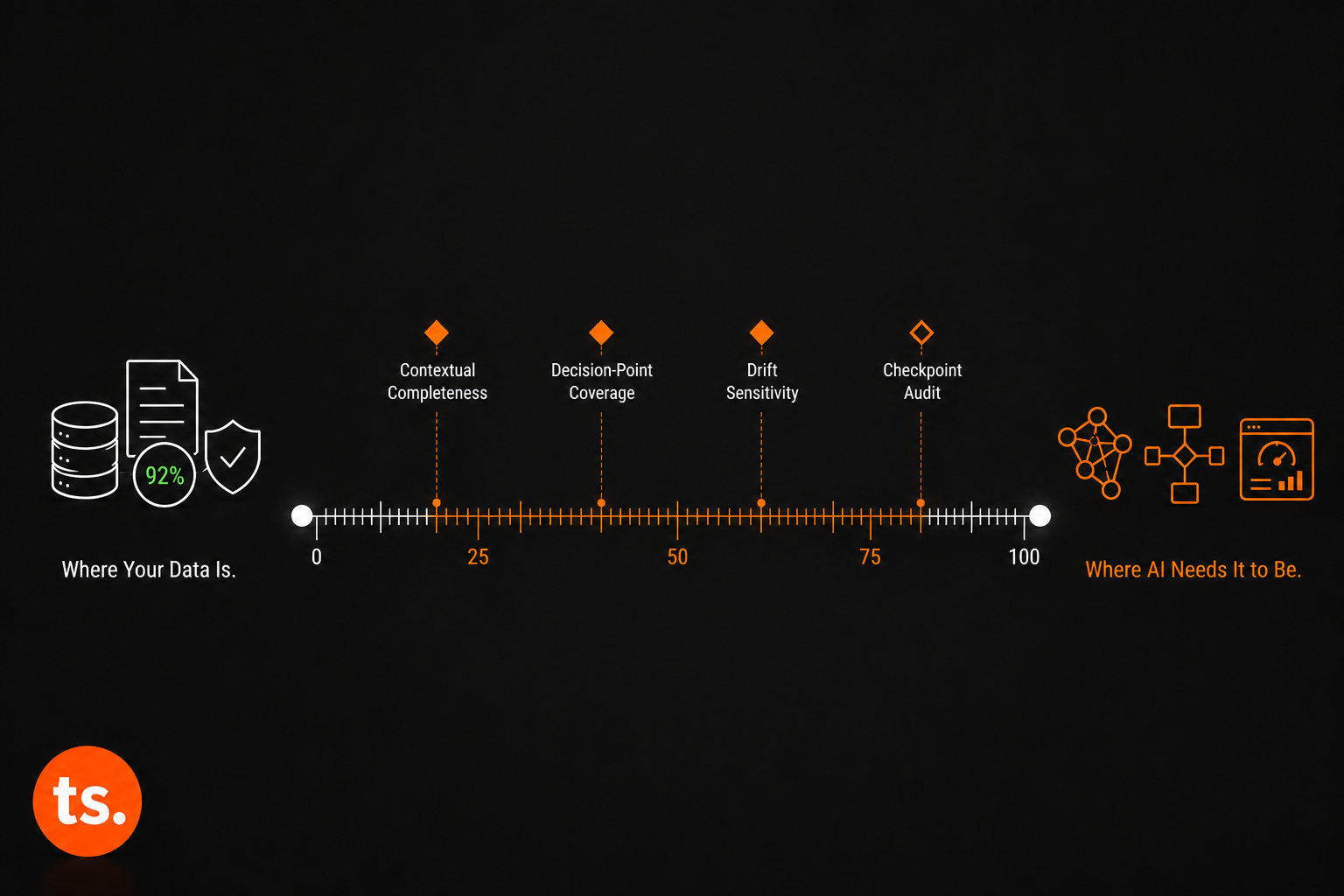
Every organization assessing data readiness for an AI initiative starts in the same place: the quality dashboard, the governance audit, the completeness report. These tools were built to answer one question: does the data meet the standards the current system requires?
Knowing the answer matters, and for an AI initiative, it is only the starting point.
An AI initiative needs to know whether the data can support the specific outputs the AI system will produce, in the specific context it will operate in, without the human judgment layer that used to compensate for what the data was missing. Standard readiness tools were built for a different consumption model.
The AI Readiness Gap Index was built for this one.
Key takeaways
- Most standard data readiness assessments were built to confirm that data meets internal quality standards. The AI Readiness Gap Index goes further, assessing whether data can support what the next AI initiative specifically demands.
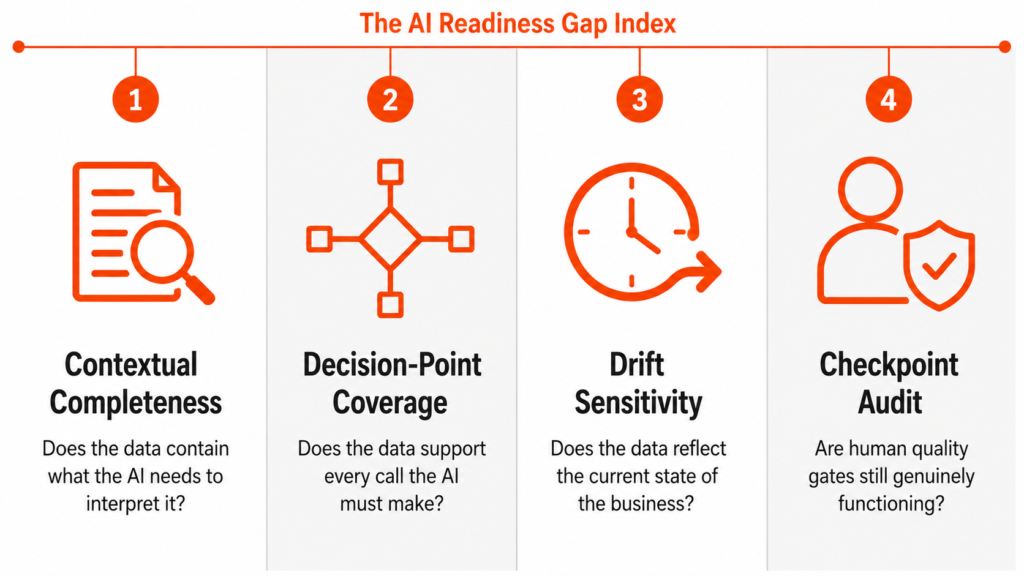
- The Index evaluates readiness across four dimensions that standard checks rarely cover: Contextual Completeness, Decision-Point Coverage, Drift Sensitivity, and Checkpoint Audit.
- The EDM Association's 2026 Global Data Management Benchmark found that only 31% of organizations have advanced data strategy capability, leaving most without the foundation required to support AI at scale.
- The Index is a structured set of questions the organization needs to answer before committing to an AI initiative timeline, producing a gap assessment rather than a score.
- Genuine AI readiness changes every time the consumption model changes. The Index should be applied before every significant AI initiative and reassessed at every material change.
Why Standard Readiness Assessments Leave a Gap
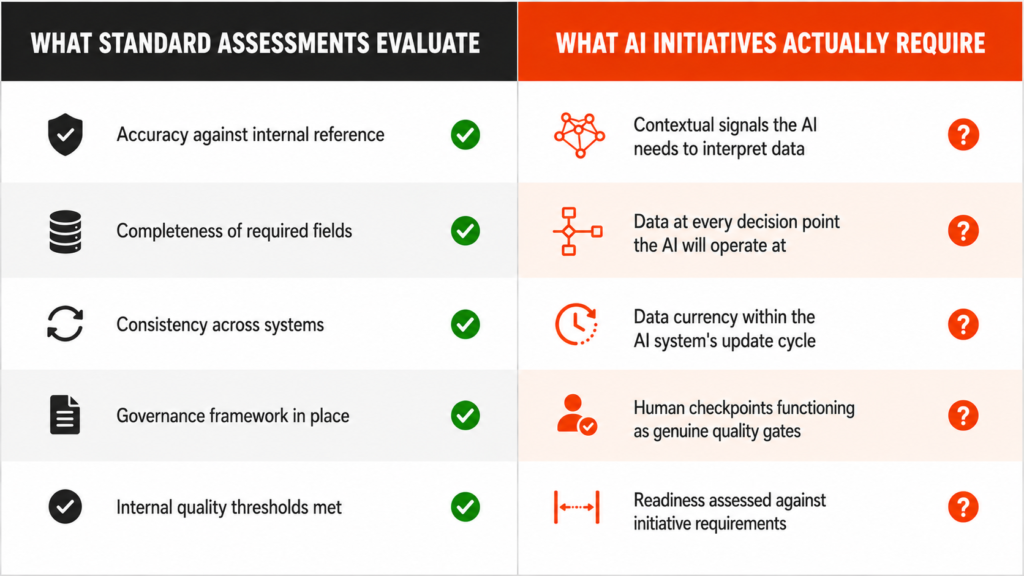
Standard data readiness assessments were designed for a specific consumption model, one where data moves through a system, gets reviewed by a person, and that person's judgment fills the gaps between what the rules enforce and what the business actually needs. In that model, evaluating accuracy, completeness, and consistency against internal thresholds is sufficient because the human reviewer compensates for whatever the data is missing by applying context, pattern recognition, and domain knowledge.
AI operates without that compensation layer. When an AI system consumes data, it acts on what it sees without the contextual judgment the human reviewer used to supply. A completeness check sufficient for human review may be insufficient for AI consumption, because the data can meet every internal standard while missing the contextual signals, decision-point coverage, data currency, and checkpoint validation the AI system needs to produce a reliable output.
Most organizations discover this gap after committing to an AI initiative timeline, because the readiness assessment they applied was designed to confirm that internal standards are met, which is a meaningful but incomplete measure of what AI consumption specifically requires.
The scale of this problem is confirmed by the EDM Association's 2026 Global Data Management Benchmark, the most comprehensive cross-industry data management capability assessment available, covering 435 organizations across more than 50 countries. The benchmark found that only 31% of organizations have advanced data strategy capability, leaving most operating in the Developmental or Defined capability ranges and without the foundation required to support AI at scale. Across nearly all data management components, AI investment is outpacing data readiness.
"AI investment is outpacing data readiness. Only 31% of organizations have advanced data strategy capability, leaving most without the foundation required to support AI at scale."
— EDM Association, 2026 Global Data Management Benchmark Report
The gap is structural. Standard assessments answer the right question for internal data management and an incomplete one for what an AI initiative specifically demands. The AI Readiness Gap Index was built to answer the complete question.
What Is the AI Readiness Gap Index?
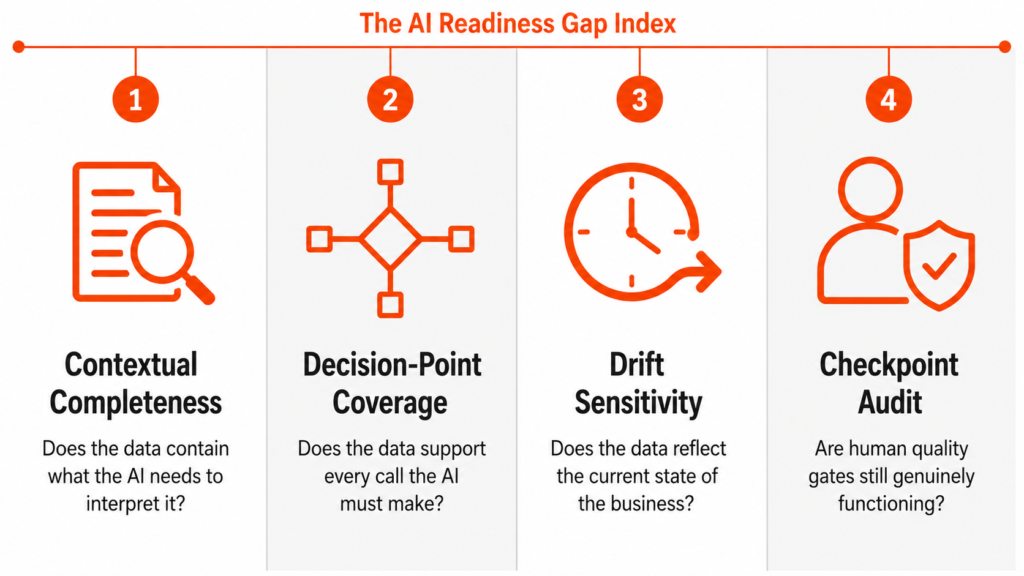
The AI Readiness Gap Index is a four-dimension framework for assessing the specific distance between where an organization's data currently performs and where the next AI initiative needs it to perform.
The Index was built to answer four questions that standard readiness tools do not address:
- Does the data contain the contextual signals the AI system needs to interpret what it is seeing?
- Does the data at every workflow decision point contain enough for the AI to make the call a human used to make?
- Does the data reflect the current state of the business within the AI system's update cycle?
- Are the human checkpoints in the workflow functioning as genuine quality gates?
A data quality audit evaluates whether data meets internal standards, covering accuracy, completeness, and consistency against thresholds the organization has defined. A governance assessment evaluates whether frameworks, ownership structures, and policies are in place. The Index sits alongside both of these, evaluating the specific gap between where data performs today and what the next AI initiative requires of it.
The Index produces a gap assessment. It identifies where the gaps are, how significant they are for the specific initiative being planned, and what it would take to close them before the initiative commits to a timeline that assumes they do not exist.
"The AI Readiness Gap Index assesses the specific distance between where an organization's data currently performs and where the next AI initiative needs it to perform, across four dimensions that standard readiness checks do not evaluate."
— ThoughtSpark
The four dimensions are Contextual Completeness, Decision-Point Coverage, Drift Sensitivity, and Checkpoint Audit. Each addresses a specific type of gap that standard assessments do not detect and that AI initiatives consistently encounter after committing to timelines that assumed the data was ready.
Contextual Completeness: What It Measures and Why It Matters for AI
How Contextual Completeness Is Measured
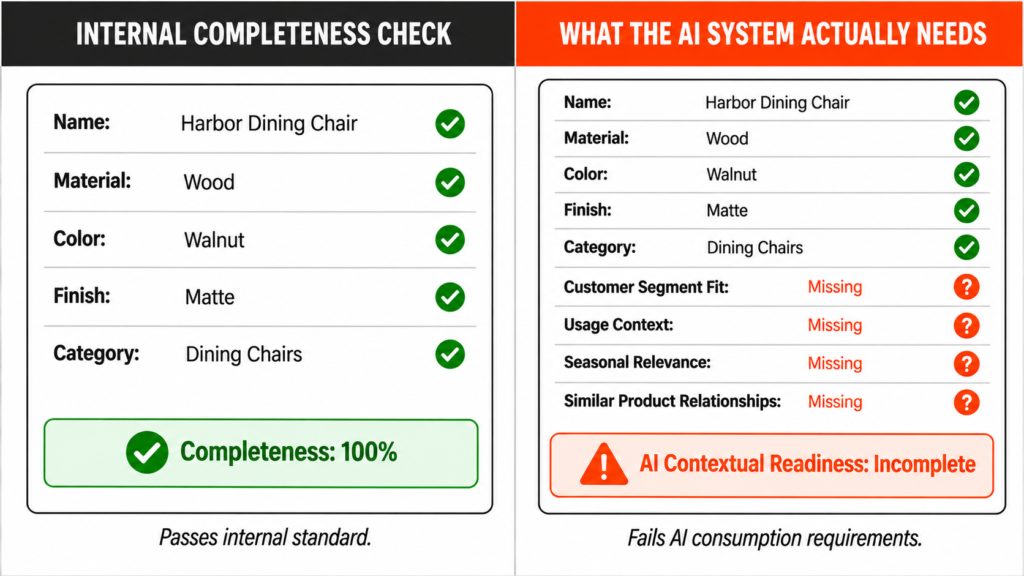
Contextual completeness measures whether data contains the signals an AI system needs to interpret what it is seeing, evaluated against what the AI will consume rather than against what the internal system requires to be populated.
What Standard Assessments Check Instead of Contextual Completeness
Standard completeness checks evaluate whether mandatory fields contain values. A product record is complete if the required fields are populated. A customer record is complete if the required attributes are present. These checks confirm that the data meets the internal standard, and that standard was defined based on what the internal system requires to process the record, not based on what an AI system needs to produce a reliable output from it.
Why Contextual Completeness Matters Specifically for AI
AI systems need more than populated fields. They need the contextual signals that tell them how to interpret what they are seeing, including the relationships between attributes, the historical patterns that establish what normal looks like, and the categorical context that determines whether a value is appropriate for the specific situation being processed.
A product record can be 100% complete against internal thresholds and still be missing the attributes an AI personalization engine needs to make the right recommendation for a specific customer segment, because the internal threshold was defined for a human reviewer who would supply that context from memory.
The contextual completeness gap is particularly significant because it is invisible to standard assessment tools. The completeness score looks healthy while the AI outputs diverge from what the business expected, and the connection between the missing context and the divergent output is difficult to trace because the data technically met the standard it was assessed against.
Diagnostic Question: Contextual Completeness
Does the data contain the specific attributes, relationships, and contextual signals the AI system will consume when making recommendations, classifications, or decisions, evaluated against what the AI requires rather than against what the internal system requires to be populated?
What a Contextual Completeness Gap Looks Like Operationally
- An AI recommendation engine surfaces the same recommendations regardless of customer segment because the data lacks the segment-specific contextual attributes that would differentiate them
- A classification model consistently misclassifies edge cases because the training data contains the required fields but not the contextual signals that distinguish edge cases from standard cases
- A generative AI system produces outputs that are factually correct but contextually inappropriate because the data meets internal quality standards while lacking the relationship and context data that would make outputs situationally relevant
Decision-Point Coverage: What It Measures and Why It Matters for AI
How Decision-Point Coverage Is Measured
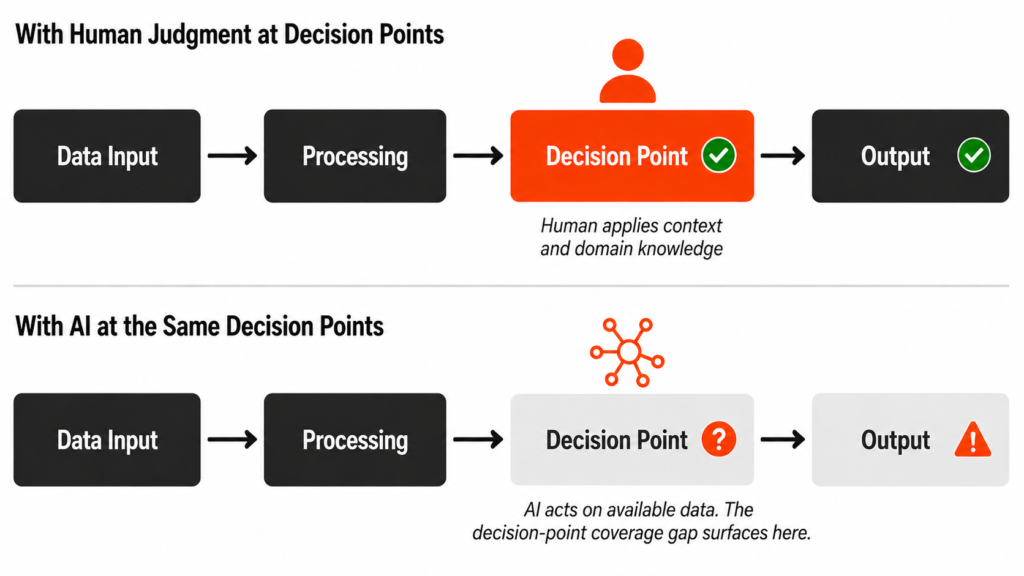
Decision-point coverage measures whether the data at every point in the workflow where a human used to apply judgment contains enough information for the AI to make the same call reliably.
What Standard Assessments Check Instead of Decision-Point Coverage
Standard readiness assessments evaluate data at the aggregate level, covering overall accuracy, completeness, and consistency across the dataset. They do not map the specific points in the workflow where judgment was applied before the output moved forward, and they do not evaluate whether the data at those specific points is sufficient for the AI to replicate that judgment.
Why Decision-Point Coverage Matters Specifically for AI
Every workflow that AI is being applied to has points where a human used to look at what the system produced and make a decision before the output moved forward. Some of those decision points were formal and documented, while many were informal, operated by a person who knew enough about the business to know when something looked wrong and who would flag it before it caused a downstream problem.
When AI replaces or accelerates that workflow, those decision points still exist structurally while the human judgment that used to operate them does not. The AI reaches the same point in the workflow and makes the call based on what the data contains. When the data at that point is insufficient for the AI to make the call the human would have made, the AI makes a different call, and the standard readiness assessment never evaluated whether that would happen.
Decision-point coverage assessment requires mapping the workflow before evaluating the data, identifying every point where judgment was applied before the output moved forward, and then evaluating whether the data at each of those points is sufficient for the AI to make the same call reliably.
Diagnostic Question: Decision-Point Coverage
Have you mapped the points in the workflow where a human used to apply judgment before the output moved forward, and evaluated whether the data at each of those points contains enough information for the AI to make the same call reliably?
What a Decision-Point Coverage Gap Looks Like Operationally
- An AI system processes standard cases correctly and consistently makes the wrong call in edge cases because the data at those decision points does not contain the signals that allowed the human reviewer to recognise them
- A content generation model produces outputs that are structurally correct but commercially inappropriate because the data available at the point between generation and publication does not encode the business context a human reviewer used to apply there
Drift Sensitivity: What It Measures and Why It Matters for AI
How Drift Sensitivity Is Measured
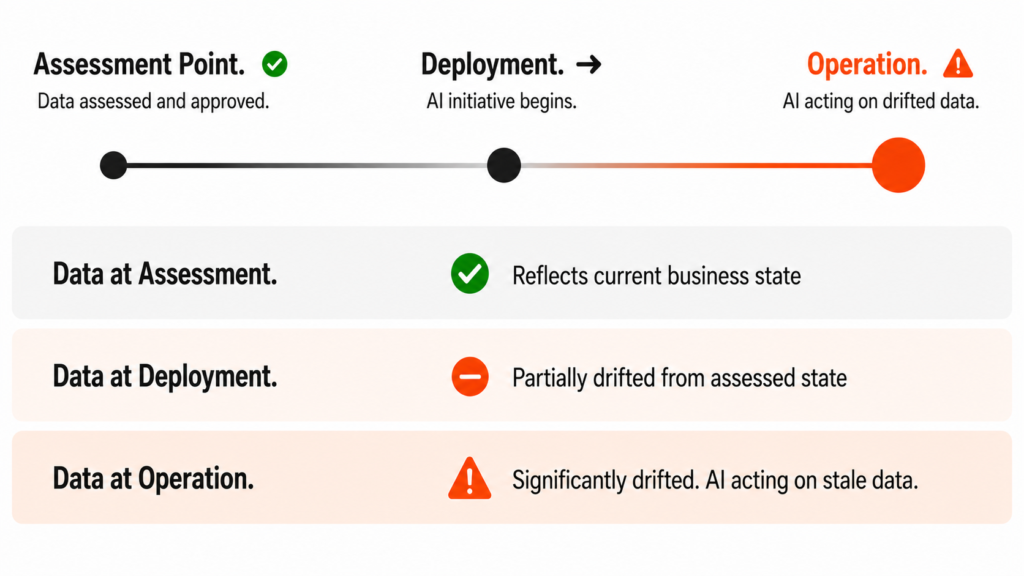
Drift sensitivity measures how quickly data moves away from the state in which it was assessed relative to the AI system's update cycle, and whether that drift creates a gap between what the AI is working with and what the business currently looks like.
What Standard Assessments Check Instead of Drift Sensitivity
Standard readiness assessments evaluate data at a point in time. The data is assessed, the standard is met, and the initiative proceeds on the assumption that the data will remain in a sufficiently similar state.
In human-reviewed workflows this assumption was manageable because the reviewer notices when something looks different from what it did before and adjusts their judgment accordingly. AI systems continue operating on the data as it was at the point of assessment, with the gap between that state and the current state of the business growing silently while the outputs continue to look correct.
Why Drift Sensitivity Matters Specifically for AI
AI systems make significantly more decisions per unit of time than human reviewers, which means the compounding effect of operating on drifted data is larger and less visible. Data drift that introduces a manageable level of error across ten human decisions a day introduces a materially different level of error across ten thousand AI decisions a day, and that drift may be invisible in the quality dashboard because the data still meets the standard it was assessed against at the last assessment point.
Diagnostic Question: Drift Sensitivity
How quickly does your data drift from the state in which it was last assessed, and does that drift happen faster than your AI system's update cycle can compensate for?
What a Drift Sensitivity Gap Looks Like Operationally
- An AI pricing model begins consistently underperforming against market conditions three months after deployment because the market data it was trained on reflected conditions that have since changed and the model's update cycle is quarterly
- A customer segmentation model produces increasingly inaccurate segment assignments over time because customer behavior data drifts faster than the model retrains, and the drift is invisible in the quality dashboard because the underlying data still meets the completeness and accuracy standards it was assessed against when the model was deployed
Checkpoint Audit: What It Measures and Why It Matters for AI
How Checkpoint Audit Is Measured
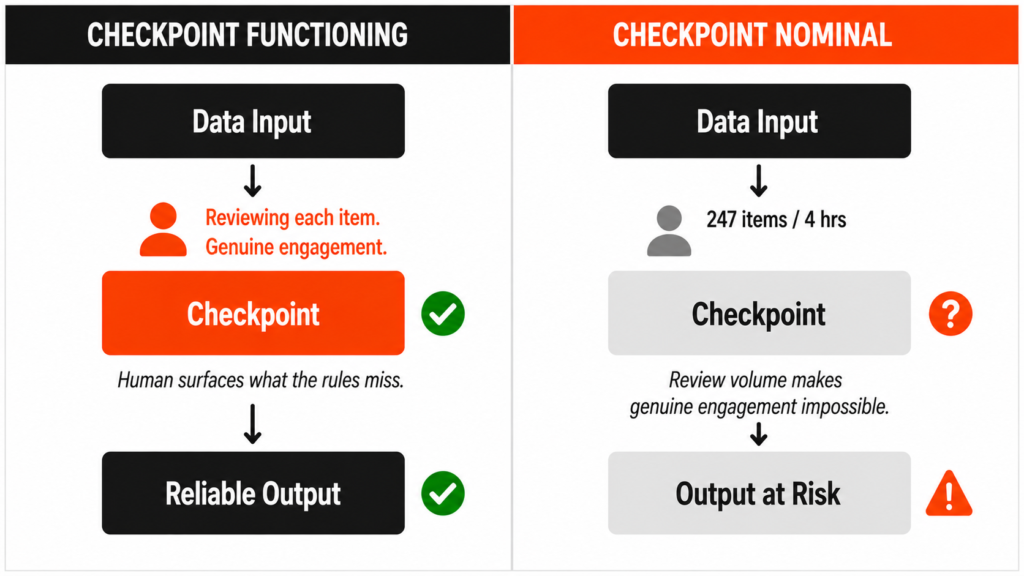
Checkpoint audit evaluates whether the human judgment that used to surface what the rules missed is still functioning in the workflow as a genuine quality gate, assessed against actual review capacity rather than against whether the checkpoint position exists on paper.
What Standard Assessments Check Instead of Checkpoint Audit
Standard readiness assessments evaluate the data. They do not evaluate the process the data moves through or the human judgment that used to operate at critical points in that process. A checkpoint that exists on paper, where a named person is documented as the reviewer, satisfies a governance assessment regardless of whether that person has the time, volume capacity, and authority to genuinely review each item.
Why Checkpoint Audit Matters Specifically for AI
Every data workflow has points where a human used to look at what the system produced and apply something the system could not supply independently: domain knowledge, business context, and pattern recognition built from experience with the data. These checkpoints were rarely documented as formal quality control steps. They existed because the people running the workflow knew enough to know when something was wrong, and they caught things before those things became problems.
When AI enters the workflow, these checkpoints change in one of two ways:
- The person is removed from the process on the assumption that the AI makes the checkpoint unnecessary
- The person remains but is asked to review so many outputs so quickly that the review becomes a formality rather than a genuine evaluation
In both cases, the checkpoint stops functioning as the quality gate it used to be. A checkpoint that processes approvals faster than genuine per-item review could take is functioning as an approval stamp regardless of what the process documentation says, and the data quality it was supposed to protect has no effective quality gate between it and the AI output.
Diagnostic Question: Checkpoint Audit
Where in the workflow did a person used to surface what the rules missed, is that person still in the process, and if they are, are they genuinely reviewing or nominally approving?
What a Checkpoint Audit Gap Looks Like Operationally
- An AI content moderation system begins allowing outputs that a human reviewer would have flagged because the reviewer who used to catch contextually inappropriate content is now reviewing AI outputs at a volume and pace that makes genuine engagement with each output impossible
- A data enrichment process begins producing records with values that are technically valid but operationally incorrect because the person who used to notice when a supplier's data conflicted with the business's own understanding of the product has been moved to a different role and the enrichment now runs without that contextual check
How to Apply the Index Before Your Next AI Initiative
The Index is applied to the relationship between the data and the specific initiative being planned, which means the first step is always defining what the initiative requires before evaluating whether the data delivers it.
Step 1 — Define the initiative's specific data requirements.
Before assessing the data against any dimension, document what the AI initiative will specifically do with the data:
- Which attributes it will consume
- Which decision points it will operate at
- How frequently the data needs to reflect the current state of the business
- Where in the workflow human judgment used to function as a quality gate
This definition becomes the standard against which the four dimensions are assessed. Without it, the assessment defaults to internal standards that were designed for a different purpose.
Step 2 — Apply the four dimensions against those requirements.
For each dimension, evaluate the data against what the initiative specifically requires:
- Contextual Completeness: does the data contain the signals this AI system needs, evaluated against what the AI will consume?
- Decision-Point Coverage: does the data at each decision point contain enough for this AI to make the call a human used to make?
- Drift Sensitivity: does the data currency match what this AI system needs at the pace it will operate?
- Checkpoint Audit: are the quality gates this workflow depends on still functioning as genuine gates?
Step 3 — Identify the gaps.
For each dimension where the data does not meet what the initiative requires, document:
- What is missing
- How significant the gap is for this initiative's specific use case
- What it would take to close it
Gaps vary in significance by initiative type. A drift sensitivity gap matters more for a real-time recommendation engine than a quarterly reporting model. A checkpoint audit gap matters more for a high-stakes decision workflow than a low-stakes classification task.
Step 4 — Decide.
With the gaps identified and sized, the organization faces a genuine decision:
- Close the gaps before committing to the initiative timeline
- Accept the gaps and plan explicitly for their operational consequences
- Restructure the initiative to operate within the data's current capabilities
Making this decision with full awareness of the gaps, before the timeline is committed, is significantly less expensive than making it after.
The most important output of the AI Readiness Gap Index is the decision the organization makes with full awareness of the gap, before the initiative timeline assumes the gap does not exist.
When to Reassess Your AI Readiness Gap Index Assessment
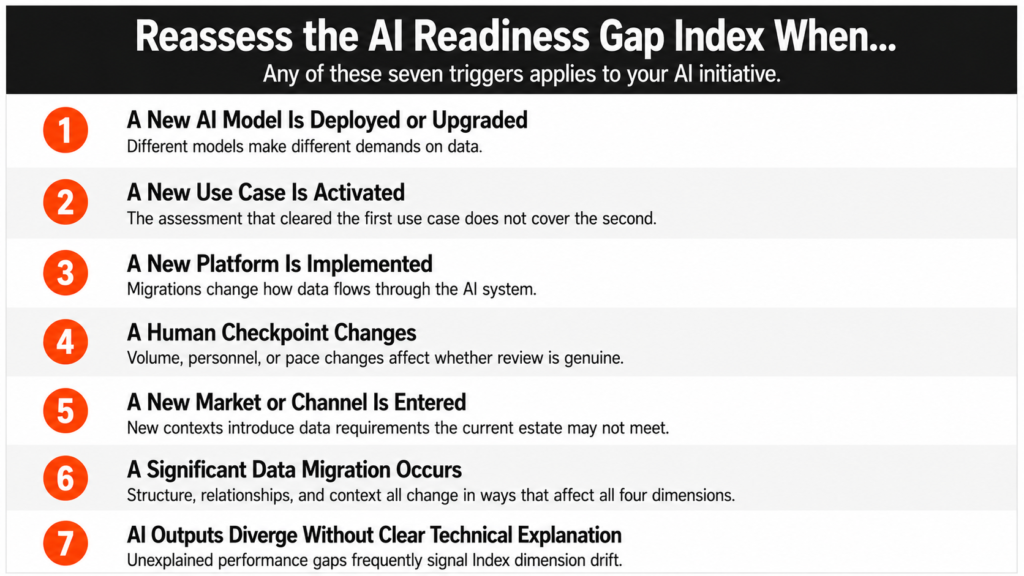
Genuine AI readiness changes every time the relationship between the data and the AI system that consumes it changes materially. Seven specific triggers should prompt a new Index assessment:
- A new AI model is deployed or upgraded. Different models make different demands on data. A model upgrade that improves performance on one task dimension may expose gaps in data dimensions that the previous model was less sensitive to.
- A new use case is activated. An AI system deployed for one use case may be extended to a second that makes different data demands. The readiness assessment that cleared the first use case does not automatically clear the second.
- A new platform is implemented. Platform migrations change how data is stored, processed, and accessed, affecting how data flows through the AI system. A dataset that was contextually complete on the previous platform may be missing signals on the new one.
- A human checkpoint changes. When the person operating a checkpoint is replaced, when review volume increases significantly, or when the approval process is accelerated, the checkpoint audit dimension should be reassessed. The checkpoint may have been functioning as a genuine quality gate before the change and be functioning nominally after it.
- A new market or channel is entered. New markets and channels introduce data requirements the existing data estate may not meet. The Index should be applied to the new context before the AI system is extended to operate in it.
- A significant data migration or transformation occurs. Data migrations change the structure, relationships, and context of data in ways that affect all four Index dimensions. Completeness checked before a migration may not reflect completeness after it.
- AI outputs begin diverging from expected performance without a clear technical explanation. Unexplained performance degradation in an AI system frequently signals that one or more Index dimensions have drifted since the last assessment. The Index should be applied before concluding the problem is in the model.
Before your next AI initiative commits to a timeline that assumes the data is ready, the conversation worth having is whether the readiness assessment applied to reach that assumption was designed for what AI actually requires.
That is the conversation ThoughtSpark helps enterprise data and AI teams have through the AI Readiness Gap Index, identifying the specific gaps between the data's current performance and the initiative's actual requirements, and building the path to close them before the initiative depends on data that was never assessed for what it will be asked to do.