

Did you know that 8 out of 10 data management programs are predicted to fail by 2027?
Not the ones run by companies that did not care. Not the ones that ran out of money halfway through. The ones with full budgets, experienced teams, and leadership that genuinely wanted it to work.
Take a moment with that number. Eight out of ten.
Now think about your own program. The meetings you sat through. The vendor you selected. The go-live everyone celebrated. And ask yourself honestly: looking back, did it deliver what was promised?
Because here is what nobody tells you before you start. MDM does not fail the way most technology programs fail. There is no crash. No error message. No moment where someone walks in and says it is over. The platform keeps running. Reports keep generating. Everything looks operational on the surface. But underneath, the business has quietly stopped trusting the data. Teams have gone back to their own spreadsheets. And the work that took eighteen months and significant budget is being ignored by the very people it was built for.
By the time anyone admits something went wrong, months of damage have already accumulated.
This article covers the eight MDM failure reasons it happens, where they start, why they are so easy to miss, and what the programs that actually deliver do differently.
What Is MDM and Why Does It Fail So Often?
Master Data Management (MDM) is the discipline of deciding which version of your data is the right one and making sure every system in your organization agrees on it.
Think about how many places your organization stores a customer name right now. Your CRM has one version. Your billing system has another. Your support platform has a third. Each one was updated at a different time by a different team. None of them fully match. And when someone needs to make a decision based on that customer, they have to guess which version to trust.
That is the problem MDM exists to solve. One version. Every system. No guessing.
But here is what surprises most people. The hardest part of MDM has nothing to do with technology. It never did.
In 2024, Gartner put a number on what data leaders have quietly known for years: by 2027, 80% of data and analytics governance initiatives will fail, and the primary reason is not technology. It is that governance never gets connected to tangible business outcomes (Gartner: 80% of D&A Governance Initiatives Will Fail by 2027). MDM is one of the most governance-dependent programs an organization can run. When governance fails, MDM fails with it.
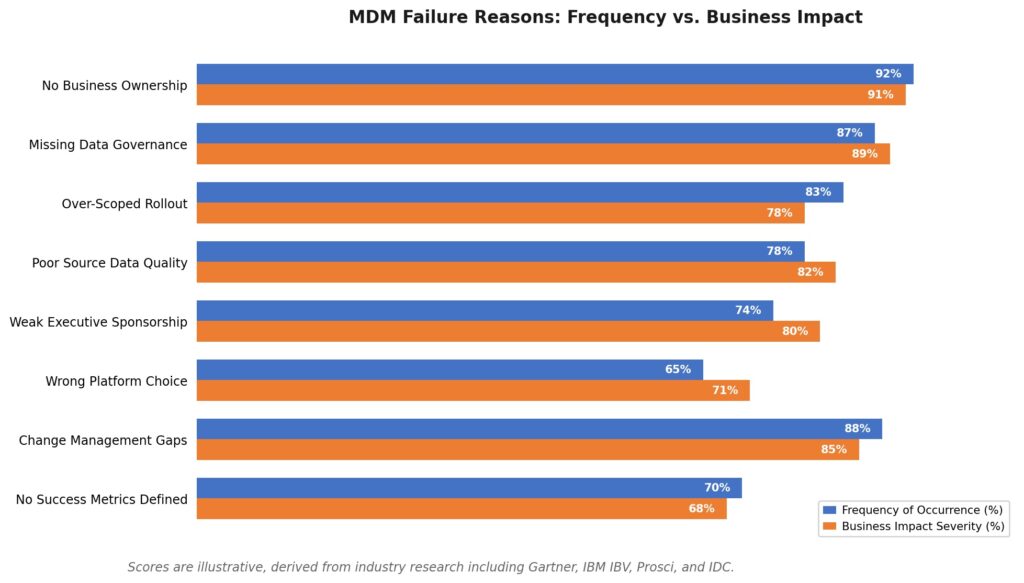
The eight MDM failure reasons below are really eight versions of the same story. An organization that underestimated what MDM actually demands from a business.
A Pattern Most Teams Recognize
You have probably seen this play out. Maybe in your own organization. Maybe somewhere you worked before. A significant budget gets approved. The implementation runs for over a year. Go-live happens. And then, slowly and without any single dramatic moment, the business stops using it.
The platform is still running. The data is in there. But your colleagues are back on spreadsheets. Nobody trusts the golden record. And the question nobody wants to answer out loud: what actually went wrong?
Here is the honest answer. The technology worked fine. It almost always does. What failed was the set of decisions made before the technology was ever switched on. Ownership decisions. Governance decisions. Change decisions. The kind that feel procedural at the time but turn out to be the ones that mattered most.
The eight reasons below are where those decisions go wrong. They are not random. They follow a pattern. And once you see the pattern, you will recognize it everywhere.
8 MDM Failure Reasons That Consistently Sink Programs
MDM failure reasons are surprisingly predictable. You would think a global bank would have different struggles than a mid-size retailer, but the gaps are almost identical. The context changes, but the underlying friction never does.
1. MDM Treated as an IT Project
Why does MDM fail when business ownership is absent?
This is where most programs lose before they begin. And it is the most widespread of all MDM failure reasons.
Leadership approves MDM. It gets handed to IT because IT handles systems. IT builds it, configures it, and delivers it on time. Everyone celebrates go-live.
And then six months later, someone in your sales team is still working off their own spreadsheet. Someone in finance is updating customer records their own way. Someone in marketing is pulling data from a source nobody else recognizes. The MDM hub is running quietly in the background with data that nobody fully trusts.
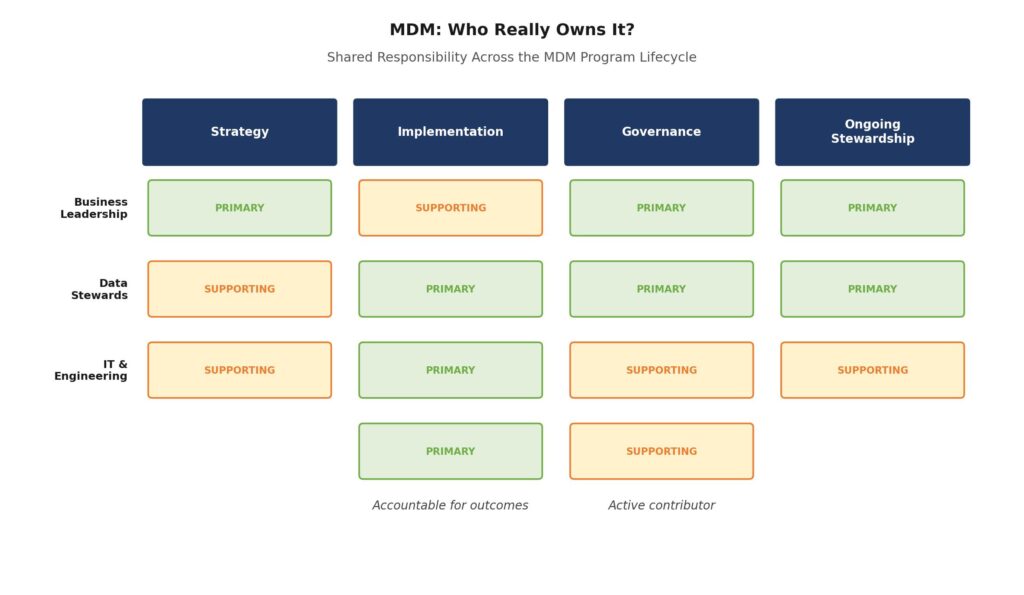
That is not an IT failure. IT delivered exactly what they were asked to deliver. The failure is that nobody in the business was ever made responsible for the data itself. MDM needs a business owner. Not a department. Not a committee. A named person whose job it is to care whether the data is right. Without that, the golden record has no one defending it.
Fix:
Before implementation starts, put a name against every data domain. Not a department. Not a team. A person. Someone whose job it is to care whether that data is right.
2. Launching Without a Data Governance Framework
What happens when MDM goes live without governance in place?
Once you have named your data owners, the next question your team will almost certainly skip is: what are the actual rules?
Governance gets pushed in every program. There is always something more urgent. The platform needs configuring. The integrations need mapping. And governance feels like paperwork. So it gets scheduled for later. Later becomes after go-live. And six months after go-live, your data is a mess again. Duplicate records. Your CRM saying one thing, your billing system saying another. Nobody sure which version to trust or who to call about it.
It does not need to be a 50-page policy document. Governance is really just answering the questions that are going to come up anyway. Who in your organization gets to create a master record. Who approves a change to it. What happens when two of your systems disagree. Leave those questions open and every team around you will invent their own answer. And that inconsistency will not stay contained. It will spread.
Fix:
Treat governance as a workstream inside the MDM program. Define ownership, stewardship roles, quality rules, and escalation paths before configuration begins. Run governance design alongside platform setup, not as an afterthought.
A practical governance framework covers these five components:
| Governance Component | What It Covers |
| Data Ownership | Named business owner accountable for quality outcomes per domain |
| Stewardship Roles | Day-to-day monitoring, exception handling, and record management |
| Policy Definition | Rules for creating, modifying, and retiring records |
| Quality Standards | Measurable benchmarks: completeness, accuracy, consistency |
| Escalation Path | How data disputes get raised, reviewed, and resolved |
3. Trying to Govern Everything at Once
Why do MDM programs fail when teams try to do too much at once?
Here is where ambition becomes the enemy.
Your leadership approved MDM. There is budget. There is momentum. And someone in the room says: while we are at it, let us fix customers, products, suppliers, and employee data all at once.
That decision feels like efficiency. What it actually does is guarantee that 18 months later, none of it is finished. Every domain you add slows every other domain down. Dependencies multiply. The team gets stretched across too many fronts. One day someone asks what has been delivered and the honest answer is: nothing production-ready yet.
One domain done completely and trusted by the business is worth more than five domains that are technically live but practically ignored. That first working domain is also your proof. The most persuasive argument for continued investment is a functioning MDM domain the business actually uses. That is how MDM programs build momentum rather than lose it.
Fix:
Pick one domain. The one keeping your CDO up at night or costing the most in rework. Deliver it end to end. Let it prove what good MDM looks like inside your organization. That is worth more than any program update deck when the next budget conversation comes around.
4. Assuming MDM Will Fix Source Data Quality
What data quality problems should you fix before MDM implementation?
This one catches almost everyone off guard, usually around month eight.
How clean is your data right now? Not the data you plan to have after MDM. The data sitting in your systems today, before a single integration is built.
Most teams do not check until it is too late. They migrate years of customer records, product entries, and supplier information into the new hub and then discover that the duplicates, the missing fields, the records nobody updated since 2019, all came with them. The platform does its best with what it receives. The output looks tidier. The underlying problems are still there, now with a golden record label attached.
Gartner puts the average annual cost of poor data quality at $12.9 million per organization (Gartner: The Financial Impact of Poor Data Quality, via IBM). That cost does not disappear when data moves into an MDM hub. It just becomes your MDM program's problem. And this is one of the MDM failure reasons that is entirely preventable, but only if you look before you leap.
Fix:
Before a single integration is mapped, run a full data profiling exercise across every source system. Find out what you actually have, not what the system owners think they have. Budget for remediation. Assign an owner for it. Going into MDM with unresolved data quality issues is like renovating on a cracked foundation.
| Data Domain | Common Quality Issues | Remediation Owner |
| Customer | Duplicates, missing fields, format inconsistencies across systems | Data Steward / CRM Owner |
| Product | Naming mismatches, incomplete specifications, orphaned records | Product Master Owner |
| Supplier | Duplicate vendors, inactive records, no standard identifier | Procurement Lead |
| Employee | Department mismatches, stale records, conflicting system entries | HR Data Owner |
Data Quality Readiness: Common issues by domain before MDM implementation
5. Executive Sponsorship That Fades After Launch
How does loss of senior sponsorship derail an MDM program?
You can have ownership, governance, a focused scope, and clean data going in. And still watch the program slowly lose momentum if the right person stops paying attention.
Think back to the last time a key stakeholder left your organization mid-program. What happened to the things they owned?
In MDM, that moment is often the beginning of the end. The person who fought for the budget, who kept departments aligned, who resolved the arguments nobody else could, is gone. And suddenly your data ownership decisions are sitting in someone's inbox with no one senior enough to move them forward. Meetings get skipped. Deliverables slip. Team members quietly redirect their energy to projects where accountability is clearer.
It looks like a resourcing problem from the outside. Underneath it is a governance problem. The program was built around a person, not a structure. And that is one of the MDM failure reasons that is hardest to see coming until it is already too late.
Fix:
Set up a data governance council where senior business leaders meet on a fixed cadence, not to receive updates but to make decisions. Connect MDM outcomes to the metrics those leaders are already measured on: data accuracy in financial close, customer record reliability in sales forecasting, supplier consistency in procurement. Build a reporting rhythm that surfaces risks and progress before they become surprises.
6. Choosing the Wrong MDM Platform
What makes platform selection a common MDM implementation failure?
Even with the right foundation in place, one decision can quietly undermine everything else.
The vendor demo was impressive. The platform handled everything they showed you. What they showed you, though, was their environment, their data, their best-case scenario.
Six months into your implementation, the gaps appear. Integrations described as straightforward are anything but. Customizations are piling up. The costs in the original business case look nothing like the actual invoice. And switching platforms now means starting over with the budget half spent.
Most platform decisions get made for the wrong reasons. An analyst ranking. A vendor relationship that already exists. A demo that looked impressive but had nothing in common with your actual data landscape. Picking the wrong platform is an MDM failure reason that stays with your program for years, as a slow and expensive friction that limits everything you try to do with it.
Fix:
Define your use cases, integration requirements, team capabilities, and realistic growth trajectory before engaging vendors. Run a proof of concept with your own data in your own environment. Evaluate total cost of ownership honestly. The platform that fits your context will outperform a prestigious one that does not.
| Evaluation Criteria | Key Question to Ask |
| Use Case Fit | Does it handle your primary domain natively, without heavy customization? |
| Integration | How does it connect to your ERP, CRM, cloud platforms, and data pipelines? |
| Scalability | Can it grow with your data volume, domains, and user base over time? |
| Total Cost of Ownership | What are the full costs: licensing, implementation, support, and operations? |
| Implementation Load | What internal skills, external expertise, and timeline does it realistically require? |
| Vendor Support | What does post-go-live support, SLAs, and the product roadmap look like? |
7. Underinvesting in Change Management
Why do employees resist MDM after go-live?
You have the ownership. The governance. The right scope. Clean data. Senior sponsorship. The right platform. And the program still fails to deliver value. This is where change management comes in, and this is the one most organizations consistently underestimate.
Your sales team did not ask for MDM. Your finance team did not design it. Your operations team found out about it three weeks before go-live. And now you are wondering why nobody is using it.
People do not resist change because they are difficult. They resist it because nobody brought them along. A two-hour training session the week before launch is not change management. It is a checkbox.
Prosci found that programs with excellent change management are seven times more likely to meet their objectives (Prosci: The Correlation Between Change Management and Project Success). Skipping it is one of the most expensive MDM failure reasons on this list, because you only find out the cost after the platform is already live.
Fix:
Build a change management workstream into the program plan from the beginning, not as a phase that follows go-live. Assign a change lead. Map impacted roles and design interventions specific to each. Set adoption metrics alongside technical delivery metrics and track both with equal rigor.
8. No Success Metrics Defined Before Implementation
How does the absence of KPIs contribute to MDM program failure?
And this is the one that makes all the others invisible.
Imagine your CFO asks you today: what has MDM delivered? Can you answer that with a number? Not a feeling. Not a project update. An actual before and after comparison.
Most teams cannot. Because nobody captured the baseline before the work started. The duplicates that existed before MDM. The average time it took to resolve a data conflict. The error rate in downstream reports. Without those numbers, you cannot prove improvement even when the improvement is real. And when you cannot prove improvement, the budget gets questioned. The program did not fail. Nobody measured whether it succeeded.
IDC research found that data mature organizations achieve 2.5x better business outcomes than those still finding their footing (IDC: How Data Maturity and Product Analytics Improve Business Outcomes). That kind of result does not happen by accident. It happens because someone decided to measure from the start. Not measuring is one of the MDM failure reasons that only hurts you later, when the questions get harder to answer.
Fix:
Define success metrics in the program charter before implementation starts. Capture a baseline. Build a reporting cadence into the program operating model. Stakeholders who see measurable progress stay invested. Those who cannot see progress find other priorities.
| Metric | What It Measures | Target Direction |
| Duplicate Record Rate | Percentage of duplicate master records per domain | Decrease over time |
| Data Completeness | Critical attributes populated per record | Increase over time |
| Exception Resolution Time | Average time to close a data quality exception | Decrease over time |
| Golden Record Confidence | Platform confidence score assigned per record | Increase over time |
| Downstream Accuracy | Customer match rate, order accuracy, report reliability | Improve vs. baseline |
Key Takeaways
Eight MDM failure reasons. Almost none of them technical. All of them connected.
Look at the list as a whole and you will notice something. Each failure creates the conditions for the next. No ownership means no governance. No governance means no consistent data. No consistent data means a platform that cannot perform as promised. A platform that disappoints kills executive confidence. And a program without confident leadership never builds the adoption it needs to justify its existence.
These are not eight separate problems. They are one problem at eight different stages of the same program.
Where Do You Go From Here?
None of the MDM failure reasons covered here are new. They have been showing up in post-implementation reviews for years. Across industries. Across budgets. Across platforms.
If you are reading this before your program starts, you are already ahead. The decisions that determine whether MDM succeeds happen early, long before go-live, and most teams make them without realizing how much weight they carry.
If you are reading this because something already went wrong, the pattern you just read is probably familiar. And the honest answer to why it happened is rarely the technology.
If any part of this felt familiar, you are not alone in it. Thoughtspark has worked through these same patterns with organizations at every stage, some before they started, some mid-program, some picking up the pieces. That conversation is always worth having.
Ready to Build MDM That Actually Works?
Whether you are evaluating MDM for the first time or stabilizing a program that has lost momentum, Thoughtspark offers a structured readiness assessment that gives your team an honest view of where you stand and what comes next.
Talk to our team. No generic playbooks. Just practitioners who have been here before.