
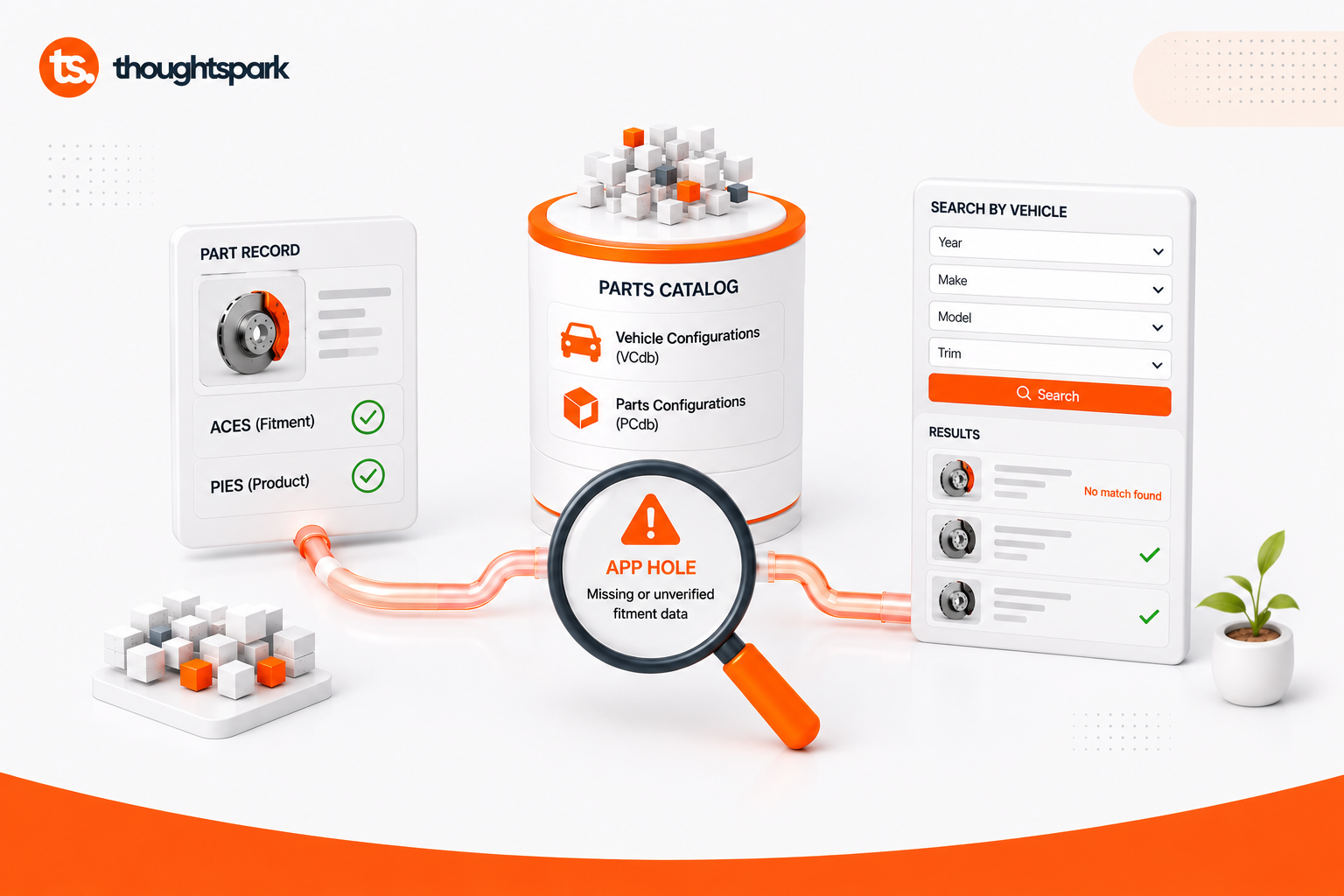
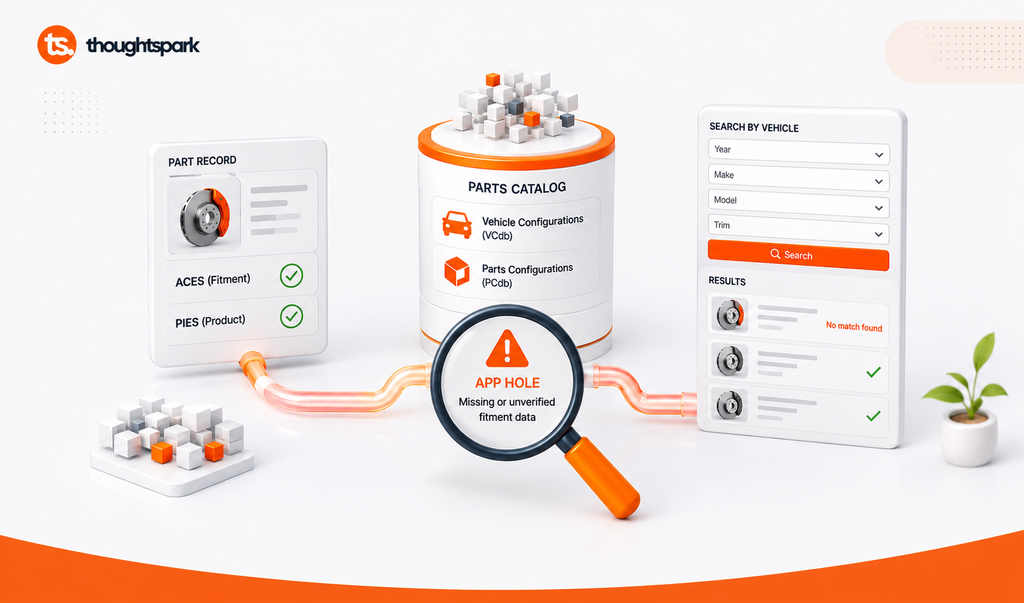
A customer searches your online catalog for their exact make, model, and year, looking for a part they already know exists. The listing itself looks complete everywhere else, price, description, photos. The one detail that actually decides whether the search returns a result, whether it fits their specific vehicle, was never entered.
The industry has a name for this gap: an app hole. What's less obvious is why it exists on a catalog that passed a full fitment audit only months earlier.
The audit was accurate on the day it ran. What has changed since follows a specific, traceable pattern, and tracing exactly what moved is the difference between fixing this once and watching it come back.
In brief
- An app hole is missing or unverified vehicle fitment data attached to a part, industry shorthand for a gap that makes a part invisible to a customer's search
- A catalog fully mapped at launch accumulates app holes as new parts, vehicle configurations, and supplier updates move faster than anyone is tracking them
- Two separate standards govern this data, ACES for fitment, PIES for the product itself, and a part can pass one while failing the other
- Closing this gap requires an ongoing owner for the update path, not a one-time cleanup or better software alone
An app hole, in this context, refers to a gap in vehicle fitment data, a part listed for sale with no verified match to the vehicles it should fit, using the Aftermarket Catalog Exchange Standard's own terminology for the failure.
What an App Hole Actually Is
What is an app hole in automotive aftermarket data? An app hole is a gap in vehicle fitment data, a part listed for sale without a verified connection to the vehicles it actually fits. The term comes directly from the industry's own data standard, not from a vendor or a consultant coining a phrase.
Fitment itself is governed by ACES, the Aftermarket Catalog Exchange Standard, maintained by the Auto Care Association. ACES structures exactly which part matches which vehicle, by year, make, model, engine, transmission, and additional qualifiers, so that every trading partner in the industry, manufacturer, distributor, retailer, marketplace, reads fitment the same way, machine to machine, without manual interpretation on either end.
That structure depends on shared reference data, not just a shared format. Two databases carry the actual weight. The Vehicle Configuration Database, VCdb, holds the master record of every vehicle configuration recognized by the industry, year, make, model, and every meaningful sub-variant. The Parts Configuration Database, PCdb, holds the corresponding structure for parts themselves. An app hole exists specifically at the point where a part in a catalog has no corresponding entry connecting it to a vehicle configuration in the VCdb, even though that vehicle configuration exists and is correctly defined elsewhere in the standard.
How an App Hole Is Different From a Data Entry Mistake
A typo is wrong data, present but incorrect. An app hole is absent data, no fitment record exists at all for that part-to-vehicle pairing, which means there is nothing for a search engine, a marketplace algorithm, or a customer-facing filter to match against. The part disappears from the search result entirely, rather than ranking lower within it.
Why "Missing" Is the Wrong Word for It
Calling this "missing data" undersells how checkable the failure actually is. It is a specific, verifiable fact, one a customer can test in seconds by searching their own vehicle and getting no result, and one a business can test systematically by running its full catalog against the current VCdb and counting exactly how many app holes exist right now. That precision is what separates this from most abstract data quality language. There is no interpretation required to know whether the gap exists.
Why a Complete Catalog Doesn't Stay Complete
A catalog that passes a fitment audit on launch day is clean for exactly one moment, that specific day, against that specific set of vehicles, suppliers, and part numbers, all of which keep changing after the audit ends.
This is the same mechanism already true of any structured catalog. Data built to be correct at one moment does not stay correct as the conditions around it shift, unless something is actively maintaining it. A closer look at AI-ready product datatraces this exact pattern in a different setting, a record accurate in January quietly going stale by June, with nothing announcing the failure. Automotive aftermarket data follows the identical pattern, just with a more concrete, more immediately visible consequence, since the VCdb and PCdb themselves are living, industry-maintained references, updated on a schedule no single catalog owner controls.
What Actually Changes Underneath a Live Catalog
Three things move constantly, independent of whether anyone updates the catalog to match. New vehicle model years release annually, sometimes with mid-year trim or configuration changes. Suppliers revise part specifications without always notifying every downstream partner. New parts get added to a catalog faster than fitment data gets verified for them. Each of these, on its own, creates one small gap. Stacked across a full catalog, they explain why app holes accumulate steadily rather than appearing all at once.
Where Fitment Data Breaks First
Where does fitment data actually break down first in a live catalog? It breaks at three specific, recurring points, not randomly across the catalog. New part onboarding, vehicle configuration updates, and supplier feed changes account for nearly all app holes that accumulate after a catalog's initial audit.
The most common point of failure is a timing gap, a new part enters the catalog before its complete fitment mapping is ready, and the listing goes live anyway because waiting costs sales.
New Part Onboarding
A part gets added to the catalog to capture a sales opportunity, with fitment data planned as a fast follow. The follow-up frequently slips past its schedule, and the part stays live with an incomplete or absent fitment field. This is the single most common origin point for a new app hole, since it happens at the exact moment commercial pressure to publish is highest and data completeness pressure is lowest.
The gap is rarely permanent by intention. A merchandiser adds the part, expecting fitment data to follow from a supplier feed or a manual mapping pass within days. Without a specific owner tracking that follow-up, "within days" becomes "whenever someone notices," and the part sits live and unsearchable in the meantime.
Vehicle Configuration Updates
A new model year or trim configuration is released, entering the VCdb as a new, valid entry. Until someone maps existing parts against that new configuration, every part that should fit it shows no match, an app hole that exists purely because the vehicle side of the equation changed, not the part itself.
This category is distinct from the other two in one important way: the part's own fitment data has simply become incomplete relative to a vehicle that did not exist when the mapping was last done. A catalog can be internally consistent and still generate new app holes every time the industry's own vehicle database expands, which happens on a predictable, recurring schedule tied to model year releases.
Supplier Feed Changes
A supplier updates a part specification on their end, a trim revision, a discontinued application, a corrected fitment range. If that update does not propagate into the receiving catalog automatically, the fitment data on file becomes silently inaccurate, still present, just no longer correct.
This is the hardest of the three to catch, since the record stays populated with data that was once accurate but no longer is. A search still returns a result. The result is simply wrong, which means the failure surfaces downstream, as a return, a complaint, or a mismatched shipment, rather than at the point where it actually occurred.
The Second Gap: When PIES Data Fails Even After ACES Passes
Can a part pass fitment validation and still fail to sell? Yes, and this is the specific failure most catalog audits never catch, because ACES and PIES are checked as two separate compliance exercises rather than one connected requirement.
A complete, accurate ACES fitment mapping does not guarantee a part is ready for sale. It can still fail the customer because the PIES side of its record, the actual product information, is incomplete.
PIES governs everything about the product itself, descriptions, attributes, pricing, packaging, digital assets, and compliance detail like hazardous material information. A part with perfect fitment data but a missing product image, an incomplete description, or an absent compliance attribute still fails to convert, or worse, gets rejected outright by a retailer's or marketplace's ingestion requirements.
Why This Compounding Failure Gets Missed
Most catalog audits check ACES and PIES separately, if they check both at all. A part that clears fitment validation often gets treated as done, with nobody circling back to confirm the product data side is equally complete.
The Two Standards Were Built to Work Together, Not Checked That Way
ACES and PIES describe the same part from two different angles, one answers whether it fits, the other answers what it actually is. A part record is only genuinely complete when both are true at once. Most catalog management workflows route ACES validation and PIES validation through entirely separate teams anyway, with no single checkpoint confirming both passed for the same part on the same day.
A part can look fully ready in one system and quietly unsellable in the other. The cause is structural, two disconnected checkpoints, not a lapse by either team.
Why This Problem Keeps Returning
A cleanup project fixes every app hole that exists on the day it runs. New app holes begin accumulating the day after, from the next part added, the next vehicle configuration released, the next supplier update that does not propagate.
Treating this as a project with an end date guarantees the same gap returns, on a predictable schedule tied to how fast the catalog and the vehicle market both keep moving.
What a Maintained Catalog Actually Requires
Closing this gap for good requires three things working together, not a single fix. A named owner accountable for fitment completeness on every new part, not just at initial catalog load. A recurring check against updated vehicle configuration data, not a one-time audit treated as permanent. A feedback path from supplier updates directly into the catalog, so a specification change on their end reaches the fitment record without depending on someone remembering to update it by hand.
Is Your Catalog Accumulating App Holes Right Now? A Quick Self-Assessment
Six honest questions reveal whether your catalog's fitment data is actively maintained or quietly accumulating gaps.
Fitment and Ownership
- Does every new part launch with complete fitment data, or does fitment data get added as a follow-up step?
- Is there one person accountable for updating fitment mappings when a new vehicle configuration releases?
- Would you know today how many app holes currently exist in your live catalog?
Process and Propagation
- When a supplier updates a part specification, does that change reach your fitment data automatically?
- Do you check ACES and PIES completeness together, or are they audited separately, if at all?
- If a customer searched their exact vehicle right now, how confident are you every eligible part would actually appear?
Outcome guide: Three or more "no" answers means your catalog is very likely accumulating app holes faster than anyone is catching them, and the gap is probably larger than what shows up in your last audit.
What Actually Closes the Gap
Day one and day ninety are two different questions, and a clean catalog only answers the first one. The organizations that keep app holes from reaccumulating treat fitment and product data completeness as a standing operational responsibility, not a project with a finish line.
That distinction, an owned, maintained update path instead of a periodic cleanup, is the same principle behind readiness in any structured catalog, just made concrete here in a way a customer can verify with a single search.
Key Takeaways
- An app hole is missing or unverified vehicle fitment data, industry shorthand for a gap that makes a part invisible to a customer's search
- A catalog fully mapped at launch accumulates app holes as new parts, vehicle configurations, and supplier updates continue after the audit ends
- ACES governs fitment, PIES governs the product itself, and a part can pass one standard while failing the other
- Most catalog audits check ACES and PIES separately, which is exactly how the compounding failure gets missed
- Closing this gap requires a named owner, a recurring update check, and a direct feedback path from supplier changes, not a one-time cleanup