
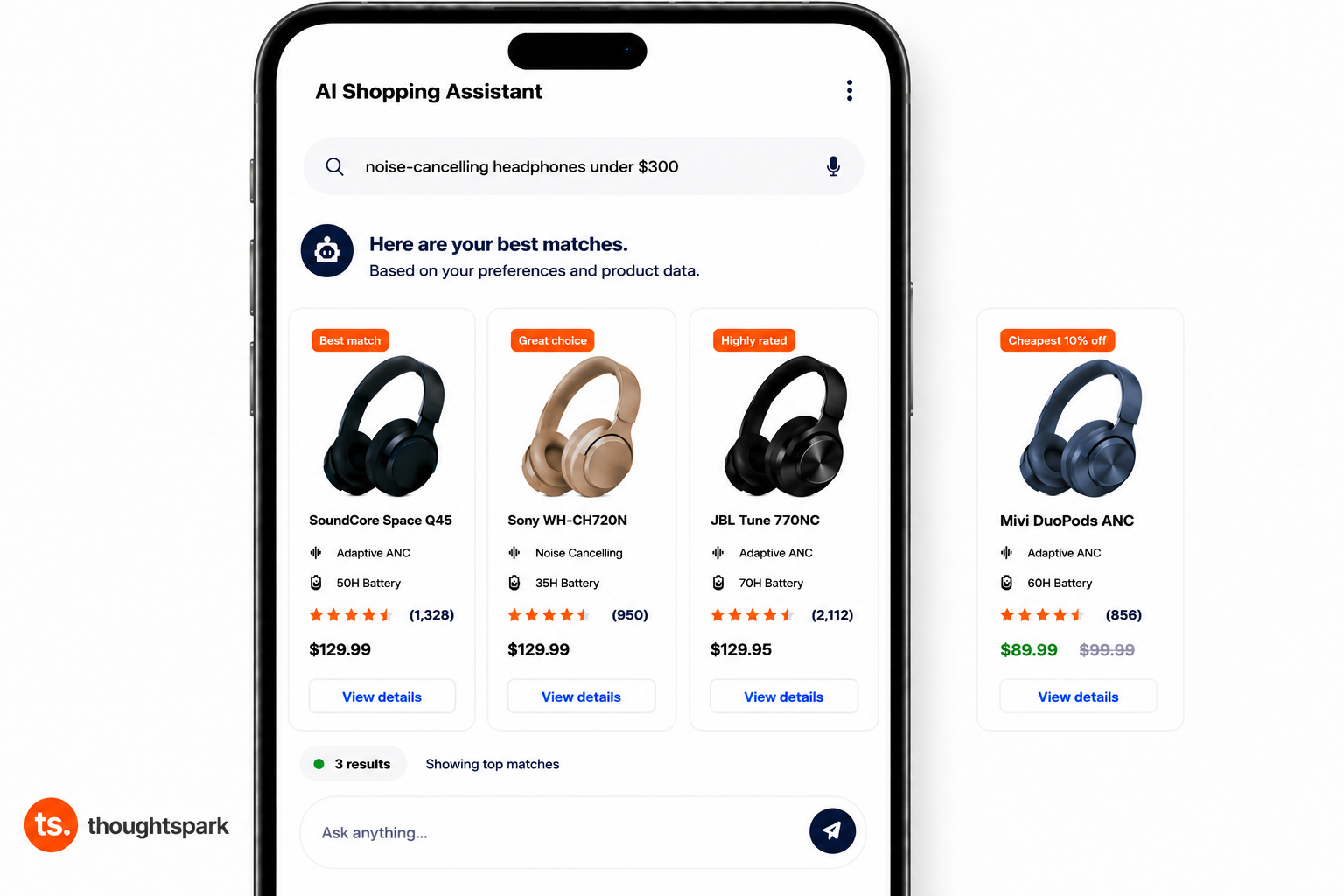
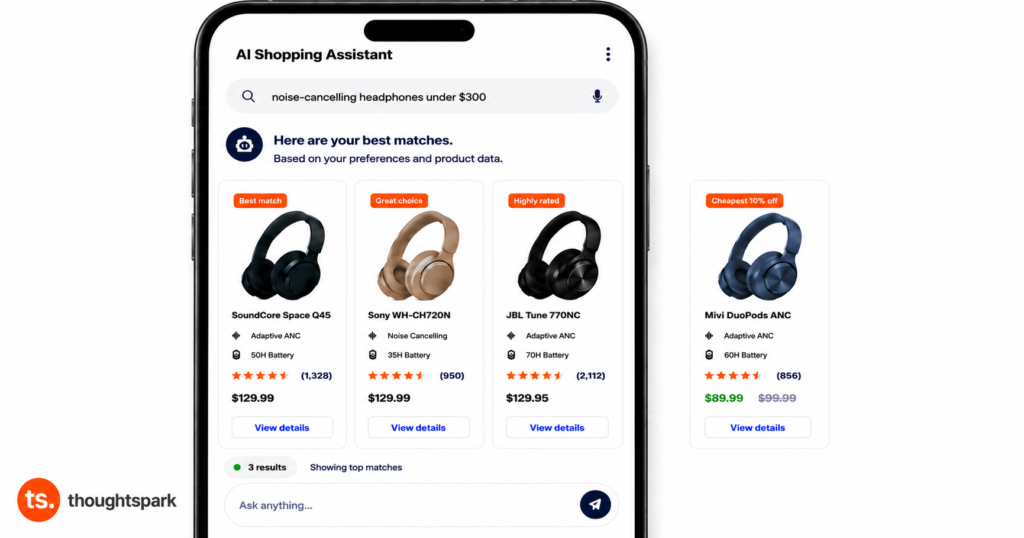
Most companies think of AI readiness the way they think of a home inspection. Pass it once, and you're done.
This is not how it works. Picture a mid-size distributor whose product data passed an AI-readiness check at the start of the year. Attributes complete, identifiers standardized, feeds clean. By the third quarter, its products had quietly stopped surfacing in agent-driven procurement comparisons, and nobody could say exactly when it started.
This happens more often than most product data teams realize. Across enterprise product data programs, the pattern is consistent: teams pass the readiness test once, then stop asking whether they would still pass it today.
In brief
- AI agents evaluate product data continuously, not once, which is why passing a readiness check today doesn't guarantee passing the next one
- Structuring a catalog is necessary, but only ever the starting point
- Lasting readiness needs an owner, a checking cadence, and a feedback loop
AI-ready product data means product information structured, complete, and consistent enough for an AI agent to verify a claim with certainty, rather than interpret or infer it the way a human buyer would. An AI agent, in this context, is software that independently searches, compares, and evaluates product data on a buyer's behalf, with or without a human confirming the final decision.
What Makes Product Data AI-Ready?
What is AI-ready product data? AI-ready product data is product information that is structured, complete, and consistent enough for an AI agent to verify a claim with certainty, rather than interpret it the way a human would. This distinction, verification versus interpretation, determines whether a product stays visible in agent-driven discovery and comparison.
A human buyer forgives a lot. A vague spec, a missing dimension, a description leaning on brand feeling instead of fact. People fill the gap with trust, patience, or enough goodwill to click through anyway.
An AI agent evaluating that same product on someone else's behalf works differently. It carries no brand loyalty and no reason to guess in your favor.
| Human Buyer | AI Agent | |
|---|---|---|
| Handles ambiguity | Fills gaps with trust and intuition | Requires explicit, structured certainty |
| Response to missing data | Clicks through anyway | Excludes the product from consideration |
| Brand loyalty | Can outweigh a data gap | Carries no influence on the evaluation |
| Evaluation frequency | Once, at the moment of purchase | Continuously, on every query |
This applies well beyond retail. Whether your product data lives in a PIM, an MDM hub, or an ERP-fed catalog, structured product data now shapes agentic commerce across grocery, industrial distribution, healthcare, and automotive aftermarket sourcing, anywhere a buyer, human or agent, needs to compare, verify, and decide.
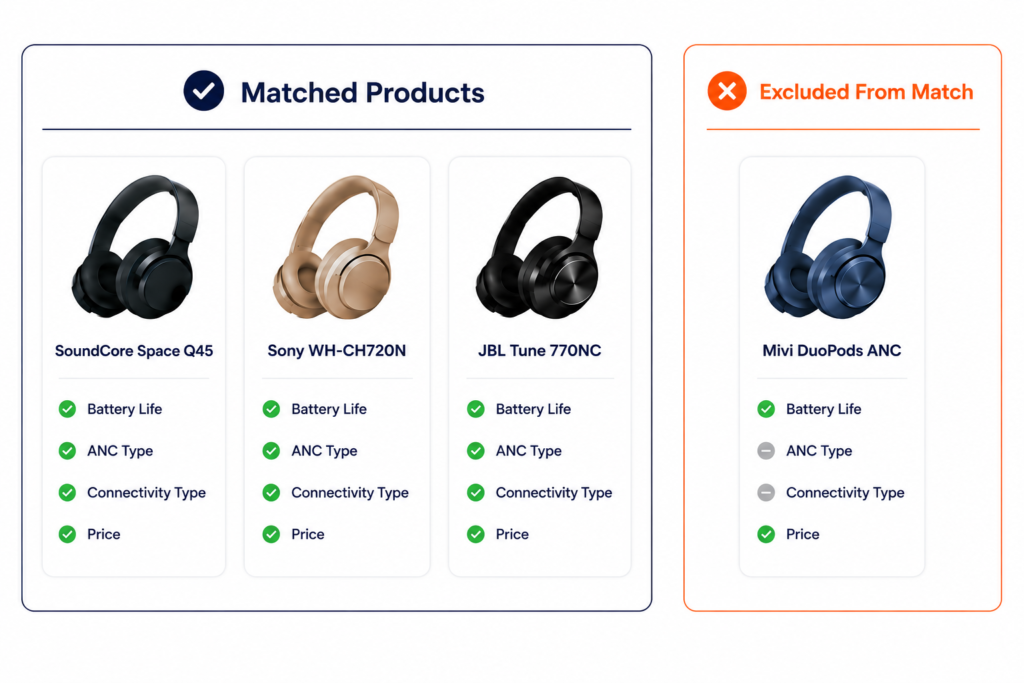
Here is what that gap looks like in practice, when an AI assistant compares real products against a real search.
Why This Matters at Scale, Not Just in Principle
The mechanism above is not theoretical. By 2028, Gartner predicts ninety percent of B2B buying will be AI agent intermediated, representing over fifteen trillion dollars in B2B spend moving through AI agent exchanges. That scale is why the difference between interpretation and verification stops being academic for any business selling into a B2B channel.
How AI Agents Actually Evaluate Product Data
How do AI agents evaluate product data? AI agents evaluate product data using three mechanics: structured attributes and schema, feed format and real-time synchronization, and cross-channel consistency. A product fails evaluation if any one of the three is incomplete, regardless of how strong the others are.
Real platforms are already doing this evaluation today. ChatGPT Shopping, Google's expanding shopping surfaces, Perplexity's shopping features, and Microsoft Copilot's checkout integration all pull from structured product data to compare, recommend, and in some cases complete a purchase on the buyer's behalf.
Forrester's own 2026 analysis names this directly: building what the firm calls a machine advantage, a content strategy built on schema, comprehensive product information, and genuine topical depth, is what earns favor with the AI crawlers and agents now evaluating brands across both owned and non-owned channels.
Three mechanics determine whether a product clears that evaluation, on any of these platforms:
| Mechanic | What It Requires | What Fails If It's Missing |
|---|---|---|
| Structured attributes and schema | Dimensions, materials, certifications exist as labeled fields, tagged with Schema.org markup where applicable, not buried in description text | The agent cannot infer a fact that was never stated as data |
| Feed format and real-time sync | Pricing, availability, and specification reflect the current ERP or transactional system state, close to real time | A weekly feed against a daily-changing system creates a standing, catchable gap |
| Cross-channel consistency | The same product shows identical attributes, identifiers, and GTINs across every channel and syndication partner where it appears | Inconsistency reads to an agent as a trust signal, not a technicality |
One recurring issue across enterprise catalogs: taxonomy inconsistency between internal PIM structures and external channel requirements. A product classified correctly in a PIM can still fail agent evaluation if the taxonomy mapping to a marketplace or GDSN feed introduces a mismatch downstream.
An agent cannot infer what a page does not state. If a fact is not structured, it does not exist to the agent evaluating it.
Why AI Readiness Fades After the Initial Fix
Why does AI readiness fade after a data cleanup project? AI readiness fades because agents re-evaluate catalogs continuously, while most organizations treat readiness as a project with a defined end date. Data that was accurate at project close can be inaccurate months later, with no alert triggered anywhere in the system.
Most guidance treats AI readiness as a structuring project:
- Clean the attributes
- Fill the missing fields
- Standardize the identifiers
- Close the project
Each of those steps genuinely matters, and skipping any of them would leave a catalog unreadable to an agent from day one. The part this checklist leaves out is what happens after the fix, once agents keep checking your master data and product records long after the project wrapped up and the team has moved on to the next priority.
Readiness Is a Condition That Has to Be Maintained
Agents evaluate your catalog fresh every time, against whatever the record says at that exact moment. That distributor's data was accurate in January and stale by June. The process itself never changed. The underlying source data simply moved while the published record stood still.
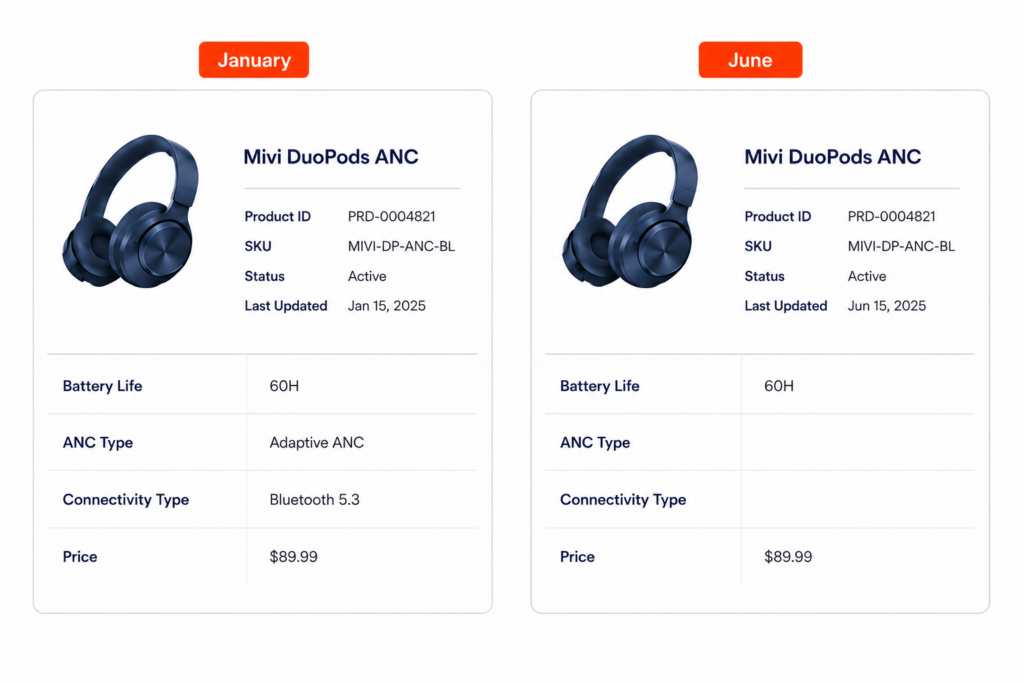
To an agent, the record is accurate or it is not. The space between what your data says and what is actually true is where visibility erodes, quietly, for months, before a pattern becomes visible to anyone on your team.
What Causes AI-Ready Product Data to Drift
What causes product data drift? Product data drift is caused by a small, repeatable set of upstream changes, most commonly supplier or specification updates, compliance shifts, pricing desynchronization between ERP and catalog systems, and expired seasonal attributes, none of which automatically propagate to the published product record.
A supplier changes a component, a compliance requirement shifts, or a pricing feed slips out of sync. Each of these is where that erosion actually begins.
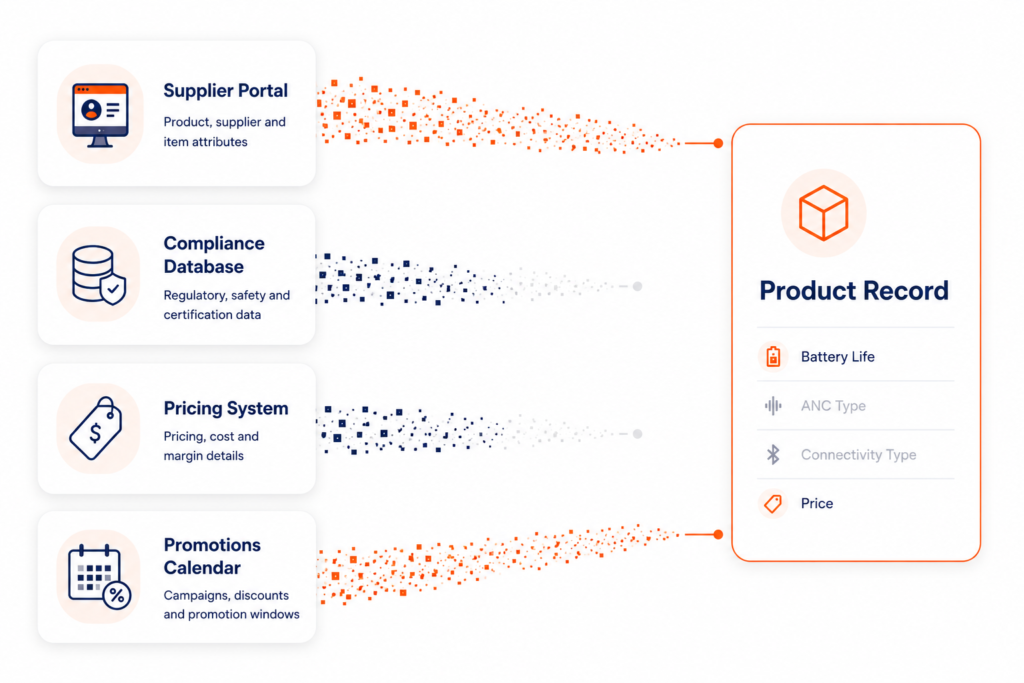
Each of these systems maps to one of the four causes below: what a system stops feeding is what quietly goes missing.
Supplier and Specification Changes
The published attribute stays exactly as it was, and an agent comparing that spec against a competitor's accurate listing quietly ranks the outdated record lower or excludes it entirely.
Compliance and Regulatory Attribute Shifts
In regulated categories like healthcare or automotive parts, this single gap can be enough for an agent to exclude the product from consideration on trust grounds alone.
Pricing and Availability Sync Gaps
An agent comparing multiple sources for price accuracy treats that mismatch as a reliability signal worth investigating.
Seasonal and Promotional Attribute Expiration
Agents built to avoid recommending unavailable or mispriced products treat this the same way they would treat any other inaccurate field.
Organizations frequently discover that these four causes trace back to gaps in cross-functional ownership. The PIM, MDM, and ERP tools involved are rarely the actual point of failure. The handoffs between the teams responsible for each system are usually where things break down.
Every organization experiences these four causes differently, some are easy to notice and low-stakes, others are easy to miss and costly. The following shows how one team might plot them, though your own catalog will likely look different:
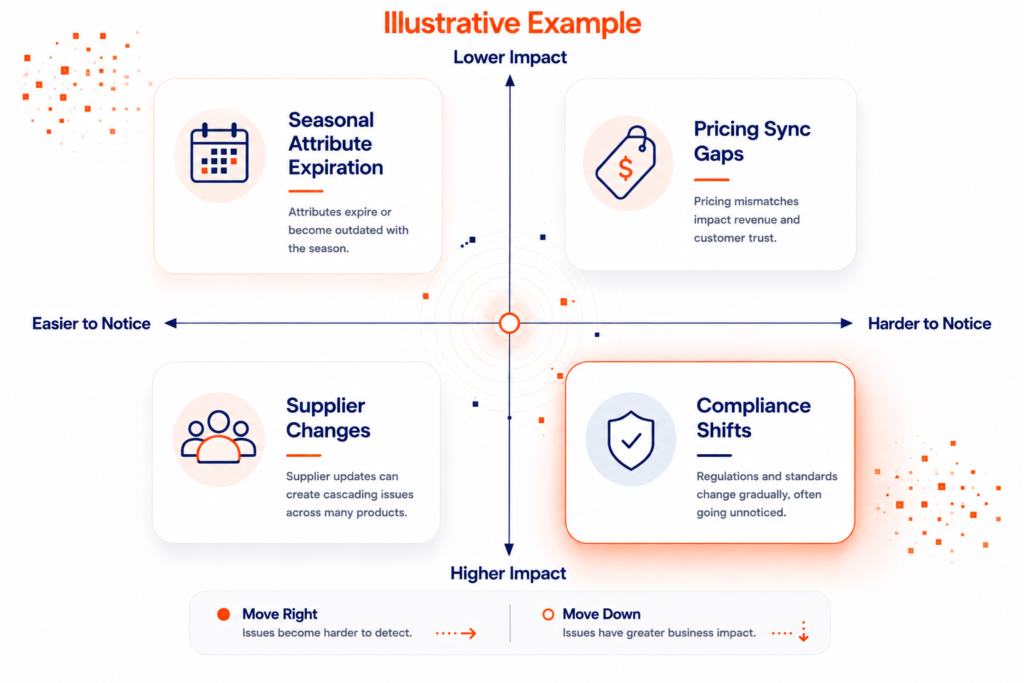
Whichever cause lands in the hardest quadrant for you, easy to miss and costly when missed, is usually the first place to build an owner and a feedback loop.
Every one of these failures hides in plain sight until an agent treats it as a disqualification.
The Ownership-Cadence-Feedback Framework
Everything so far explains why readiness fades. What follows is what actually stops it.
What does it take to maintain AI-ready product data? Maintaining AI readiness requires three organizational commitments: a named owner accountable after project close, a recurring cadence for checking readiness, and an automated feedback loop connecting source system changes to the published product record.
Preventing drift does not require a large technical investment. It requires three commitments, made in this order, each addressing a different point where readiness typically breaks down.
MIT Sloan Management Review argues that durable governance comes from embedding controls directly into workflows and decision rights, rather than layering periodic reviews on top of business as usual. Product data readiness follows the same logic, one level down, at the level of the catalog rather than the enterprise.
Assign Ownership That Outlives the Project
Someone stays accountable for catching drift after the initial cleanup ends, by name. Without a named owner past go-live, drift stops being a possibility and becomes the expected outcome.
Build a Recurring Readiness Cadence
Waiting for a sales dip to surface a data problem means the damage already happened before anyone noticed. A defined cadence, whether monthly or quarterly, gives the organization a rhythm for catching drift independent of whether a problem has already surfaced elsewhere.
Create a Feedback Loop From Source to Record
When a spec, price, or compliance attribute changes upstream in an ERP or supplier system, that update should reach the published product record automatically, through system integration rather than manual re-entry. Most drift starts exactly in this gap, between catalog operations and the systems feeding it.
The project that structures your data has a deadline. The agent that keeps checking it does not.
Most organizations do not build all three at once. That sequence maps directly onto four stages most organizations move through, whether they name them or not.
| Stage | What It Looks Like |
|---|---|
| Structured | Data has been cleaned and organized once, typically as part of a defined project |
| Owned | A named individual is accountable for readiness beyond the original project |
| Monitored | A recurring cadence exists for checking readiness |
| Autonomous | Source-to-record updates flow automatically, closing the loop |
Most organizations sit at Structured the moment a readiness project closes. Moving to Owned is the highest-leverage next step, since ownership is what makes a cadence and a feedback loop hold.
When to Reassess Product Data Readiness
When should you reassess AI readiness outside a regular schedule? Reassess immediately whenever a specific trigger event occurs, a new supplier, a compliance update, an ERP migration, a seasonal catalog refresh, or an unexplained shift in conversion, rather than waiting for the next scheduled review.
A recurring cadence catches drift that accumulates slowly, the kind that builds up over weeks without a single identifiable cause. Some drift arrives all at once, triggered by a specific event elsewhere in the business, and a calendar alone will not catch it in time.
| Trigger Event | Why It Matters |
|---|---|
| New supplier or manufacturing change | Specifications may shift without downstream notification |
| Regulatory or compliance update | A compliance attribute can fall out of date instantly |
| Pricing or ERP system migration | Sync gaps are most likely during and immediately after migration |
| Seasonal catalog refresh or promotional cycle | Expired attributes are easy to overlook at scale |
| Unexplained shift in conversion or consideration | Often the first visible symptom of drift already in progress |
Each of these is a moment where cost starts accumulating quietly, whether or not anyone is watching for it yet.
The moment a supplier changes a spec or a system migrates, drift already has a head start, whether or not anyone notices right away.
What Poor AI Readiness Actually Costs
What does poor AI readiness cost a business? The cost is not a single missed sale. It is compounding exclusion, since an agent that excludes a product once will exclude it again on every future query, until the underlying data is corrected.
That accumulation is not abstract. With B2B buying shifting this heavily toward agent intermediation, the cost of invisibility compounds fast.
How this shows up varies by industry, but the pattern repeats:
- Grocery and distribution: products silently missing from automated procurement comparisons, quarter after quarter, with no single event marking when it started
- Industrial manufacturing: a spec sheet mismatch quietly removing a part from consideration in every automated sourcing search run afterward
- Healthcare and regulated categories: a lapsed compliance attribute excluding a product on trust grounds, even when the product itself remains fully compliant
Six months of any of these is six months of lost consideration that never shows up on a report, because nobody was checking while it was happening.
Fifteen products silently dropped from consideration this quarter cost exactly as much as fifteen products rejected at checkout. The first kind never generates a report.
That distributor from the opening eventually found its own gap, though not through a report. A channel partner asked why volume had quietly dropped, months after the actual cause had already passed.
Is Your Product Data Actually AI-Ready? A Quick Self-Assessment
The problem, the framework, and the stakes are only useful if you can see where your own organization stands right now. Six honest questions make that concrete.
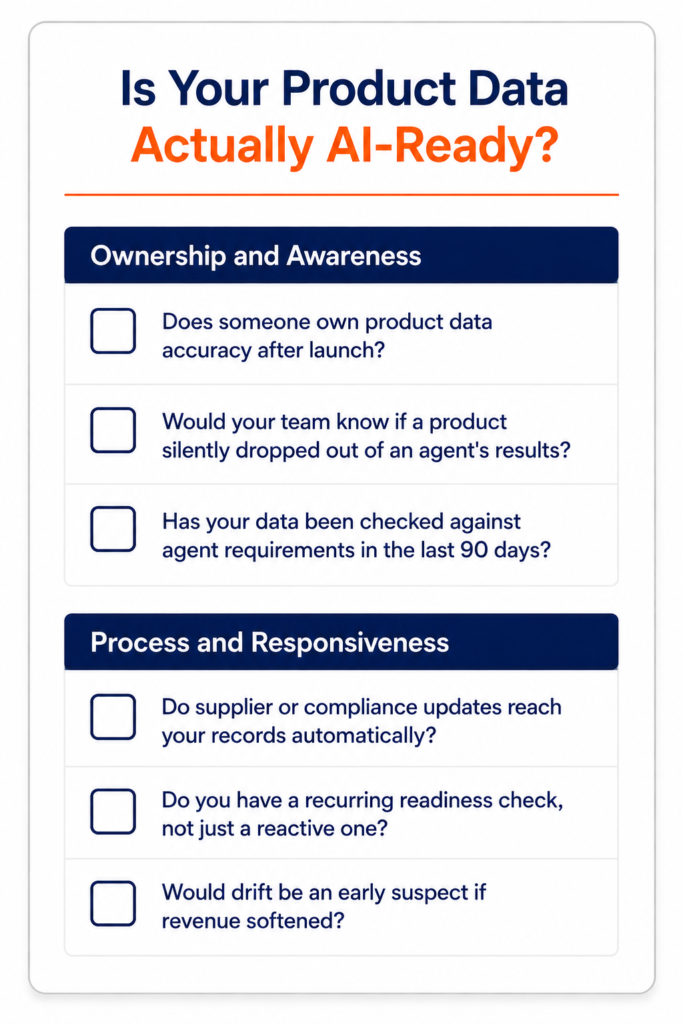
Ownership and Awareness
- Does someone specifically own product data accuracy after launch or cleanup ends?
- Would your team know today if a product had silently dropped out of an agent's consideration set?
- Has your product data been checked against current agent requirements in the last ninety days?
Process and Responsiveness
- When a supplier or compliance detail changes, does that update reach your published record automatically?
- Do you have a recurring cadence for checking readiness, separate from reacting to a known problem?
- If revenue softened next quarter with no obvious cause, would data drift be an early place your team would look?
Outcome guide: Three or more "no" answers means readiness is currently a one-time event in your organization rather than an ongoing discipline, and drift is likely already underway somewhere in your catalog.
Where This Leaves You
Most organizations discover this gap eventually, usually after a partner or a customer notices before the data team does. The six questions above exist so that discovery happens on your terms.
What separates the organizations that catch drift early from the ones that find out the hard way is rarely technology. It is whether anyone owns readiness once the initial project ends. A framework without an owner stays a document. Add an owner but no cadence, and the response stays reactive instead of proactive. Add a cadence but no feedback loop, and the work never stops being manual.
Put those three together, and readiness stops being something you finish and becomes something you run. That is the operating model ThoughtSpark's Data Readiness Hub and Data & AI Strategy work exists to help build, for teams that would rather close this gap on their own schedule than have an agent expose it first.
Key Takeaways
- Gartner predicts ninety percent of B2B buying will be AI agent intermediated by 2028
- Forrester identifies a machine advantage, a content strategy built on schema, comprehensive product information, and topical depth, as what earns favor with AI crawlers and agents
- MIT Sloan Management Review links durable governance to embedding controls into workflows, not periodic review
- Drift traces back to four specific causes: supplier changes, compliance shifts, pricing sync gaps, and seasonal attribute expiration
- Poor data quality broadly costs organizations millions annually, a cost that compounds as agent-driven evaluation scales
- Three commitments, a named owner, a recurring cadence, and a feedback loop from source to record, separate organizations that stay visible from ones that drift unnoticed