


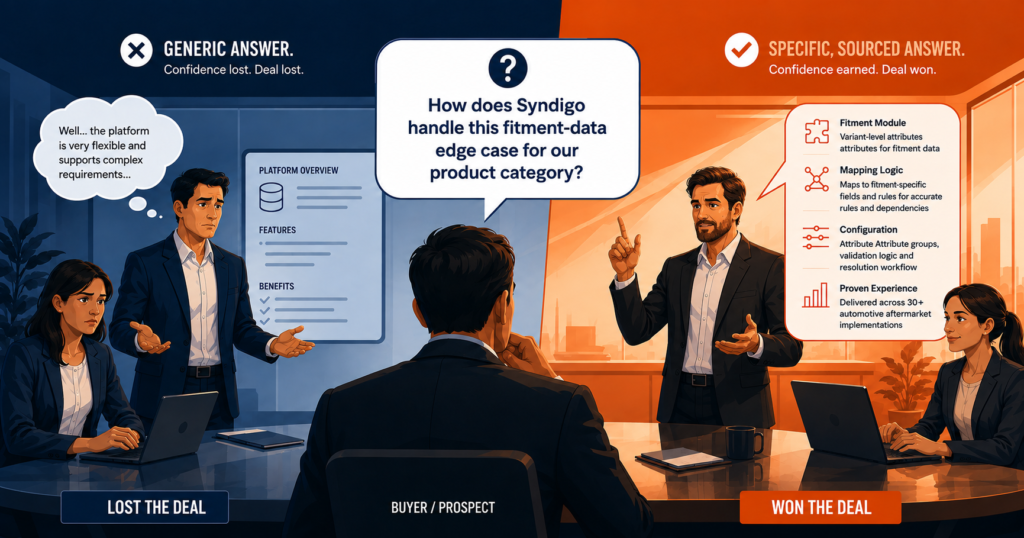
Picture a regional Syndigo SI walking into a pre-sales meeting fully prepared on paper. Certified consultants, a solid delivery track record, every technical box checked. The prospect asks one specific question, how the platform handles a fitment-data edge case particular to their category. The room hesitates, and the confidence the deal needed to survive the next round goes with it.
Three weeks later, a competitor with a thinner delivery bench but a sharper answer to that exact question wins the business. The difference came down to something specific and fixable.
In brief
- Most lost Syndigo deals fail in the pre-sales conversation, before implementation ever begins
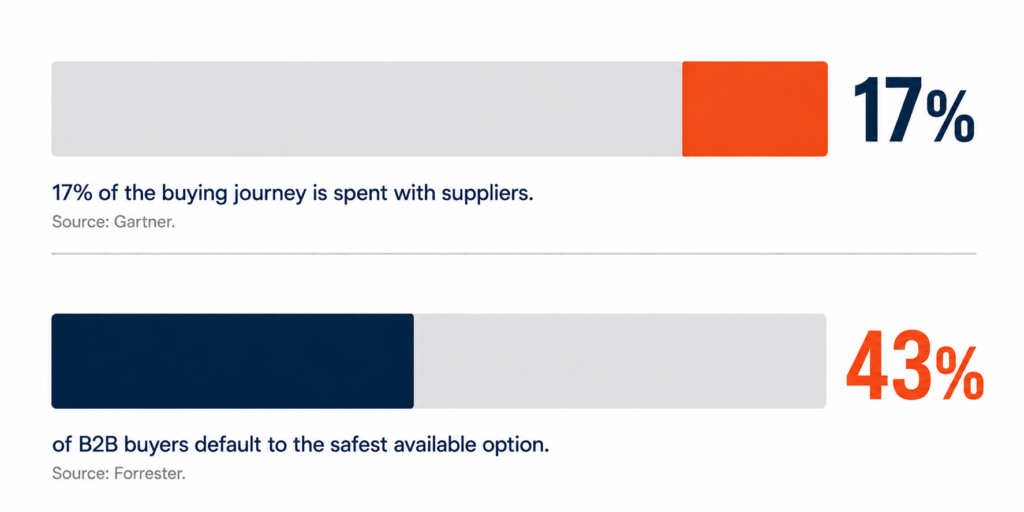
- Buyers now spend only 17% of the total purchase journey meeting with suppliers, leaving little room to recover from a generic answer
- 43% of B2B buyers report making defensive purchase decisions more than 70% of the time, favoring the SI that reduces their risk over the one with the most polished pitch
- The gap between winning and losing SIs usually comes down to the depth and specificity a team can bring to a single hard question, on the spot
The pre-sales depth gap, in this context, means the difference between an SI that can describe what Syndigo does in general terms and an SI that can answer a specific, category-level question with certainty, using Syndigo's own history, architecture, and ecosystem standing as evidence.
Where Syndigo Deals Actually Get Lost
Where do most Syndigo implementation deals actually fall apart? They fall apart before implementation begins, in the pre-sales conversation, the moment a prospect asks a specific question and you answer with something closer to a platform overview than a real answer.
This matters more today than it did even a few years ago. Gartner's own research confirms buyers now spend only 17% of their total purchase journey meeting with suppliers at all. Split across every SI a prospect evaluates, your window shrinks further still, and there is very little time inside it to recover from a generic answer.
What Buyers Are Actually Testing in Pre-Sales
Most pre-sales preparation focuses on proving delivery capability, certified consultants, past projects, a clean track record. That preparation answers a question the buyer has usually already settled by the time you're in the room. The unsettled question is narrower and harder, and it follows your team into every conversation that comes next: does this specific group understand the platform well enough to be trusted with our specific problem.
Why Technical Capability Isn't the Problem
That unsettled question is exactly where technical capability stops mattering as much as it should. A team can have genuine, deep implementation skill and still lose a deal in pre-sales, because implementation skill and pre-sales credibility are two different capabilities, built and demonstrated in different ways.
Delivery capability gets proven through a portfolio. Pre-sales credibility gets tested live, in the room, in response to a question nobody scripted for. Most SI training investment goes toward the first capability, since it is easier to structure, certify, and measure.
Why the Pre-Sales Depth Gap Exists
The imbalance has a clear cause. Delivery skill has a formal path, exams, credentials, and structured curricula all validate it in a repeatable way:
- Exams and certifications validate implementation competence in a structured, repeatable way
- Credentials give buyers an external signal of technical readiness
- Structured curricula teach delivery methodology step by step
Pre-sales product depth has no equivalent path. Nothing formally teaches the ability to answer an unscripted, category-level question on the spot, which is exactly why it develops unevenly. One or two people end up carrying the depth the whole team needs.
Why the Depth Gap Is Sharper in Regulated Categories
That unevenness shows up fastest in categories like healthcare or automotive aftermarket, where product attributes carry compliance weight. A prospect in these categories often opens with a compliance-adjacent question specifically because they are testing whether the SI understands the regulatory stakes behind the platform mechanics. A generic answer here reads as a double risk signal, both platform inexperience and category inexperience at once.
What Is a Skeptical Buyer Actually Asking?
That double risk signal is really a version of one question every buyer is quietly asking underneath whatever they say out loud. What is a skeptical buyer actually trying to learn in a pre-sales meeting? Whether choosing your team is the safer decision. Forrester's own research on B2B buying found that 43% of buyers admit to making defensive purchase decisions more than 70% of the time, choosing the option that felt safest even when a more innovative one was on the table.
A specific product question, like the fitment-data edge case from the opening, works as a proxy test. The buyer is really asking whether your team has genuinely lived inside the platform long enough to be trusted with everything that comes up later, the parts of the project nobody has thought to ask about yet.
A Vague Answer Reads as a Risk Signal
A generic response to a specific question confirms the exact fear a defensive buyer already carries, that this team has not gone deep enough to be safe. That impression is harder to reverse than a single lost point in a longer conversation, since it colors how the buyer reads everything that follows it.
What Separates SIs Who Win From SIs Who Don't
That colored impression is what separates the two outcomes this piece opened with. The SIs who consistently win Syndigo deals share one identifiable habit. They answer specific questions with specific, sourced detail, drawn from real product knowledge rather than a rehearsed talking point.
| Generic Pitch | Specific, Credentialed Answer | |
|---|---|---|
| Platform history | "Syndigo is a leading PIM/MDM platform" | Names the platform's actual scale and standing in the category |
| Ecosystem standing | "We are a certified Syndigo partner" | Names the specific role, Advisory Board seat, partner tenure, and what that access has produced |
| Product depth | "The platform handles that use case" | Walks through exactly how, naming the specific configuration or module involved |
| Track record | "We have delivered similar projects" | Names the recurring problem solved across multiple engagements |
| Objection handling | "We can work through that limitation" | Names the specific workaround or roadmap detail, showing the limitation was already anticipated |
The Depth Gap in Practice
Return to the fitment-data question from the opening. A generic answer says the platform "supports complex attribute structures." A specific answer names the exact module handling variant-level attributes, describes how it maps to fitment-specific fields, and states plainly what configuration work that requires.
The same gap shows up in how a track record gets described for that same client. A generic answer offers a list of similar past projects. A specific answer names the recurring pattern across them, three separate automotive aftermarket implementations that each required the same fitment-mapping configuration, and what was learned across all three.
The specific version of each answer takes only seconds longer to deliver, and closes the door on the buyer's underlying doubt in a way the generic version never can.
Building a Business Case for Syndigo
That closed door is the actual goal, and it requires a different kind of conversation than most pre-sales teams are having. A pitch describes the platform. A business case connects the platform's specific strengths to the buyer's specific risk.
Lead With the Platform's Own Credentials
Syndigo's ecosystem standing and scale, its market position and depth in the category, is evidence a skeptical buyer weighs heavily. Citing this specifically does real credibility work in the room, well beyond gesturing at "a leading platform."
Answer the Buyer's Specific Question First
The instinct under pressure is to widen a hard question into a safer, more general answer. The stronger move answers the narrow question precisely first, then uses that precision to earn trust for the rest of the conversation.
Can Your Team Make This Case Today? A Quick Self-Assessment
Earning that trust is one thing to describe and another to actually be ready for. Six honest questions reveal whether your pre-sales team is prepared for the moment that decides most deals.
Depth and Readiness
- Could your pre-sales team answer a specific, category-level platform question on the spot, without pausing to check with someone else?
- Does your team routinely cite Syndigo's own history and ecosystem standing, or default to general platform language?
- Has your team ever lost a deal specifically because a narrow technical question went unanswered well?
Preparation and Process
- Is pre-sales depth something your team actively trains for, separate from delivery certification?
- Do you know which specific product areas your team is weakest on when questioned live?
- If a prospect asked the hardest possible question in your category tomorrow, would your team already know the answer?
Outcome guide: Three or more "no" answers means the gap costing deals is not visible yet, and is very likely showing up as lost opportunities currently attributed to price, timing, or fit.
What to Bring Into the Next Pre-Sales Conversation
That outcome guide is also a starting point for what comes next, since the next Syndigo opportunity will very likely include one hard, specific question, the same kind that stalled the room in the opening scenario. Preparing for it means building specific, sourced answers ahead of time, before the pressure of the room tests whether the general pitch holds up.
Name the platform's credentials specifically. Answer the narrow question first. Treat pre-sales depth as its own discipline, trained deliberately, separate from delivery certification.
That specific kind of preparation, product knowledge deep enough to survive a hard question live, is what ThoughtSpark's Business Creation work is built to strengthen, closing the gap between your team's real delivery capability and how convincingly that capability gets proven in the room where the deal is actually decided.
Key Takeaways
- Formal certification paths exist for delivery skill. No equivalent path exists for pre-sales product depth, which means the gap has to be closed on purpose. It does not close by itself
- A specific answer takes only seconds longer to deliver than a generic one, and closes the exact doubt a generic answer leaves open
- Delivery capability and pre-sales credibility are different skills, and most SI investment goes toward the former, since a formal training path exists for it and none exists for the other
- A specific, sourced answer to a narrow question reads as far more credible than a longer, general one
- In regulated categories like healthcare or automotive aftermarket, a vague answer to an early question reads as a double risk signal, both platform and category inexperience at once