Reconciliation cost shows up as a line item finance already tracks, hours spent re-verifying data nobody trusts. What rarely gets tracked is where that distrust actually comes from.
It comes from one specific place. A handoff between two departments where nobody is accountable for confirming the data arrived correctly. Not a data category. Not a vague governance gap. One specific, nameable moment where responsibility passes from one team to another with no one owning the transfer itself.
That single fact changes how this cost should be read. A labor problem invites more hands. A structural gap invites a different question entirely: who was supposed to own this moment, and what happened when nobody did.
In brief
- Reconciliation cost, the labor spent manually re-verifying data nobody trusts, has a specific, traceable root cause: the unowned handoff between departments
- Nobody owning the confirmation that a handoff happened correctly forces the receiving team to check everything themselves
- IBM's research confirms distorted decision-making and eroded stakeholder trust as two of the direct consequences of poor data quality, both of which trace back to exactly this kind of unmanaged transfer point
- Closing the ownership gap at the handoff does not just fix accountability. It directly reduces the cost line item finance already tracks
Reconciliation cost, in this context, refers to the labor an organization spends manually re-verifying data it no longer trusts, a category most finance teams already log without realizing its root cause traces back to a single, specific organizational gap.
What Reconciliation Cost Actually Measures
Reconciliation cost is manual labor spent re-verifying data nobody trusts. A team spends real, billable hours cross-checking two systems that disagree, or rebuilding a report because the automated version cannot be relied on.
That definition explains what the cost looks like. It never explains why the trust disappeared in the first place. Data does not become untrustworthy on its own. Something specific happens upstream that makes a team stop believing what a system tells them.
IBM's own analysis of data quality names erosion of trust among stakeholders as one of four distinct consequences of poor data, alongside distorted decision-making, automated amplification, and compliance risk. Trust erosion is not an abstract cultural symptom in that framing. It has a specific mechanism, and that mechanism is what this piece traces.
Where the Trust Actually Breaks
Trust breaks at a specific point, not a general one: the handoff, the exact moment data transfers from one department to another. Ownership assigned to a title survives inside a single department. It fails at the transfer point itself, because nobody is ever assigned to the moment of handoff, only to the categories sitting on either side of it. ThoughtSpark's own reporting on cross-functional data ownership traces this exact gap in detail, the specific mechanism by which a named owner still leaves the transfer point uncovered.
That gap is where reconciliation cost actually originates.
Why Unowned Handoffs Produce Exactly This Cost
Follow the logic one step at a time, since each step is a direct consequence of the one before it.
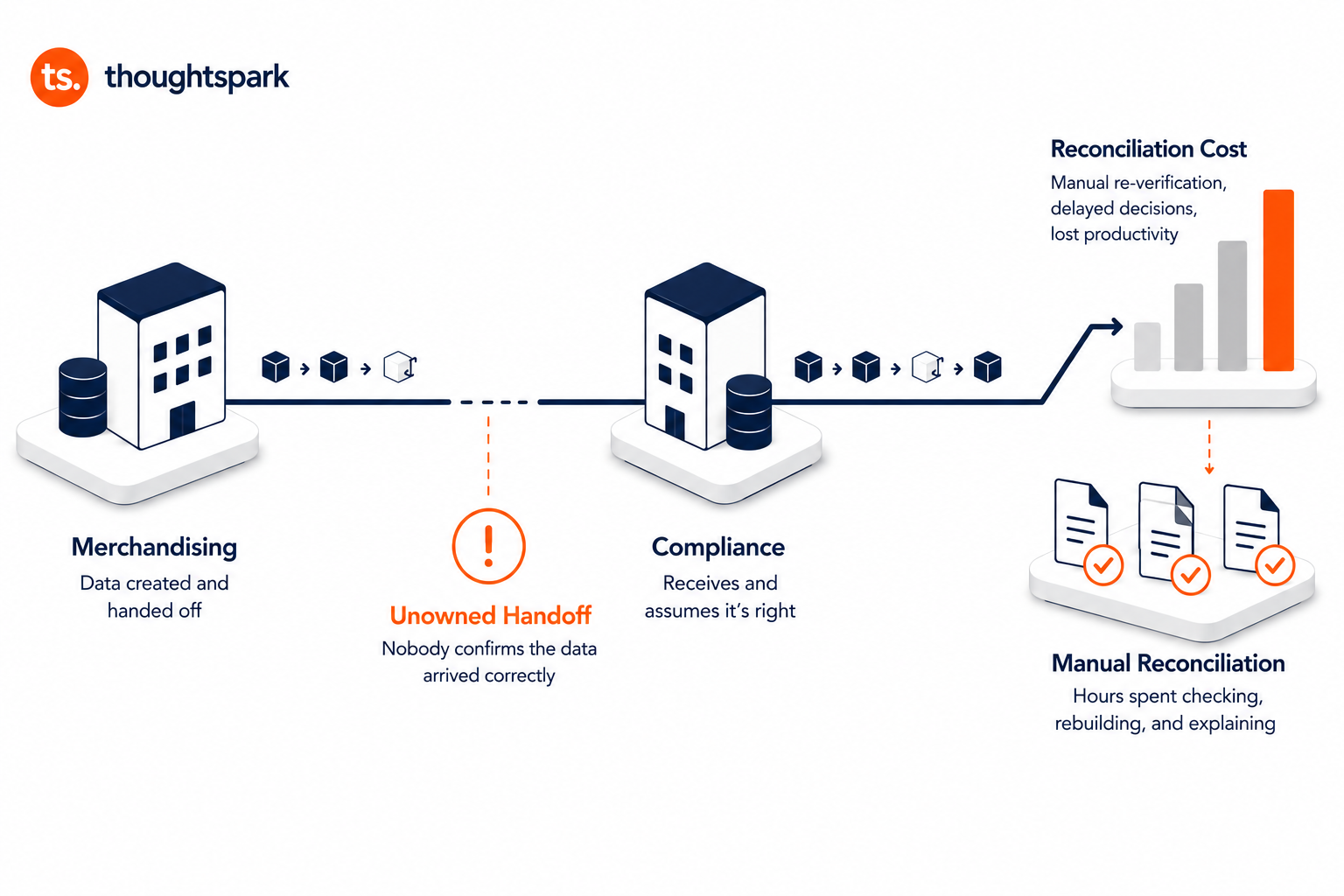
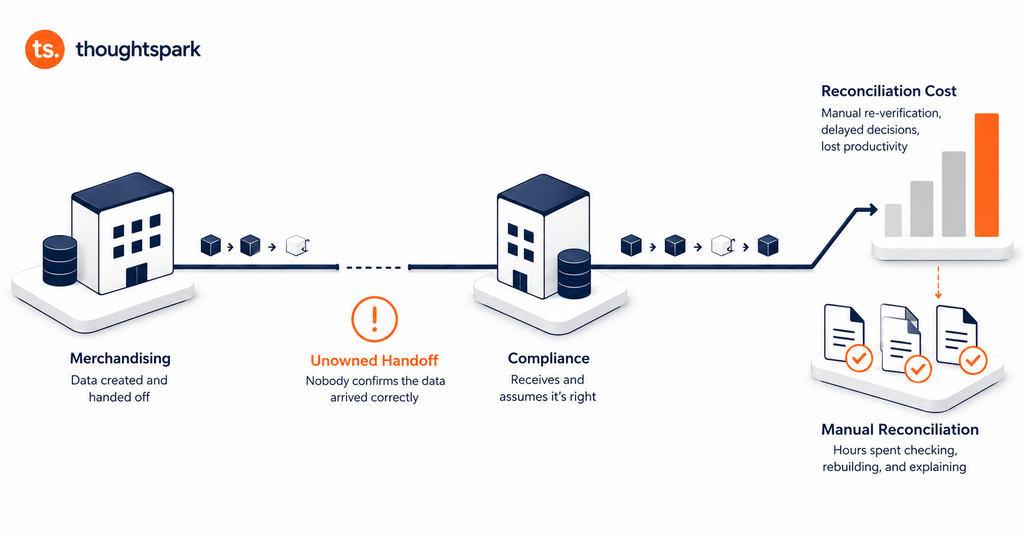
A handoff has no named owner. Because nobody owns confirming the handoff happened correctly, the receiving team cannot assume the data arrived intact. Since they cannot assume it, they check it themselves before using it. That checking, by definition, is reconciliation cost.
Cause, Not Coincidence
This is worth stating plainly, since it is a stronger claim than simply noting the two ideas relate. Unowned ownership does not merely correlate with higher reconciliation cost. It produces it directly, as an unavoidable consequence. A team with no reason to trust a handoff has exactly one option available to them: verify everything by hand. There is no third path.
Deloitte's 2025 Global Business Services Survey found that matrixed ownership structures, where accountability is distributed with genuine business-unit authority rather than concentrated centrally, consistently outperformed centralized models. The reason tracks directly onto this mechanism: a matrixed structure is more likely to assign someone specific to a transfer point, while a centralized one tends to assign ownership only at the category level, leaving the handoff itself uncovered.
Following the Money From the Handoff to the Ledger
Trace one specific handoff to see this play out concretely. A merchandising team updates a product record and passes it forward, assuming compliance will catch anything that needs review. Compliance assumes merchandising already handled what needed handling. Neither team is wrong about their own half of the process. The gap sits in the space between them, where the two halves are supposed to meet and don't.
Weeks later, a data team notices two reports do not agree. Nobody told them to expect a discrepancy, so nobody flagged it before it reached them. They spend the afternoon manually tracing which system is right, hours that get logged against a dozen different task categories, never against the actual cause.
That afternoon is reconciliation cost. Its origin was never a data problem. It was a handoff nobody owned, three departments removed from where the bill eventually landed.
What Changes When Ownership Closes the Cost
Naming a data owner for a category does not, by itself, reduce this cost. A title covering "product data" in general still leaves the specific transfer point between merchandising and compliance untouched.
What actually closes the cost is narrower and more specific: a named owner for the handoff itself, someone accountable for confirming the transfer happened correctly, not just for the data sitting on either side of it.
The Same Fix, Read Two Different Ways
Described one way, this fix closes an accountability gap. Described another way, the identical fix reduces a line item, fewer hours spent on manual re-verification, because the underlying trust problem no longer exists. Both descriptions are correct, and both point back to the same single intervention: naming an owner for the moment of transfer, not just the data itself.
Is Your Reconciliation Cost Ownership or Effort?
Six honest questions separate a reconciliation cost problem that is genuinely about effort from one that is actually about ownership.
Tracing the Cost
- Could you name the specific handoff point most of your reconciliation hours trace back to?
- Is there one person accountable for confirming that handoff happens correctly, separate from whoever owns the data category itself?
- Would a missed handoff be visible before it reaches the team that has to manually fix it?
Testing the Fix
- If you named an owner for one specific handoff today, would reconciliation hours in that area actually drop, or just move somewhere else?
- Has your organization ever tried adding more people to reconciliation work, rather than adding ownership to the handoff producing it?
- If the answer to the first question was no, would anyone in your organization currently know where to start looking?
Outcome guide: Three or more "no" answers means your reconciliation cost is very likely an ownership problem still being treated as an effort problem, more hands doing the same manual work, rather than one handoff finally getting a name attached to it.
Key Takeaways
- Reconciliation cost, manual labor spent re-verifying untrusted data, has a specific, identifiable root cause rather than a diffuse one
- IBM names erosion of stakeholder trust as one of four direct consequences of poor data quality, and this piece traces the specific mechanism behind that erosion
- Deloitte's 2025 research found matrixed ownership structures outperform centralized ones, consistent with the argument that transfer points need named accountability, not just category-level ownership
- An unowned handoff between departments removes the receiving team's ability to trust that data arrived correctly, forcing manual verification as the only remaining option
- Naming an owner for a data category does not close this cost. Naming an owner for the specific handoff point does