Most companies think they have solved data ownership the moment a title exists for it. Someone becomes "the data owner," a line goes on an org chart, and the conversation moves on.
Picture a mid-size consumer goods company where a product recall requires updated compliance and safety data to reach the customer-facing record within twenty-four hours. The named Data Owner sits with the VP of Merchandising. Updating that record depends on three other teams, none of whom report to that VP, and none of whom are measured on how fast the handoff happens. The record updates five days later. The org chart says someone owns this. In the moment it mattered, nobody actually did.
In brief
- Naming a data owner does not guarantee that ownership survives the moment data crosses from one department to another
- The strongest governance models tie ownership to a functional domain that spans departments, not to a single centralized title
- Deloitte found organizations with a Chief Digital Officer as primary owner achieved 88% of expected program value, compared with 59% under a more centralized CIO-led model
- Fixing this rarely requires a reorganization. It requires naming who owns each specific handoff point, not just who owns the category of data
Cross-functional data ownership means accountability for a data domain, structured to follow the data across the departments it actually touches, rather than sitting with a single role disconnected from those departments.
What "Having a Data Owner" Actually Looks Like Today
What does it mean to have a data owner? In most organizations, it means a single title, usually senior, has been assigned formal responsibility for a category of data. It rarely means that role has operational authority over the teams whose actions actually determine whether that data stays accurate.
That gap between formal title and operational reach is not a rare misconfiguration. It is the default setup in most enterprises, since ownership usually gets assigned during a governance initiative, a single meeting, a single sign-off, rather than being built into the actual workflows where departments hand data to one another.
Why This Gap Persists Even After Governance Programs Launch
A governance program can produce a policy document, a RACI chart, and a named owner in a matter of weeks. What it cannot produce in that same window is a change to how Compliance, Supply Chain, and Marketing actually work together day to day. The policy exists on paper before the operational relationship exists in practice, and the gap between the two rarely closes on its own.
Why Ownership Assigned to a Role Doesn't Survive a Handoff
Why does data ownership fail even when someone is formally accountable? Ownership assigned to a role fails at the handoff because the owner has authority over their own team's work, not over the work of the other departments the data has to pass through to stay accurate.
A title gives someone the right to be asked questions. It does not give them the right to change how another department prioritizes its own work.
The Handoff Is Where Accountability Actually Lives
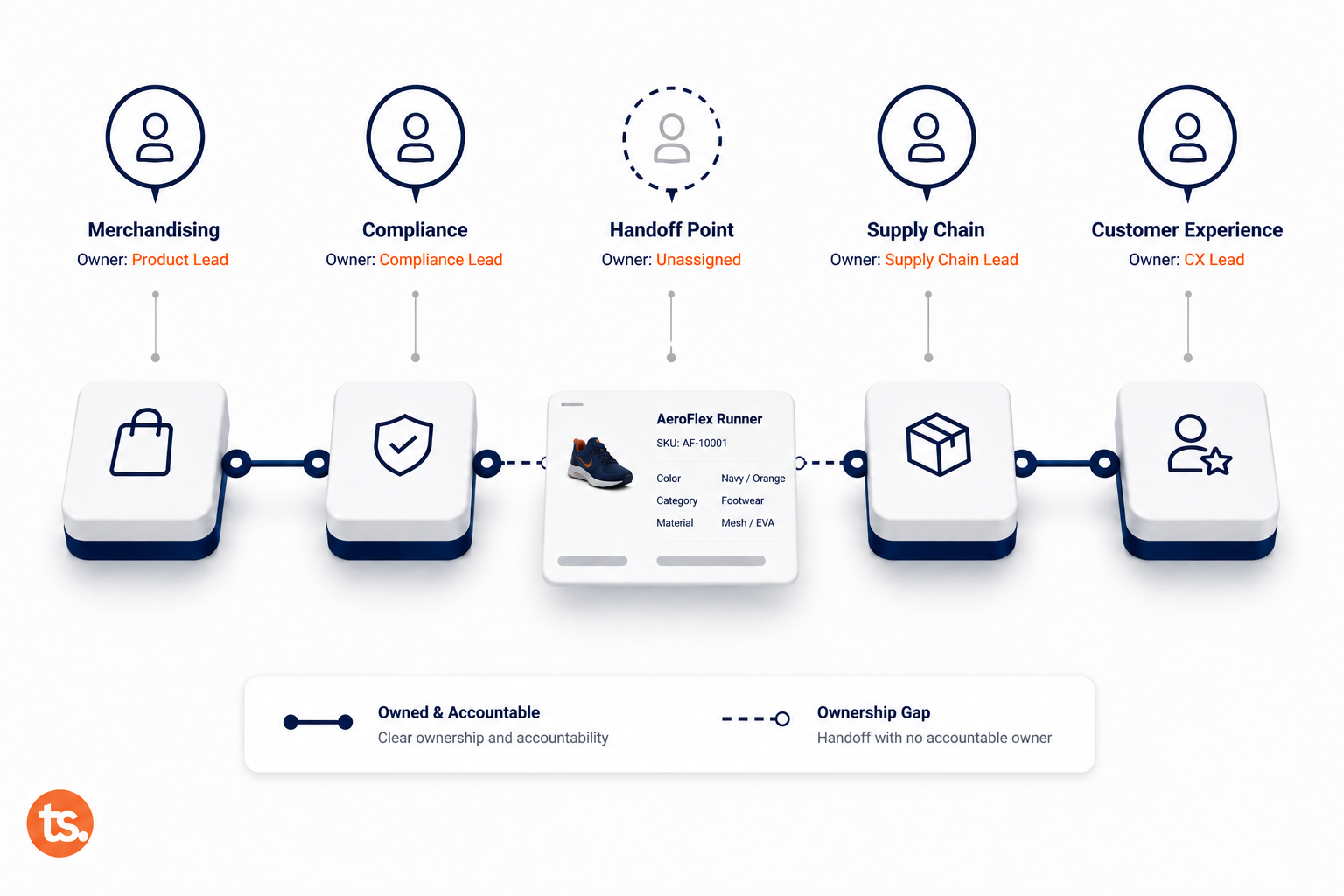
Data rarely breaks inside a single department. It breaks in the space between two departments, where one team finishes its part and assumes the next team will pick it up correctly, without anyone confirming that assumption is true. That space, the handoff itself, is exactly where most ownership models have nothing to say.
A title answers who is accountable. It never answers who acts first when two departments disagree about whose job it is.
Where Data Ownership Actually Breaks Down
Where does data ownership typically fail inside an organization? It fails most often at three specific points: where merchandising or product teams hand data to compliance, where supply chain systems feed customer-facing records, and where marketing content depends on data neither team owns outright.
| Handoff Point | What Typically Breaks |
|---|---|
| Merchandising to Compliance | A product change ships before the compliance-relevant fields are confirmed updated |
| Supply Chain to Customer-Facing Record | Inventory or sourcing changes reach internal systems before they reach the public record |
| Marketing to Regulatory | Campaign content references product claims neither team has final authority to verify |
Merchandising to Compliance
A product update moves fast because merchandising is measured on speed to market. Compliance is measured on accuracy. Neither team is measured on how quickly the two connect, so the connection is the first thing that slips.
Supply Chain to Customer-Facing Record
Supply chain systems update the moment a sourcing or inventory change happens internally. The public-facing record updates only when someone remembers to push that change forward, and remembering is not a system, it is a hope.
Marketing to Regulatory
Campaign content often references product claims that live in a completely different system than the one marketing actually edits, creating a gap between what marketing believes is true and what the record confirms is true.
McKinsey's own analysis of enterprise data governance describes a retailer that solved this differently. Rather than assigning ownership by data category, it assigned ownership by domain, giving specific executives accountability for data domains that explicitly spanned multiple functions, so the product owner driving checkout improvements also owned the sales and payment domains outright, not just the parts that touched their own team.
The handoff does not fail because nobody is responsible. It fails because two people are responsible for two different halves of the same problem.
What Works Instead: Ownership Built Into the Handoff
Everything so far explains why ownership assigned to a title fails. What follows is what actually holds up in its place.
What does effective cross-functional data ownership look like in practice? It looks like ownership tied to a domain that explicitly includes the handoff points, not just the data itself, with a single accountable person at each point of transfer, not a single accountable person for the category as a whole.
Deloitte's 2025 research on digital operating models found that organizations with a Chief Digital Officer as the primary owner of digital initiatives achieved an average of 88% of expected program value, compared with 69% under a Chief Technology Officer and only 59% under a Chief Information Officer. The same research found that matrixed structures, where a central team supports individual business units while those units retain real autonomy, consistently outperformed centralized, single-decision-body models.
Assign Ownership at the Domain, Not the Category
A domain includes every department the data actually touches. Ownership of "product data" in the abstract solves nothing. Ownership of the specific domain spanning merchandising, compliance, and the customer-facing record gives one person authority across the exact handoff that keeps breaking.
Name Who Acts First at Each Handoff
Every handoff needs a single person whose job is to notice when the transfer has not happened, not just a person who is accountable after the fact. That is a different role than a data owner. It is closer to an operational trigger than a title.
Build the Handoff Into the Workflow, Not the Policy
A policy document describes what should happen. A workflow makes it happen automatically, or at minimum, makes its absence immediately visible. The organizations Deloitte and McKinsey both describe succeeded because they changed the mechanism, not just the org chart.
Ownership that lives only in a policy document is a title. Ownership built into the workflow is a mechanism, and mechanisms are what survive a busy quarter.
Is Your Data Ownership Structural or Just a Title? A Quick Self-Assessment
The difference between a title and a working structure is only visible when you look for it directly. Six honest questions make that concrete.
Ownership and Authority
- Does your named data owner have any authority over the teams the data actually passes through?
- If two departments disagreed about whose job a data update was, would there be a clear, immediate answer?
- Is anyone specifically accountable for the handoff itself, separate from the data category as a whole?
Structure and Visibility
- Would a missed handoff be visible automatically, or only after something downstream goes wrong?
- Is your ownership model closer to centralized, one final decision-maker, or matrixed, shared but clearly assigned?
- Could you name, right now, the exact three or four handoff points where your own organization's data is most likely to break?
Outcome guide: Three or more "no" answers means your data ownership currently exists as a title rather than a working structure, and the handoffs beneath it are very likely unmanaged.
Where This Leaves You
Most organizations discover this gap the same way, not through an audit, but through a moment where the record was wrong at exactly the wrong time, and the person with "owner" in their title had no way to have caught it.
Naming an owner is not the mistake. Stopping there is. A title without operational reach is a name on a chart. A domain that includes the handoff, with someone accountable for the transfer itself, is a structure that actually holds when a real deadline hits it.
That is the exact gap ThoughtSpark's Data Governance and Data Readiness Hub work is built to close, for teams that would rather find their weakest handoff on their own schedule than have a recall, an audit, or a customer find it first.
Key Takeaways
- McKinsey's analysis of enterprise data governance found that assigning ownership by domain, spanning the departments data actually touches, outperforms assigning ownership by data category alone
- Deloitte found organizations with a Chief Digital Officer as primary digital owner achieved 88% of expected program value, compared with 59% under a more centralized CIO-led model
- Matrixed ownership structures, which pair central support with real business-unit autonomy, consistently outperform centralized, single-decision-body models
- Most data failures happen at the handoff between departments, not inside any single department's own work
- Fixing this requires naming who acts first at each specific handoff point, not just who owns the data category overall