
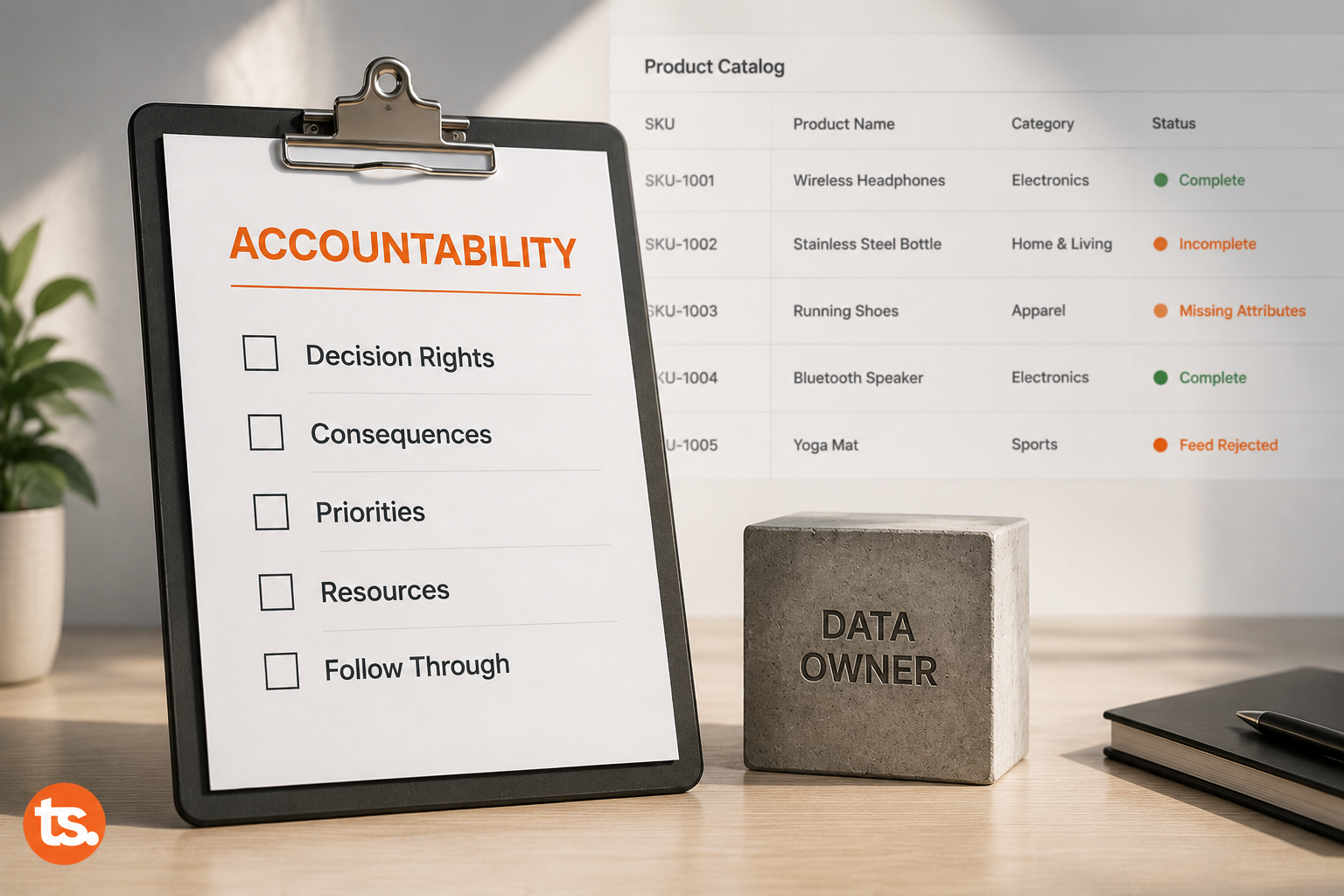
There is a moment most data and commerce leaders recognise.
A product record arrives in the wrong state. An attribute is missing. A classification is inconsistent with what three other records in the same category use. Someone investigates. The record has a named owner in the governance framework. That person is contacted. They did not know the record existed. Or they knew it existed but did not know they were responsible for its quality. Or they knew both of those things but had no clear way to act on the responsibility within the systems and workflows they use every day.
The ownership was assigned. The accountability never arrived.
Most organisations that have invested in product data governance have also invested in defining ownership. It appears on the framework as one of the foundational elements — stewards named, domains scoped, responsibilities documented. In practice, ownership tends to be the part of the governance framework that looks most complete on paper and functions least reliably in operations.
Understanding why that gap persists, and what it takes to close it, is what this blog works through.
Why Product Data Ownership Breaks Down After Governance Initiatives
Ownership is assigned during governance initiatives because the initiative creates the right conditions for that conversation to happen. Stakeholders are engaged. The question of who is responsible for what gets raised in workshops and working groups. Decisions get made and documented. A steward is named for each domain or product category. The framework reflects genuine organisational agreement.
The initiative then closes.
What the initiative produced was a record of who is responsible. What it did not produce was a change to the environment where those responsible people actually work. The systems they use day to day, the workflows they follow, the approval processes they operate within — none of these changed because of the ownership assignment.
According to Cynozure's 2026 State of the Industry Report, based on insights from 60 senior data and AI leaders across sectors including retail, consumer goods, and financial services, 40% of organisations still split data strategy ownership across multiple executives, and 17% report no clear owner at all. These are not small organisations with immature data practices. Nearly half of respondents reported revenue over £1 billion. Ownership fragmentation at that scale is not a resourcing problem. It is a structural one.
The governance framework named a steward. The operational environment kept running without them.
The Difference Between Assigned Ownership and Operational Accountability
What Ownership Assignment Produces
When governance initiatives define data ownership, they typically produce:
- A named steward for each data domain or product category
- A documented scope of responsibility
- An escalation path for resolving data conflicts
- A RACI or equivalent matrix showing who is responsible, accountable, consulted, and informed
- Governance meetings where ownership decisions get made
These are real outputs. The conversations that produced them required genuine organisational alignment. The ownership structure reflects something that was agreed.
Why Operational Accountability Does Not Follow Automatically
A named steward can only influence product data quality at the moments when the system or workflow routes a decision to them. If those moments do not exist — if the product creation workflow does not require steward approval, if the enrichment process does not trigger a review, if the taxonomy update does not notify the domain owner — then the steward is responsible in the governance framework and invisible in the operational process.
Research published in the Journal of Business Analytics by Fadler and Legner at the University of Lausanne examined data ownership in enterprise organisations and found that allocating ownership rights has a direct effect on system implementations only when that ownership is enforced through the systems and workflows where data is actually created and modified. Ownership defined in documentation, without corresponding enforcement in systems, produces a responsibility that exists on paper rather than in practice.
That distinction is where most product data ownership structures break down. The steward was named in the workshop. The system never learned their name.
How Ownership Confusion Creates the Operational Problems Teams Experience
When ownership exists nominally rather than operationally, the consequences are specific and recurring. They tend to show up in a consistent set of situations.
Conflicting Product Records Across Systems
When multiple teams can update the same product record without a stewardship checkpoint, the record reflects whoever updated it most recently. The merchandising team updates the product description for a promotional campaign. The supply chain team updates the same record with logistics attributes. The digital team updates it again with channel-specific content. No single version is authoritative. No one is sure which one should be.
The governance framework has a named owner for this product category. That owner was not consulted during any of these updates. They find out about the conflict when a retailer rejects the feed.
Taxonomy Inconsistency That Governance Did Not Prevent
A product manager introduces a new subcategory for an incoming range. The taxonomy owner exists on the governance framework. The product creation workflow does not require their approval before the classification is saved. Three months later, the same product type has been classified under four different values by four different team members who each created what made sense to them at the time.
Enrichment Gaps That Surface at the Wrong Moment
A new marketplace requires a set of attributes the existing product records do not carry. An enrichment owner is named in the governance framework. The workflow for adding new channel requirements does not loop them in. The gap is discovered during onboarding, not during product creation when it would have been far cheaper to address.
In each of these situations, the ownership structure was in place. The operational process ran around it.
Why Ownership Breaks Down More Predictably in Complex Organisations
The governance initiative assigned ownership at a point in time, for a data environment that existed during the initiative. Organisations are not static. Ownership structures degrade as the organisation around them evolves.
New product categories get created that the original ownership matrix never anticipated. Teams are restructured and named stewards move to different roles or leave the organisation. Systems get added or replaced and the integration between the new environment and the governance framework is never fully established. Commercial urgency produces decisions that bypass the stewardship process because the deadline is today and the steward is available next week.
Gartner's research on data governance platforms consistently identifies the gap between governance maturity as measured by framework completeness and governance effectiveness as measured by actual data quality outcomes. Organisations with documented ownership structures and organisations with operationally enforced accountability produce measurably different results, and the gap between them grows over time as business complexity increases.
The ownership framework was built for the organisation as it existed. The organisation kept changing. The framework did not adapt with it.
What Operational Accountability Actually Requires
Organisations where product data ownership produces real accountability tend to have made one decision that others have not. They stopped treating ownership as a governance artefact and started building it into the operational environment where data decisions get made.
In practice, that looks like:
- A product record in a given category cannot be activated without a review step that routes to the named domain owner
- A taxonomy classification outside the approved vocabulary triggers an automatic flag before it can be saved
- An enrichment gap against a channel's required attribute set surfaces as an alert to the owner before the product reaches syndication
- When a steward changes roles or leaves, the system flags the orphaned records and the ownership gap gets resolved before it produces downstream problems
None of these require an extraordinary governance programme. They require the ownership decisions made during the governance initiative to be translated into system logic rather than left in a document.
That translation is the work that most organisations defer, or never resource, because it comes after the initiative closes and the governance project has already been declared complete.
The Question Worth Asking About Your Current Ownership Structure
Before the next governance initiative adds more names to an ownership matrix, one question is worth sitting with.
For each named data steward in your governance framework, can you point to a specific system step, workflow trigger, or approval checkpoint that makes their ownership operational? Or does their responsibility exist primarily in the documentation?
If the answer is documentation for most of them, the ownership structure is more complete on paper than it is in the systems where product data actually gets created, updated, and submitted.
That gap is not resolved by adding more stewards or running clearer workshops. It is resolved by connecting the ownership decisions the governance initiative made to the operational environment those decisions were meant to govern.
If the patterns feel familiar, the starting point is usually not a new ownership framework. It is understanding where the existing one stops influencing what actually happens to the data.
That is the gap ThoughtSpark helps enterprise data and commerce teams identify and address: the distance between ownership as it was assigned and accountability as it needs to operate.